 Jasim Al-Azzawi

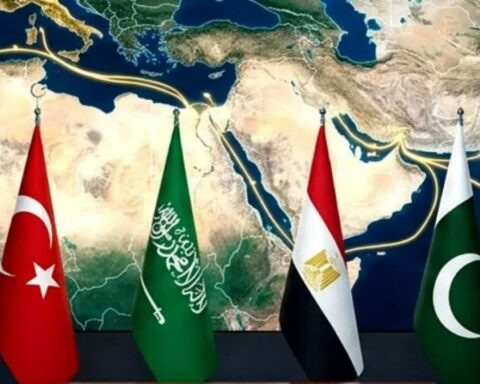
With Iran’s “Land Bridge” fractured by the new Syrian leadership, Türkiye is not merely seeking influence; it is seeking to fill the strategic vacuum and secure its Blue Homeland (Mavi Vatan) doctrine. Ankara views Lebanon as the final “missing piece” in the Eastern Mediterranean energy map.
With its declared ambition to be a significant regional energy player not only with Central Asian countries but also in the Eastern Mediterranean, Ankara rejected the 26 November Lebanese-Cyprus agreement signed by Presidents Aoun and Christodoulides, arguing that any deal without Turkish Cypriots creates “a maritime wall” that locks Türkiye out of the Southern Mediterranean.
Türkiye’s evolving strategy in Lebanon reflects a broader recalibration of its regional posture, one that extends far beyond its earlier engagement with Muslim Brotherhood-aligned networks. Demographic shifts have opened new avenues for influence, particularly as expedited citizenship for Turkmens subtly expands Ankara’s footprint. Meanwhile, Saad Hariri’s withdrawal from politics has created a Sunni vacuum that external actors increasingly seek to fill through demographic and political engineering. Dr Lina Marouf, Center for Middle East Demographic Studies, notes, “Demography has become the quiet battlefield of the Levant, and every expedited passport is a political message written in population numbers.”
Lebanon, long accustomed to competition between Iran and Saudi Arabia, now finds itself navigating a third axis of influence — one that blends soft power, humanitarian outreach, and calibrated political engagement. Türkiye’s approach is neither improvisational nor purely ideological; it is rooted in a broader ambition to redefine its role in the eastern Mediterranean and reclaim a measure of historical relevance. Understanding this emerging dynamic is essential for grasping the new balance of power taking shape across the Levant.
The “Sunni card”: Beyond the Muslim Brotherhood
Türkiye’s engagement with Jamaa al-Islamiyah and its Fajr Forces further illustrates a calibrated proxy strategy aimed at shaping Lebanon’s fragmented Sunni arena. While not replicating Iran’s deep, decades-long patronage of Hezbollah, Ankara’s political outreach, funding channels, and security coordination echo elements of Tehran’s model. This parallel has prompted observers to question whether Türkiye is positioning itself as a “Sunni Iran” in the Levant. Prof Karim Haddad, of the Institute for Regional Security Dynamics, puts it starkly: “In a region where influence is measured by the loyalties you cultivate, Türkiye is learning that soft power alone no longer shapes the battlefield.”
Yet Türkiye’s ambitions face structural limits imposed by the broader Sunni power contest. Saudi Arabia and the UAE remain determined to preserve their leadership of the Sunni world, leveraging financial networks and long-standing ties to Lebanon’s Sunni establishment. — Dr Samer Al-Qadi, Gulf Strategic Forum, explains, “Sunni leadership in the Middle East is not inherited; it is defended, and Riyadh has no intention of lowering its shield.”
Compounding these constraints is the fragile political transition in Syria under President Ahmad al-Sharaa. Any relapse into instability could disrupt Türkiye’s regional calculus and expose its Lebanese outreach to sudden shocks. Prof Rania Khoury of the Damascus Center for Political Futures warns, “A power projection strategy is only as stable as the neighborhood it relies on.” If Syria falters, Ankara risks overextension at a moment when its rivals are consolidating. Fadi Nasser of the Levant Policy Observatory summarises the situation in simple terms: “Influence without insulation is vulnerability disguised as ambition.”
Soft power and relief
Türkiye’s influence is reinforced through an assertive soft-power strategy centered on humanitarian relief. Agencies like International Humanitarian Relief (IHR) have become lifelines for marginalis ed Sunni communities abandoned by Lebanon’s collapsing state institutions. By providing food, medical support, and development projects, Ankara has positioned itself as the most reliable external patron for vulnerable Sunni populations. “In Lebanon’s neglected peripheries, the flag that feeds you becomes the flag you trust,” says Dr Hala Othman, Beirut Social Policy Institute.
These networks generate durable local loyalties and embed Turkish influence where traditional Sunni leadership has eroded. Soft power becomes hard leverage when it fills a vacuum that the state no longer can. Framed as humanitarianism, these efforts also serve Ankara’s long-term geopolitical calculus. “Humanitarian aid is the quiet diplomacy of ambitious states.” Says Prof Nadim Safar, Eastern Mediterranean Policy Forum.
Türkiye’s ambitions could face additional constraints if Syria’s political transition falters. President Ahmad al-Sharaa’s authority remains far from consolidated, and the challenges ahead are substantial. Any renewed instability risks drawing Türkiye deeper into Syrian affairs, diverting its attention and limiting its ability to project influence beyond its immediate neighbourhood. Dr Leila Mansour of the Syrian Transition Observatory cautions, “No state can expand outward while the ground beneath its feet is still shifting.”
For Lebanon, these dynamics carry direct implications. Maritime demarcation, energy policy, and regional diplomacy cannot be framed solely through the lens of Washington and Tel Aviv. Türkiye’s expanding role — and its vulnerabilities — must be factored into Beirut’s strategic calculus. “Ignoring a rising actor does not make its influence disappear; it only blinds you to its consequences,” notes Faris Haddad, Eastern Mediterranean Policy Group.
If Ankara’s trajectory in Lebanon begins to mirror Tehran’s model — this time through the Sunni community — the implications for Lebanese sovereignty could be profound. “When external powers build parallel states, the real state becomes a façade,” cautions Mira Khalil, Levant Governance Monitor.
Lebanon’s challenge, therefore, is not simply to react to Türkiye’s moves, but to anticipate the regional shifts that will shape them—and to craft a strategy that protects its sovereignty in an increasingly competitive Levant.
Lebanon through a Turkish lens
Lebanon’s challenge is not merely to interpret Türkiye’s moves, but to anticipate the regional shifts that will shape them. Ankara’s influence will continue to rise or contract in tandem with developments in Syria, the Gulf, and the broader Sunni landscape. For Beirut, this means adopting a more multidimensional foreign policy lens—one that recognises Türkiye as a consequential actor whose ambitions intersect with Lebanon’s maritime, economic, and security interests. Whether Ankara ultimately becomes a stabilising partner or a disruptive force will depend on how its strategy evolves and how Lebanon positions itself in response. In a region defined by shifting alliances, the cost of misreading emerging power centers can be profound.