 Cherkaoui Roudani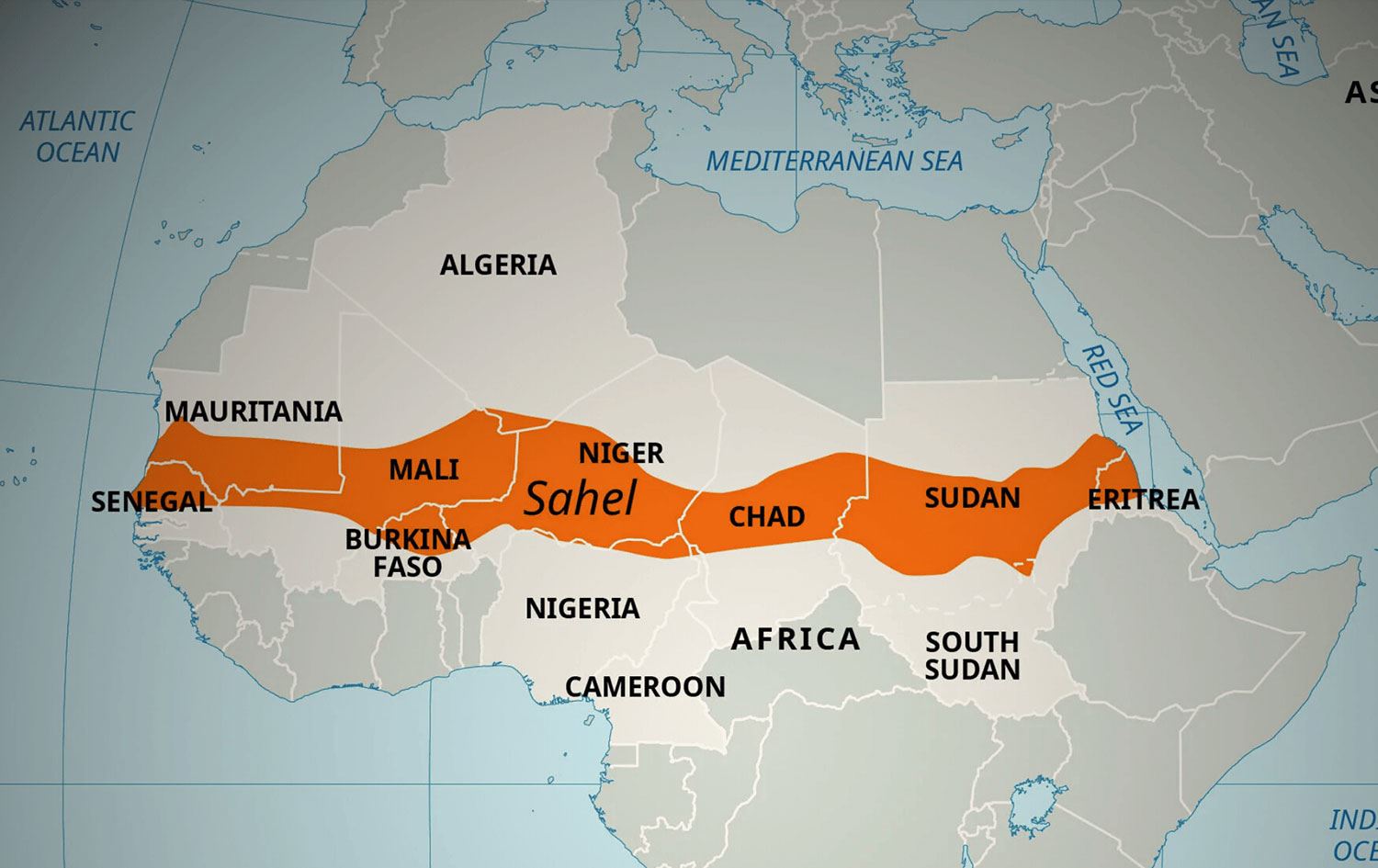

The war unfolding around Iran may be centered in the Middle East, but its strategic effects are not geographically bounded. While attention remains fixed on the Persian Gulf, another space is quietly acquiring geopolitical significance: the corridor stretching from the Sahelian hinterland to the Atlantic approaches of Europe. What is taking shape is not a secondary theater, but a connective strategic space where local fragilities intersect with global competition.
For decades, Western strategic thinking treated the Sahel as a zone of chronic instability with limited systemic consequence. That assumption is no longer sustainable. The region is increasingly understood as part of a broader security continuum linking inland instability to maritime routes, energy infrastructure, and Europe’s southern flank. Within this evolving geography, localized disruptions can generate effects far beyond their point of origin.
This shift reflects a deeper transformation in contemporary conflict. Strategic competition is no longer confined to clearly defined theaters. It unfolds across dispersed environments where state authority is uneven, non-state actors proliferate, and external powers operate through indirect means. In such contexts, peripheral spaces become arenas where pressure can be applied without triggering open confrontation.
For US and allied planners, this corridor is no longer a distant concern—it is becoming a zone where indirect pressure can be applied against Western interests without triggering direct escalation.
A Hybrid Environment of Interlocking Instabilities
The transformation of the Sahel into a strategically relevant space is not the result of a single factor, but of the convergence of multiple structural dynamics. State erosion, the entanglement of terrorism with transnational criminal economies, the persistence of armed separatist movements, and the presence of external actors experimenting with indirect strategies have collectively produced a layered security environment across the Saharo-Sahelian belt.Western stabilization efforts have struggled to adapt to this evolving landscape. The limits of France’s counterterrorism engagement and the subsequent repositioning of US forces in the region underscore the growing difficulty of managing such crises through conventional frameworks. What once appeared as geographically contained instability now interacts with broader patterns of geopolitical competition.
In this environment, the distinction between “regional instability” and “strategic threat” has eroded. The Sahel and North Africa increasingly function as a continuous security space whose developments carry implications for Europe, the Atlantic basin, and NATO’s southern flank. Rather than a distant periphery, the region is becoming a zone where local conflict dynamics intersect with global rivalries.
The nature of violence itself has evolved accordingly. Armed groups no longer operate in isolation. They exist within hybrid ecosystems where ideological militancy, illicit trafficking, and opportunistic alliances overlap. The trajectory of Adnan Abou Walid Sahraoui, founder of the Islamic State in the Greater Sahara, illustrates how militant pathways can move fluidly across ideological and operational domains. Sahraoui’s early involvement in the Polisario Front before his later alignment with jihadist networks highlights how individuals can transition across different forms of armed mobilization within the region’s fragmented security landscape.
More broadly, certain separatist environments, including those structured around long-standing territorial disputes, have at times provided permissive spaces where illicit economies, armed socialization, and militant interactions intersect. Similar patterns can be observed in the structure of Jamaat Nusrat al-Islam wal-Muslimin (JNIM), whose networks intersect with local grievances and transnational flows. These environments rarely produce centralized command structures. Instead, they generate fluid interfaces where different forms of violence coexist and reinforce one another. Such configurations are characteristic of contemporary grey zones—spaces where instability becomes self-sustaining and resistant to traditional security responses.
Iran’s Indirect Strategy Beyond the Middle East
Within this already fragile situation, Iran’s approach to strategic competition acquires particular relevance. Tehran has long relied on indirect projection, operating through dispersed networks, proxies, and ambiguous partnerships rather than direct confrontation. This model has been extensively documented in the Levant, the Gulf, and the Red Sea.
At the conceptual level, this approach is often associated with what Iranian strategists describe as “mosaic defense”—a decentralized architecture designed to absorb shocks and maintain operational continuity even under sustained pressure. Rather than concentrating power in a single center of gravity, it distributes capabilities across multiple nodes, complicating adversary targeting and enabling adaptive responses.
While this doctrine is rooted in the Middle Eastern context, its operational logic is not geographically confined. In loosely governed environments such as parts of the Sahel and West Africa, similar patterns of indirect influence can emerge. These regions offer the very conditions in which decentralized strategies thrive: fragmented authority, overlapping networks, and porous borders.
Elements of Iranian ideological influence are already present in parts of West Africa. The Shiite movement associated with Ibrahim Zakzaky in Nigeria demonstrates how revolutionary narratives have traveled beyond the Middle East, reflecting patterns of Iranian religious and political outreach documented in recent international analyses. Although primarily embedded in local dynamics, such movements illustrate the diffusion of ideological networks that can, under certain conditions, intersect with broader geopolitical agendas.
More concretely, recent investigative reporting has pointed to exploratory activities consistent with this indirect approach. A February 2026 investigation by BBC Africa Eye described an alleged recruitment attempt involving a Ugandan national tasked with conducting reconnaissance on Israeli diplomatic facilities in Senegal and Uganda. The operation was reportedly linked to Unit 840 of the Islamic Revolutionary Guard Corps’ Quds Force, a unit associated with external operational planning.
While such cases remain limited in scale, they reveal an important pattern. Rather than immediate operational deployment, external actors may first establish exploratory networks, map local environments, and identify potential vectors of influence. Crucially, this model does not require large-scale deployment to be effective. Its strength lies in its ability to operate below the threshold of conventional deterrence. In regions where diplomatic, commercial, and security infrastructures intersect, these preparatory activities can lay the groundwork for future operations without attracting significant attention.
This incremental approach does not seek rapid escalation. Its objective is to create a distributed environment of pressure in which multiple low-intensity actions cumulatively affect adversary interests.
A Distributed Architecture of Pressure
Iran’s indirect strategy can be understood as the construction of a layered architecture of peripheral pressure. This model operates across several interconnected levels, each reinforcing the others while maintaining a high degree of ambiguity.
The first layer involves reconnaissance and network formation. Rather than launching immediate attacks, actors establish contacts, map vulnerabilities, and position themselves within local environments. This phase is characterized by discretion and deniability, allowing influence to develop without triggering direct responses.
A second layer emerges through interaction with existing local actors. In environments where insurgent groups, trafficking networks, and political grievances overlap, external actors can amplify local dynamics without assuming formal control. This form of engagement blurs the line between internal and external drivers of instability.
The third layer involves the exploitation of ideological and social fault lines. Religious narratives, identity-based mobilization, and perceptions of external interference can provide channels through which geopolitical competition is translated into local conflicts. In fragile political systems, these dynamics can be particularly potent.
Taken together, these layers form a dispersed system of pressure that does not rely on a single operational center. Instead of producing a clearly identifiable front line, it generates multiple friction points across a broad geographic space. For Western security planners, this creates a complex challenge: threats emerge not as discrete events, but as interconnected processes unfolding across different domains.
Energy, Infrastructure, and Strategic Exposure
The strategic significance of the Atlantic–Sahel corridor is not limited to its security fragilities. It is also deeply embedded in the global energy system. The Gulf of Guinea has emerged as one of the world’s most important offshore hydrocarbon zones, hosting major producers such as Nigeria, Angola, Ghana, and Equatorial Guinea.
Collectively, African countries produce close to 10 million barrels of oil per day, representing roughly 10 percent of global output. A significant share of this production is concentrated along the Atlantic coast, where offshore installations, coastal terminals, and maritime routes connect regional resources to global markets.
Western energy companies maintain a strong presence across this corridor. Major firms operate offshore projects that feed into global supply chains, while large-scale gas developments link the region to liquefied natural gas markets. Projects such as the Greater Tortue Ahmeyim field between Senegal and Mauritania illustrate the growing importance of West Africa in global energy diversification strategies.
For Europe, this evolution has acquired particular significance following the reduction of Russian gas supplies after the war in Ukraine. The need to diversify energy sources has increased reliance on Atlantic routes and African production. Liquefied natural gas exports from Nigeria, Senegal, and Equatorial Guinea now form part of a broader effort to reduce strategic vulnerability.
This configuration transforms the Atlantic basin into a critical interface where energy infrastructure, maritime security, and geopolitical competition converge. Disruptions affecting this corridor would not remain localized. They could reverberate through global energy markets, affect supply diversification strategies, and impact the resilience of transatlantic energy systems.
From the perspective of indirect competition, such an environment presents clear opportunities. Regions where Western economic assets coexist with fragile security conditions are particularly susceptible to low-intensity forms of disruption. Rather than targeting infrastructure directly, pressure can be applied through the surrounding environment—by destabilizing inland areas, disrupting logistics, or increasing operational risk. In such an environment, the vulnerability of infrastructure is not defined solely by physical exposure, but by the stability of the surrounding strategic ecosystem.
The Sahel as Strategic Depth
The role of the Sahel within this configuration is often underestimated. Beyond its image as a zone of instability, it functions as the inland strategic depth of the Atlantic energy corridor. The security of maritime routes and coastal infrastructures is closely linked to developments across the Saharo-Sahelian interior. Trafficking networks, militant groups, and illicit logistical corridors operating in the Sahel frequently intersect with routes that connect inland territories to coastal ports. This geographical relationship creates pathways through which instability can project outward toward critical infrastructures and maritime flows.
In this sense, the Sahel is not simply adjacent to the Atlantic system—it is structurally connected to it. Instability in the interior can gradually translate into increased risk along the coast, affecting ports, offshore installations, and shipping routes. For external actors seeking to exert pressure, this configuration offers indirect avenues of influence that avoid direct confrontation while producing tangible effects.
Such dynamics illustrate a broader principle of contemporary strategy: control over strategic depth can be as consequential as control over critical infrastructure itself. In environments where direct access to high-value targets is constrained, shaping the surrounding space becomes a viable alternative.
From Periphery to Strategic Interface
These developments are reshaping how Western policymakers conceptualize the region. The Sahel and the Atlantic approaches are no longer viewed as distant peripheries. They are increasingly understood as strategic interfaces where instability can project toward Europe through multiple channels, including migration, organized crime, maritime disruption, and militant activity.
This shift is reflected in evolving policy debates. In Washington, discussions concerning the designation of certain non-state actors are increasingly framed within a broader context of preventive security. The issue is no longer limited to specific organizations, but extends to the nature of the environments in which they operate.
European thinking has followed a similar trajectory. The European Union’s strategic frameworks emphasize the need to prevent the consolidation of hybrid threat ecosystems in its southern neighborhood. This reflects a growing recognition that security challenges in the region cannot be addressed solely through reactive measures.
Within this context, partnerships with regional actors acquire heightened importance. Countries positioned at the intersection of the Sahel, the Atlantic, and the Mediterranean play a critical role in shaping the security of this broader space. Their capacity to manage instability, control flows, and cooperate with Western partners contributes directly to the resilience of the Euro-Atlantic system.
Strategic Implications
The evolving dynamics of the Atlantic–Sahel corridor highlight a fundamental shift in the nature of contemporary conflict. Strategic competition increasingly unfolds across fragmented environments where multiple actors operate simultaneously and where the boundaries between local and global dynamics are blurred.
For Western security planners, this requires a recalibration of analytical frameworks. Traditional distinctions between core theaters and peripheral regions are becoming less relevant. This demands a shift in how Western security is conceptualized—away from geographically bounded threats and toward networked environments of competition. What matters is the connectivity of spaces—the ways in which instability can travel across networks, routes, and systems.
The war involving Iran illustrates this transformation. Its effects are not confined to the Middle East. Through indirect strategies, ideological diffusion, and opportunistic engagement with fragile environments, its strategic footprint can extend into regions that were previously considered secondary. The Sahel and the Atlantic approaches exemplify this evolution. They are emerging as one of the arenas where the next phase of geopolitical competition may unfold—not through large-scale confrontation, but through the gradual accumulation of pressure across interconnected spaces.
In this emerging landscape, the central challenge is not the absence of stability in a single region. It is the interaction between multiple zones of fragility that, when connected, create systemic vulnerability. The next phase of geopolitical competition may not unfold where the world is looking—but where it is least prepared to respond.