 Adnan Hmidan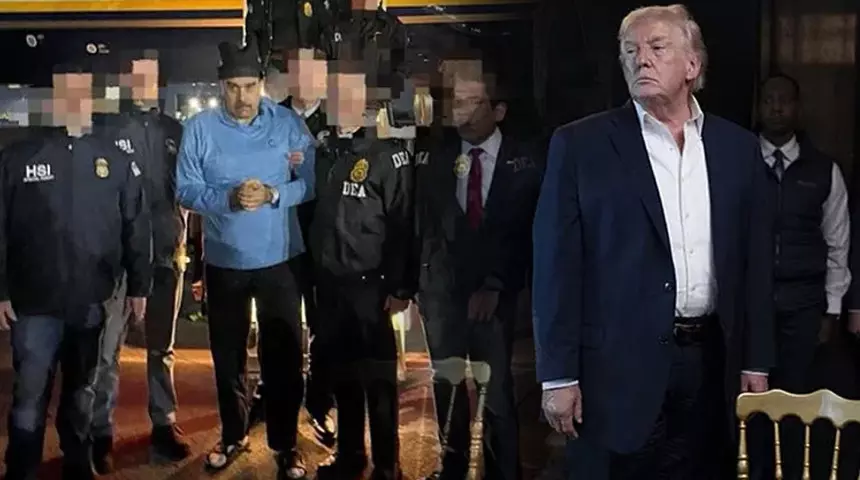

The abduction of Venezuelan President Nicolás Maduro and his wife from the presidential palace in Caracas by a US Delta Force unit, acting on direct orders from Donald Trump, and their transfer from their bedroom to a military base in New York in preparation for trial before a US court, is neither a passing incident nor one to be mocked or trivialised.
It is a fully fledged political and legal crime.
Every principle of international law, every notion of state sovereignty, and every remaining pillar of the post–Second World War international order has been trampled upon without hesitation. What the world is witnessing is not merely an abuse of power, but the public demolition of the very framework that was meant to restrain it.
This global order did not collapse overnight; it has been corroding for years.
Its terminal decline became unmistakable during the genocide in Gaza, when international court rulings were openly ignored, dismissed, and ridiculed without consequence. The supposed guardians of international law stood paralysed, while mass killing was normalised and accountability reduced to empty statements. The abduction of a sitting head of state from his own palace is not an aberration, it is the final act in a long process of decay.
The most alarming aspect of this moment, however, is not only the crime itself, but the moral numbness that has followed. Many have chosen to mock Maduro, to exchange jokes or display schadenfreude based on their prior political positions. In doing so, they miss the point entirely.
This was not an attack on a man.
It was a warning to the world.
What happened in Caracas shattered the last illusion of political immunity for any leader, anywhere. It delivered a blunt message: no office, no title, no statehood offers protection if a government dares to step outside the boundaries of US dominance.
In this new reality, military power; nuclear capability even, no longer guarantees security. The instruments of domination have evolved. Internal betrayal, technological interference, surveillance, and the weaponisation of proximity have replaced conventional warfare. Leadership is no longer removed by armies crossing borders, but by strikes launched from within spaces once thought secure.
Danger now comes from where safety was assumed.
No one can predict with certainty the shape of the global order emerging from the ruins of the old one. But one fact is undeniable: the law of the jungle is advancing. Raw power is asserting itself as the ultimate authority. The strong will consume the weak, seize resources, and extract expertise without the inconvenience of occupation. Why invade a country when abducting its leadership suffices?
The future points towards deeper lawlessness, escalating intimidation, and a world governed less by norms than by fear.
For the Gulf region, the economic implications should not be overlooked. Washington’s unilateral control over Venezuelan oil inevitably alters global energy calculations and reduces dependence on Saudi and Emirati supplies. This recalibration of interests carries long-term consequences, even if its full impact requires further analysis by energy specialists.
A British news outlet summarised the moment with striking clarity: Trump has invaded Venezuela. The real danger, however, lies in the assumption that Venezuela represents an endpoint. History suggests otherwise.
We are entering an era in which international relations resemble organised coercion more than diplomacy; where legality is selective, sovereignty conditional, and accountability negotiable.
In such defining moments, character is revealed. Some will cling to principle regardless of cost. Others will trade dignity for protection, office or temporary favour; securing survival today at the price of a permanent place in history’s dustbin.
For ordinary people, indifference is no longer an option. What occurred was neither distant nor exceptional. It was a clear and unmistakable alarm bell.
The rules have changed.
The masks have fallen.
And what lies ahead demands clarity, courage, and moral memory.
History, as always, is watching and taking notes.