 Jacob Childress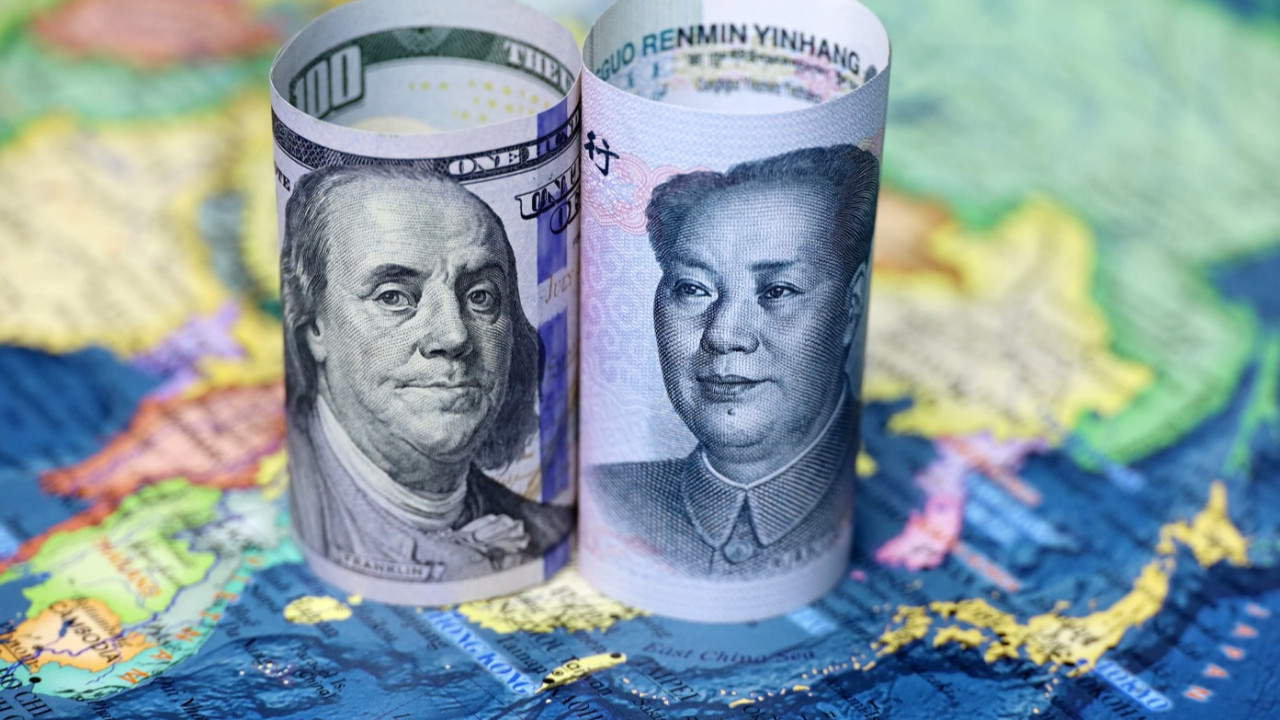

Over the past eighteen months, nearly every condition analysts have long said would erode the dollar’s dominance arrived at once. War broke out in the Persian Gulf. The Strait of Hormuz has closed, reopened, and closed again, and remains shut as this is written. Iran began charging transit tolls denominated in yuan. Indian refiners started settling Russian crude in yuan and dirhams, the first time a top-five oil importer structurally routed around the dollar for energy. China’s cross-border payment system posted record volumes, clearing 1.22 trillion yuan in a single day in March. Central banks bought gold at a pace not seen in half a century. If the dollar’s position were going to crack, this was the stress test.
Over that same stretch, the yuan’s share of global payments fell. SWIFT’s tracker put the renminbi at 4.33 percent of world payment volume in February 2025, good for fourth place among currencies. By February 2026 it had dropped to 2.74 percent and sixth place. The dollar’s share sat near 48 percent and did not move much.
That gap between the conditions and the outcome is the most important thing happening in international finance right now, and almost nobody is describing it accurately. One camp insists the dollar’s collapse is imminent and has been saying so for fifteen years. The other waves off the entire alternative financial architecture as theater. Both are wrong in ways that matter, and the truth underneath is considerably more interesting than either.
Start with what China has actually built, because it is real and it is not theater. The Cross-Border Interbank Payment System, Beijing’s answer to the dollar clearing infrastructure, processed the equivalent of roughly 24.5 trillion dollars in 2025, up more than forty percent year over year, and now connects several thousand institutions across more than a hundred countries. mBridge, a settlement platform built jointly by the central banks of China, Hong Kong, Thailand, the United Arab Emirates and Saudi Arabia, moves money between participants in seconds rather than days and at roughly half the cost of conventional international transfers. Beijing is preparing to move it from pilot to commercial operation. Chinese firms now settle close to thirty percent of their own trade in renminbi, up from essentially nothing fifteen years ago. Russia and China conduct the overwhelming majority of their bilateral trade outside the dollar entirely.
None of that is a mirage. It is a decade of deliberate engineering by a state that watched what happened to Russian reserves in 2022 and drew the obvious conclusion. The intent is settled, the money has been spent, and the pipes are in the ground.
The place to see the distinction between what is real and what is theater is the bloc that was supposed to be the vehicle for all of it. At the BRICS summit in Rio last July, Xi Jinping did not show up, the first summit he had missed since taking power, sending his premier instead while Putin attended by video link over an outstanding arrest warrant. Egypt and Ethiopia blocked the group from endorsing South Africa for a Security Council seat inside the summit declaration itself. Peter Zeihan has spent years describing BRICS as a group of countries that mostly do not like each other performing consensus for the cameras, and Beijing appears to agree with him, because in the same year its president stopped attending the summit, its settlement system posted record volumes. China has decided which of its two projects matters, and it is not the one that issues communiques.
The project that matters is bilateral, and it is better understood as the purchase of a clientele than the construction of a currency. Over two decades China disbursed more than a trillion dollars in state-backed lending across roughly 150 countries, becoming the largest bilateral creditor to 53 of them and holding about a quarter of all developing-country external debt. What it bought was not de-dollarization. It bought ports, resource contracts, diplomatic alignment on Taiwan written into loan agreements, and reliable votes in international bodies, with the loans increasingly denominated in renminbi and settled on Chinese rails. The shadow market this series has traced, the dark-transponder tankers, the barter clauses, the sixty billion dollars into Caracas, is the commercial wing of that same structure, a parallel economy where sanctioned trade clears because both sides of the transaction already answer to the same creditor. And the creditor is now collecting. Chinese lending peaked in 2016, and this year the developing world will pay Beijing thirty-five billion dollars more in debt service than it receives in new loans, which means the clientele is bought, the bills are arriving, and the votes are the interest payments.
Then look at what is flowing through them. Renminbi settlement is almost entirely confined to transactions with at least one Chinese firm on one side, which means the system functions as a bilateral channel rather than a global currency. Measured against all global trade, the yuan settles somewhere around five percent. It accounts for two to three percent of central bank reserves against roughly fifty-eight percent for the dollar. Most decisive of all, the total pool of yuan held outside China’s borders stood at about 234 billion dollars in early 2025. The comparable pool of dollar-denominated assets held outside the United States is roughly fifteen trillion. The alternative currency system has less offshore liquidity than a mid-sized American bank.
That last number is where the real constraint lives, and it is not an accident of timing or a problem that scale will eventually solve. A currency becomes a reserve currency when foreigners can acquire it freely, hold it safely, move it without permission, and trust that a court will enforce a claim denominated in it. Beijing permits none of those things. Capital controls determine how much renminbi can exist beyond China’s borders, and Beijing keeps that number small on purpose.
The purpose traces to a specific memory. In 2015 and 2016, Chinese firms and households moved money out of the country fast enough to threaten the currency and drain hundreds of billions in reserves. The Party responded by tightening the capital account and has not meaningfully loosened it since. The controls are not a regulatory preference. They are the mechanism by which the state keeps the savings of 1.4 billion people inside a banking system that funds the property developers, the local governments, and the state enterprises that the entire political economy rests on. Open the account and that money starts looking for somewhere safer, particularly now, with a property sector that has not been repaired and a population that has been shrinking for four straight years.
So the alternative architecture has a ceiling built into its foundation. To make the yuan a genuine reserve currency, Beijing would have to permit exactly the capital mobility that its own experience says would destabilize the system the Party exists to control. It can build the rails, and it has. It can wire in the partners, and it is doing that too. What it cannot do is fill the pipes, because filling them requires letting money leave.
The shadow fleets moving Iranian crude under false flags, the sixty billion dollars in Chinese credit to Caracas, the barter clauses written into the twenty-five-year Iran agreement, the discounted Russian oil settled in whatever currency the parties could agree on, all of it looked like the early architecture of a post-dollar order. It was something narrower and more durable at once, a functioning gray market for the clientele, running on Chinese credit and Chinese rails, that still could not do the one thing a reserve system does, which is let its members hold their wealth in it. If a real alternative existed, Venezuela would not have needed a tanker fleet with its transponders switched off and Cuba would not have privatized, because the improvisation was the evidence.
The honest complication is that incremental erosion is still erosion, and the trend line is not nothing. The dollar’s share of global reserves has fallen from roughly seventy-one percent in 2000 to about fifty-eight percent today, the lowest in three decades. Central banks bought more than 860 tonnes of gold in 2025 by public reporting, and the true figure is likely higher given that China stopped reporting its purchases in 2024. Every sanctions campaign teaches more countries to build a fire exit even if they never intend to walk through it, and fire exits accumulate. A world where forty percent of reserves sit outside the dollar is a world with meaningfully less American leverage than one where twenty-five percent do, even if no single currency ever displaces the dollar at the center.
The more serious threat is domestic and always has been. The dollar’s position does not rest on the absence of competitors. It rests on deep and liquid markets, enforceable contracts, an open capital account, and the belief that American obligations get paid. Debt trajectories, weaponized financial access applied without discipline, and periodic congressional brinkmanship over whether the government will honor its own paper all erode that belief in ways Beijing cannot. China has spent a decade trying to build an alternative to the dollar and has produced a bilateral settlement channel with a rounding error’s worth of offshore liquidity. Washington could do considerably more damage to the dollar in a single bad appropriations season.
Beijing understands the ceiling better than most of the commentary about Beijing does. The construction continues anyway, because the architecture is not primarily meant to replace the dollar. It is meant to ensure that the next time American financial power is aimed at China, there is something on the other side of the wall to stand on. That is a defensive project, not an offensive one, and it is being built by a country that cannot afford to finish it.
*Jacob Childress is a retired Army Master Sergeant with four combat deployments and four years supporting presidential operations from inside the White House Communications Agency across two administrations. He is a Senior TSCM Technician supporting the National Nuclear Security Administration and writes geopolitical analysis at jacobchildress.com.