 Mira Oklobdzija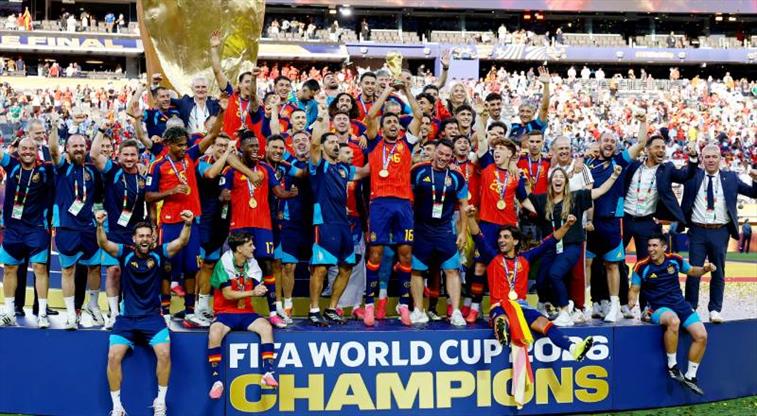

Given all the corruption and scandals, the World Cup doesn’t stand a chance of remaining a showcase of the “beautiful game.”
The World Cup is a photographic image of the world, but it is overexposed. It is blurred though the filters of nationalist propaganda and individual heroics. At play are all the features of geopolitics: power games, big money, troubles with AI, competition at all costs, threats, animosities, and mistrust, to name just a few.
Consider, for instance, the Olympic Games. In the Olympic Games, the rules are clear. No kind of demonstration or political, religious, or racial propaganda is permitted at any Olympic sites, venues, or areas. Individuals, organizations, and nations cannot profit from them, politically or commercially. The goal is to promote friendly efforts and healthy rivalry.
The World Cup, by contrast, is a professional championship with its own changing rules and an open focus on profit for all involved. The national exaltation of the results is expected. The World Cup mobilizes nations around their teams and, especially, around heroes on those teams. As the biggest spectacles on the planet, aside from wars, World Cup matches would make Roman rulers envious.
Ritualized Spectacle
The bigger the spectacle, the more elements of rituals they embrace. According to Émile Durkheim, rituals create a state of collective effervescence, forging emotional unity and reminding people they are part of something larger. That can give individuals a warm feeling of belonging or a blinding patriotic zeal. In The Mass Psychology of Fascism, Wilhelm Reich convincingly depicted how the energies of the masses can be steered, manipulated and exploited.
When it comes to rituals connected to sport events, “togetherness” is demonstrated through repetitive acts, the wearing of various sorts of uniforms, flag-waving, shouting with or without music. The “Viking row” of the Norwegian fans leaves many impressed and others envious. Testosterone is on open display, allowing for the free expression of basic instincts without the label of “uncivilized.” Hero-worship also plays a prominent role, even when the heroes are not at their best. This summer in the United States, the heroes have been Harry Kane, Lionel Messi, Erling Haaland, Cristiano Ronaldo, Kylian Mbappe, Jude Bellingham and others at the top of the list. . Donald Trump and FIFA chief Gianni Infantino, though not actively chasing the ball, have tried but failed to join their ranks.
At the margins but persistently followed by the cameras are the rich, famous, and powerful. Many heads of states traveled to support their national teams. Glued to their screens, spectators around the world could also follow the socializing of David Beckham and Tom Cruise, scrutinize the national insignia embraced by Brad Pitt and his girlfriend, wonder if Mick Jagger has lost weight, eyeball the outfits chosen by the jaded Victoria Beckham, witness Ryan Reynolds’s joy of cheering. and observe Jeff Bezos and Lauren Sánchez conversing. Who can ask for more from a sport?
Whatever else the World Cup delivers, it certainly provides a good amount of kitsch. According to the definition, kitsch appeals to popular or lowbrow taste, it is often of poor quality, using bright and clashing colours, is overly dramatic, immediately grabs attention, and evokes shallow emotions. Two steps forward is novelist Milan Kundera and his concept of “totalitarian kitsch,” which denies the complexities, doubts, and unpleasant realities of human existence by banning dissent, irony, and individuality. Each group of World Cup fans shows dissent only toward the judges when they start waving yellow or red cards at their favorites. Such fans unify against all the others, who are also unifying against all the others. It is blind tribalism at its best.
Money and Power
The World Cup means money.. Tickets prices are soaring. “FIFA recently listed a ticket for the July 19 final at New Jersey’s MetLife Stadium for $32,970,” according to Forbes. “In April, FIFA’s resale site listed four seats to the final for a little less than $2.3 million each.”. So, FIFA and the host stadiums are financially thriving, and so are broadcasters, traveling companies, sponsors, advertisers, hotels in America, and pubs around the world. Visitors are spending whatever they can. And before each game, the TV audience in The Netherlands was regularly informed that “this program has been brought to you by Coca Cola.”
Professional football has long been a big business, with players bought and sold at high prices. This practice is called the “transfer system,” and it’s been in effect since 1893, when the English Football Association formally registered players as owned by their clubs. This year’s World Cup features two hero-billionaires, Cristiano Ronaldo and Lionel Messi. Others are simply millionaires, earning on-field salaries and off-field payments through endorsements, licensing, appearances, and memorabilia as well as cash returns from any businesses in which the athlete has a significant interest.
Money goes well with power. In football, Gianni Infantino (an Italian, Swiss, and Lebanese citizen) is worth $20 million as of 2026, plus an annual compensation as FIFA president of $6 million per year. He also knows how to choose friends. He tirelessly and shamelessly praises Donald Trump, awarding him the FIFA Peace Prize in a rather tasteless political spectacle that shouldn’t have anything to do with sport. Afterwards, after an intimate phone call from Trump, Infantino decided that a decision of a professional referee wouldn’t stand and American footballer Folarin Balogun could play even after receiving a red card. For a moment Trump was happy, but his outrageous intervention didn’t save the American team, which lost convincingly against Belgium.
In Other Scandals
U.S. foreign policy also played a role in the games. Iran’s team could enter U.S. soil only a day before each match and then had to quickly return after the game to their accommodations in Tijuana, Mexico. U.S. Customs and Border Protection denied Somalian referee Omar Arana entry to the country because of some unspecified security challenge, and FIFA promptly removed him from the tournament.
Artificial intelligence also contributed to the games this summer. Video Assistant Referee (VAR) come under scrutiny following a string of controversial decisions in matches involving several countries, particularly Argentina and Portugal.
For these moves and others, FIFA and Infantino in particular lost a lot of respect. Trump was ridiculed in virtually all corners of the globe. And European trust in the United States and its president dropped, with 81 percent of citizens from eight countries considering America unreliable. But this, too, was an expression of patriotism, of the anti-American variety.
The game itself remains beautiful. As Tárlach Ó Ruiséil writes:
Football is one of the greatest art forms. The ability of a player to manipulate their body like the finest ballet dancer, to do what appears unnatural—a sudden change of direction, the power of a shot or header, athletic grace and strength—comes together in a free-flowing orchestra at its very best… The best players on the biggest stage, cultivating their talents while inspiring national pride, have turned the World Cup into the most iconic sporting spectacle on earth.
Though he insists that football belongs to the people, not to oligarchs, politicians, advertisers, or corporate executives, Ruiséil points out that the game never lacked political significance.
Italy’s triumphs in 1934 and 1938 were inseparable from Mussolini’s fascist regime. The 1978 World Cup served Argentina’s military dictatorship as a notorious exercise in sportswashing. And in 2026, Donald Trump’s public intervention… sounded less like a head of state respecting sporting independence and more like a powerful man expecting a favour.
Viking Row
The term ‘patriotism’ is generally perceived as something positive, though much has been written to the contrary. It is something more than the sense of belonging, and its darker sides are easily overlooked. For example, and characteristically, Milénio Stadium, a Portuguese Canadian Weekly claims:
That emotional connection is what makes the FIFA World Cup one of the most powerful and patriotic events in the world…. (it) proves that soccer is more than a game—it is a powerful expression of national pride, capable of uniting millions in a shared sense of identity, passion, and hope.
It would be useful to elaborate more on the word “hope” in this context, but sport commentators don’t have to be experts on all things socio-political. On the other hand, it would be farfetched to expect equal enthusiasm from football fans for both their team and their opponents. Their hearts go first to their own flag and team, and only when their clubs of choice are not playing or have been eliminated can football lovers appreciate the sport as it should be.
Not everyone will go along with the masses and their patriotic enthusiasms. Norwegian football fan Emil Anners Lappen decided, for instance, not to row while thousands of his countrymen directly around him did. Kundera’s totalitarian kitsch describes a political and aesthetic system in which all answers are given in advance in such a way as to preclude any questions. The true opponent of totalitarian kitsch is the person who asks questions and refuses to succumb to mass sentiment, even if those feelings are close to his heart and mind.
Source: https://fpif.org/world-cup-a-poisonous-cocktail-of-spectacle-kitsch-and-patriotism/