

 Dr. Mustafa Ekici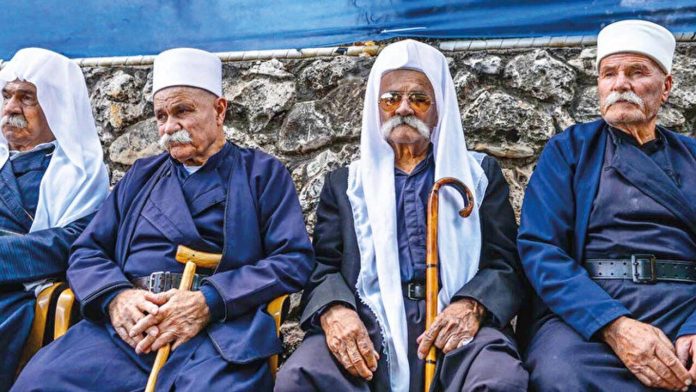

Following a bloody civil war that lasted fourteen years, the Syrian revolution is shaking the regional order imposed by the victors of World War I to its foundations. The massive tectonic upheavals triggered by the revolution in the Middle East are confronting not only states but also the region’s minorities with dislocations and provocations similar to those seen in the aftermath of the First World War. In this sense, Syria’s ancient minorities—the Druze and the Alawites—have once again gained value for regional states and international powers seeking to exert influence over the region from outside, just as they did in the past. This value lies essentially in the leverage these minorities can be used to provide.
Throughout the Syrian civil war, both the regime and regional/international powers frequently instrumentalized minorities as part of a conflict dynamic. It is now observed that this minority-based conflict dynamic is being reactivated in the wake of the Syrian Revolution. In this context, Israel’s military and intelligence activities are particularly noteworthy as efforts to trigger a new conflict dynamic through the Druze, who constitute a fragmented demographic structure settled along the country’s southern borders.
It is clear that, based on certain myths constructed since the founding of Israel, a significant portion of the Druze population feels a sense of closeness to Israel. In particular, the Druze population living within Israel, and the Druze community in the Golan foothills and Mount Hermon (Jebel al-Sheikh) associated with them, are strategically significant for this conflict dynamic. However, the picture is more complex than what Israel and some ‘Zionist’ Druze leaders are trying to portray.
Druze is one of the remnants of the Shiite wave that swept through the region a thousand years ago, coming from Iran. As one of the esoteric interpretations of Islam, Druze is a closed “secret” sect. The influence of this closed structure has been significant in enabling them to preserve their existence to the present day. Although its creed has deviated quite far from mainstream Islamic belief, Druze Islam still resides within the Islamic cultural universe. The Druze population, mostly settled in Syria, Lebanon, and the occupied Palestinian territories (in Israel), is estimated to be around 1.2 million worldwide. Although not certain, the Druze, who make up about 3% of Syria’s population (around 600,000), mostly reside in mountainous and rural areas.
Generally settled in the rugged terrain of the southern foothills of the Anti-Lebanon Mountains, the Hawran plateau, Mount Hermon (Jebel al-Sheikh) in Quneitra, the Galilee Hills in Palestine, and the Golan Heights, the majority of Druze are settled in the province of Suwayda (around 350,000). Jaramana, Sahnaya, and the surrounding areas in the southeast of Damascus also have a significant Druze population (around 150,000–200,000). This strategy of isolated settlement in rural and rugged terrain can be seen as a way to protect religious autonomy as well as to protect against the pressure of central authority.
Compared to the Lebanese Druze, the Syrian Druze community leads a more isolated life. The political (meşa’ihul zaman) and religious (Sheikh al-Aql) authorities, which are the fundamental authorities of Druze community organization, are more stable and relatively autonomous in the Syrian Druze community than in the Lebanese Druze community. In the Syrian Druze community, the practice of the last two centuries has resulted in the office of Sheikh al-Aql being passed successively between three families (Ceruba, Hinawi, and Haceri), establishing a tripartite Sheikh al-Aql authority today.
The political stance of the Druze community in Syria toward the Syrian revolution can be grouped into two main camps. The first group rejects the new Syrian administration and defends the “autonomy” of the Druze region. This group is represented by Muwaffak al-Tarif, the Druze religious leader in Israel, and Sheikh Hikmet al-Hicri, a Venezuela-born figure known for his close ties with Israeli intelligence agencies and his notoriety for drug trafficking. Theologically, this group can be defined as “Druze Zionists.”
The military supporters of this political group are mostly composed of Druze soldiers and officers—remnants of the deposed Assad regime—who fear being prosecuted by the new Syrian government and who are connected to Hikmet al-Hicri. This armed group, which formed the Military Council in Suwayda, currently holds the same political position as Hikmet al-Hicri. However, despite efforts to instill sympathy for Israel (Druze Zionism) in al-Hicri’s base, which is under the influence of Muwaffak al-Tarif, a rift—based on Arab nationalism—is also known to exist between the Military Council and al-Hicri, although both sides are currently choosing to ignore it.
The second group is represented by Sheikh Yusuf al-Cerbu and Sheikh Hamud al-Hinnavi, who defend Syria’s unity and its central government. This approach, also supported by the militia group called Men of Honor (Rical al-Kerame) commanded by Leys Balus, is known as the group with the largest representative base grounded in Arab nationalism. Indeed, in order to quell the conflicts that flared up immediately after the Revolution due to Israeli provocations, a statement approved by all Druze leaders—including Hikmet al-Hicri (who left the hall just before the statement was read)—expressed the group’s political approach as follows:
“A united Syria, of which we are an indivisible part, is our honor. Our Syrian identity is our honor. Love of the homeland is a matter of faith. We categorically reject division, separation, or secession.”
This group maintains the same political position today.
Although there is no clear data regarding the representative capacity and actual strength of these groups, it is no secret that the current situation has dashed the hopes of Israel and Muwaffak al-Tarif, who has aligned himself with it. Druze leaders collaborating with Israel appear to be attempting to atone for the degraded politics and ontological deviation they advocate by seeking partners among the Syrian Druze. Israel, for its part, is engaging in opportunism through futile tactical moves that lack strategic depth—moves which, in effect, will both harm its own internal cohesion and squander the investments it has made in the Druze for decades.
The externally supported “autonomous” structure briefly experimented with under the French Mandate at the beginning of the twentieth century failed to bring lasting stability and peace to the Druze—just as it did not for other minorities. It would not be a prophecy to say that the fate of this colonial project, which Israel is now trying to revive in an anachronistic manner, will mirror the outcome of the first.
The resurfacing of the Druze autonomy project—which was dissolved into the ideology of Arab nationalism with the Great Revolt led by Druze leader Sultan Pasha al-Atrash in 1925—amounts to nothing more than déjà vu. Any plan built upon the Druze and similar minorities, who have historically held an uneasy position in relation to central authorities, is destined to backfire in the short term.
In 1939, following the outbreak of events against the French occupation, Gabriel Puaux, the High Commissioner of the French Mandate, decided to visit the region. According to the intelligence he received, two-thirds of the Druze supported Druze autonomy and, by extension, the French (i.e., the occupation). Trusting this intelligence, Puaux visited the Druze in Jebel, only to be met with a striking scene: a large and unexpected crowd—led by the very leaders who had collaborated with the French—protested him with slogans and banners full of insults. Behind him, under the protection of the Armée du Levant (a special unit established by the French occupation army), a small group waving French flags would go down in the record as a sign of the absurdity of the commissioner’s situation.
Mossad agents, who had recently crossed into Syria through the barbed wire in Quneitra with great expectations, would soon experience the same fate—disappointment and painful losses.
The Jewish–Druze relationship is not, as both sides hypocritically claim, an existential or ontological one. Rather, it is an ambivalent relationship between two “disconnected societies,” grounded in fear, distrust, and uncertainty about the future, and adorned with myths and fabrications. A story told by then Deputy Chief of the Israeli General Staff and nephew of Moshe Dayan, Major General Uzi Dayan, is a good example of the kinds of fairy tales told to fill the void of this ambivalent relationship:
“I had the sorrowful honor of having two fathers. One was my father, Zurik Dayan; the other was my uncle, Moshe Dayan, who would later become Chief of the Israeli General Staff. My father Zurik was killed in a war between us and the Druze when I was a hundred-day-old infant. The deputy commander of the Druze at that time was a man named Ismail Kablan. Some time after my father’s death, my uncle Moshe made an alliance with the Druze, and as a result of that alliance, the Druze were employed in the Israeli Border Police. Ismail Kablan was one of the founders of this unit. Much later, Ismail’s son Jihad became one of the first four officers under my command to reach the Tomb of Abraham in Hebron (al-Khalil). That gave me infinite joy.”
The myth of a Druze–Jewish “blood bond,” propagated by Israeli and collaborator Druze leaders through such fairy tales, is doomed to give rise to a nightmare similar to that of the Lebanese Civil War—built on Maronite–Jewish collaboration and resulting in the death of over 200,000 people.
From the very beginning, Israeli officials have defined the Druze as a kind of “security buffer” between themselves and Syria. Yet this reflects geographical, cultural, and political ignorance. In principle, the idea of a buffer zone simply means an area with “depth” extending outward from the border. However, when each “buffer” is coded as new territory to be occupied, matters become truly complicated, and what was designed as a simple security measure turns into a form of geopolitical absurdity—each buffer requiring a new buffer, a new layer of protection.
This is precisely what Israel, with its doctrine of territorial occupation and expansionism, envisions: a “buffer” that it hopes to annex to its territory in the future by merging it with the Golan Heights, through certain Druze leaders and their followers whom it has seduced. This “buffer” plan, which appears perfectly reasonable on paper, is an absurd Jewish fairy tale—one that anyone with even a rudimentary knowledge of maps and demographics would laugh at. Between Suwayda and the Israeli border lie Daraa, Quneitra, and hundreds of affiliated settlements where more than two million Sunni Arabs live. Only Jews who are truly detached from reality could imagine that this vast geographical and demographic area could be “cleansed” by dropping a few bombs from the air.
After a century of waging war against geography and demography since 1918, the Jews have not arrived at a stable state or society. On the contrary, they find themselves in a grotesque position: highly fragile, with an uncertain future, and vitally dependent on external support for political, military, economic, and even demographic continuity. The only way to remove geography and demography from the equation is to annihilate the population through wholesale genocide, as they are currently doing in Gaza, and to completely erase both the land and the memory of the land. If there exists a multilayered power capable of paying the price, this is what will occur; but for the Jews, the impossibility of this option renders the endeavor a kind of Sisyphean futility.
Neither Christian Zionists, Muslim (!) Zionists, nor Druze Zionists will be able to save the Jewish colonial state of Israel—locked in conflict with geography and history—from extinction. History will once again run its course, and the Jews will once again take to the road, carrying their exile on their backs. Whether they will find an open door for themselves after such grave crimes—only time will tell.