
 Majid Maleki Meighani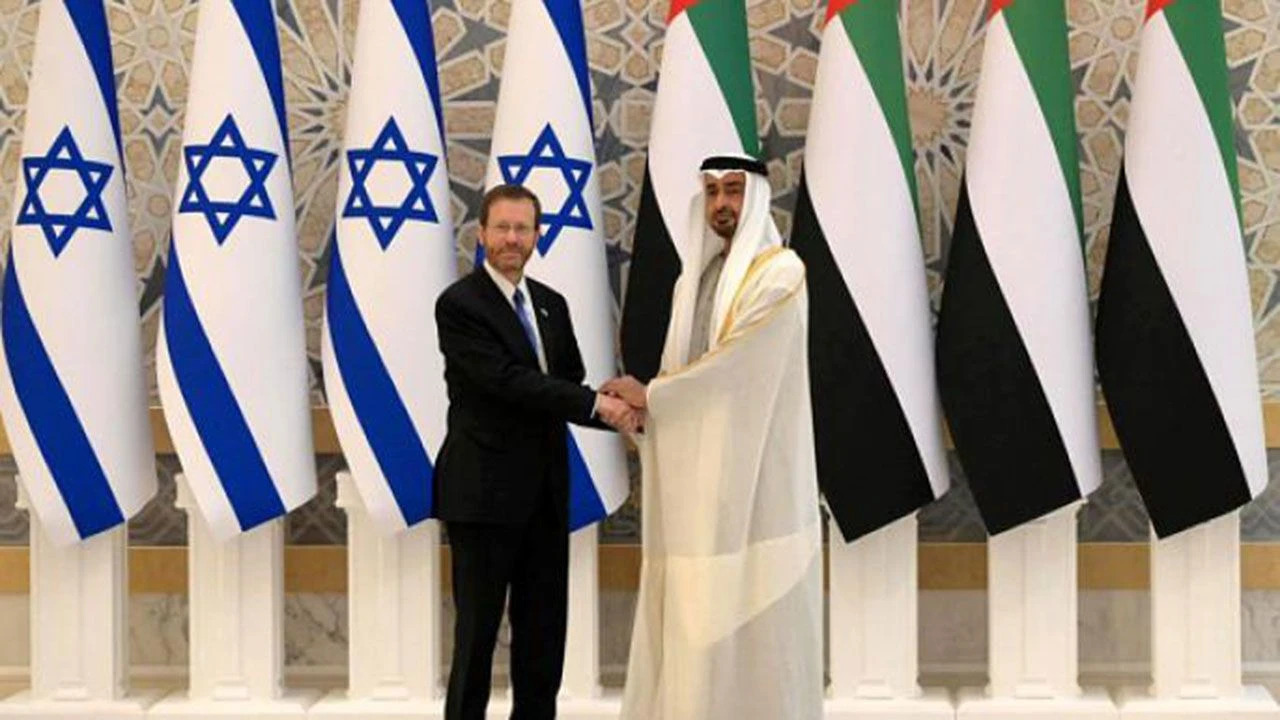

In contemporary political discourse, Israel is not merely a state or a strategic ally of the United States. It represents a particular relationship between imperial power and a regional actor: a state whose significance exceeds its demographic and geographic size because it functions as a key component in the maintenance of a wider hegemonic order. From this perspective, the central question today is not whether the United Arab Emirates resembles Israel in historical terms, but whether it is assuming a comparable structural role within the contemporary political economy of West Asia.
This question becomes particularly relevant when viewed against the transformations of the past two decades. The UAE has evolved from a small oil-producing sheikhdom into a major center of global finance, logistics, technology, and regional influence. Despite its limited population, it now plays an increasingly important role in strategic arenas stretching from the Red Sea and the Horn of Africa to the Persian Gulf and the Eastern Mediterranean. Its influence often exceeds what traditional measures of state power would predict.
This transformation is not accidental. In the post-Cold War era, the United States has gradually shifted from direct military occupation toward a model of indirect imperial management. The experiences of Iraq and Afghanistan demonstrated the political and economic costs of large-scale military intervention. As a result, Washington has increasingly relied on regional allies capable of enforcing a political and security order favorable to global capital accumulation and Western strategic interests.
For decades, Israel performed this function. It served not only as a military ally but also as a center of intelligence gathering, technological innovation, regional surveillance, and political influence. Today, the UAE appears to be emerging as another pillar of this architecture. Although it lacks Israel’s historical origins and ideological foundations, it increasingly performs similar systemic functions through instruments better suited to the conditions of twenty-first-century capitalism.
If Israel’s regional role was historically built upon military superiority, the UAE’s influence rests on three interconnected pillars: financial capital, technology, and security.
Dubai and Abu Dhabi have become major nodes in the circulation of global capital. Multinational corporations, financial institutions, and investment funds use the UAE as a regional platform for operations across West Asia, Africa, and South Asia. In an era in which financial flows increasingly shape political power, this position grants the UAE strategic importance far beyond its territorial size.
Financial power, however, is only one dimension of the story. The UAE has simultaneously positioned itself as a technological hub within the Arab world. Massive investments in artificial intelligence, digital infrastructure, surveillance systems, and advanced industries have transformed the country into a significant actor in the emerging political economy of technological control. In this context, cooperation between the UAE and Israel following the Abraham Accords acquires particular significance. What appears as diplomatic normalization is in reality a deepening convergence of interests in cyber-security, intelligence operations, surveillance technologies, and regional security management.
The Abraham Accords should therefore be understood as more than a diplomatic agreement. They represent the institutional consolidation of a regional bloc aligned with U.S. hegemony, Israeli military superiority, and transnational capital. Their significance lies less in the language of peace than in the creation of a stable political and security environment favorable to neoliberal accumulation and geopolitical control.
Alongside finance and technology, the security dimension remains central. The UAE’s involvement in Yemen, its interventions in Libya, its growing presence in the Horn of Africa, and its development of military and logistical facilities in strategic locations demonstrate that it is no longer simply an economic actor. Rather, it has become a state increasingly willing and able to project military, intelligence, and security power beyond its borders.
These interventions are not isolated foreign-policy choices. They form part of a broader regional strategy in which local allies assume responsibilities that were once exercised more directly by imperial powers themselves. In this sense, the UAE functions not merely as an independent regional actor but as a participant in a wider architecture designed to regulate trade routes, secure energy flows, contain political challenges, and preserve favorable conditions for global capital.
It is here that the structural similarities with Israel become most visible. Both states possess relatively small populations yet wield influence far beyond their demographic weight. Both maintain deep strategic relationships with Washington. Both function as critical nodes in a regional order centered on security cooperation, technological integration, and the protection of geopolitical arrangements favorable to Western power.
Of course, important differences remain. Israel emerged through a settler-colonial project with a history stretching back more than a century. The UAE has no equivalent historical foundation. Israel continues to rely heavily on military deterrence and direct coercive capacity, whereas the UAE expands its influence primarily through finance, trade, technology, diplomacy, and selective military projection.
Yet despite these differences, the practical outcomes frequently converge. Both states contribute to the reproduction of a regional order in which the uninterrupted circulation of capital, energy, and strategic resources remains paramount. Both are positioned against political forces that challenge this order. And both benefit from extensive political, military, and economic support from Western powers.
The dominant image of the UAE emphasizes modernization, efficiency, innovation, and economic success. Yet this narrative obscures important realities. Much of the country’s prosperity rests upon the labor of millions of migrant workers who possess limited political rights and receive only a small share of the wealth they generate. Extreme concentrations of wealth, dependence on migrant labor, and restrictions on political participation reveal another side of the Emirati development model—one largely absent from official representations.
The UAE should therefore not be understood simply as a successful example of economic development. Rather, it represents a new type of state within contemporary globalization: a state whose legitimacy derives less from democratic participation than from its capacity to attract capital, ensure security, manage labor, and facilitate accumulation.
From an anti-imperialist perspective, the significance of the UAE lies not merely in its economic achievements or diplomatic activism, but in its growing role as a regional instrument in the reproduction of an unequal global order. Like Israel—though through different historical and political mechanisms—it increasingly serves as a node through which military power, financial capital, surveillance technologies, and geopolitical influence are coordinated in support of a broader imperial system.
The question, therefore, is not whether the UAE is becoming identical to Israel. Rather, it is whether a new model of regional power is emerging: one in which local states assume responsibility for managing instability, disciplining dissent, and safeguarding the conditions necessary for global capital accumulation. In this sense, the comparison with Israel is not primarily historical but structural.
Whether this model proves sustainable remains uncertain. What is already clear, however, is the emergence of a new generation of regional states whose role extends beyond governing their own territories. Their function is increasingly tied to the management and reproduction of a wider imperial order. The UAE has become one of the most important examples of this transformation in contemporary West Asia.
References
- Harvey, David. The New Imperialism. Oxford University Press, 2003.
- Harvey, David. A Brief History of Neoliberalism. Oxford University Press, 2005.
- Federici, Silvia. Caliban and the Witch. Autonomedia, 2004.
- Federici, Silvia. Revolution at Point Zero. PM Press, 2012.
- Bhattacharya, Tithi (ed.). Social Reproduction Theory. Pluto Press, 2017.
- Fraser, Nancy. “Contradictions of Capital and Care.” New Left Review, 2016.
- Bayat, Asef. Life as Politics. Stanford University Press, 2010.
- Bayat, Asef. Revolution without Revolutionaries. Stanford University Press, 2017.
- Abrahamian, Ervand. A History of Modern Iran. Cambridge University Press, 2008.
- Adelkhah, Fariba. Being Modern in Iran. Hurst, 2000.
- Galtung, Johan. “Violence, Peace, and Peace Research.” Journal of Peace Research, 1969.
Source: https://znetwork.org/znetarticle/the-united-arab-emirates-another-israel-in-west-asia/