

 Rezgar Akrawi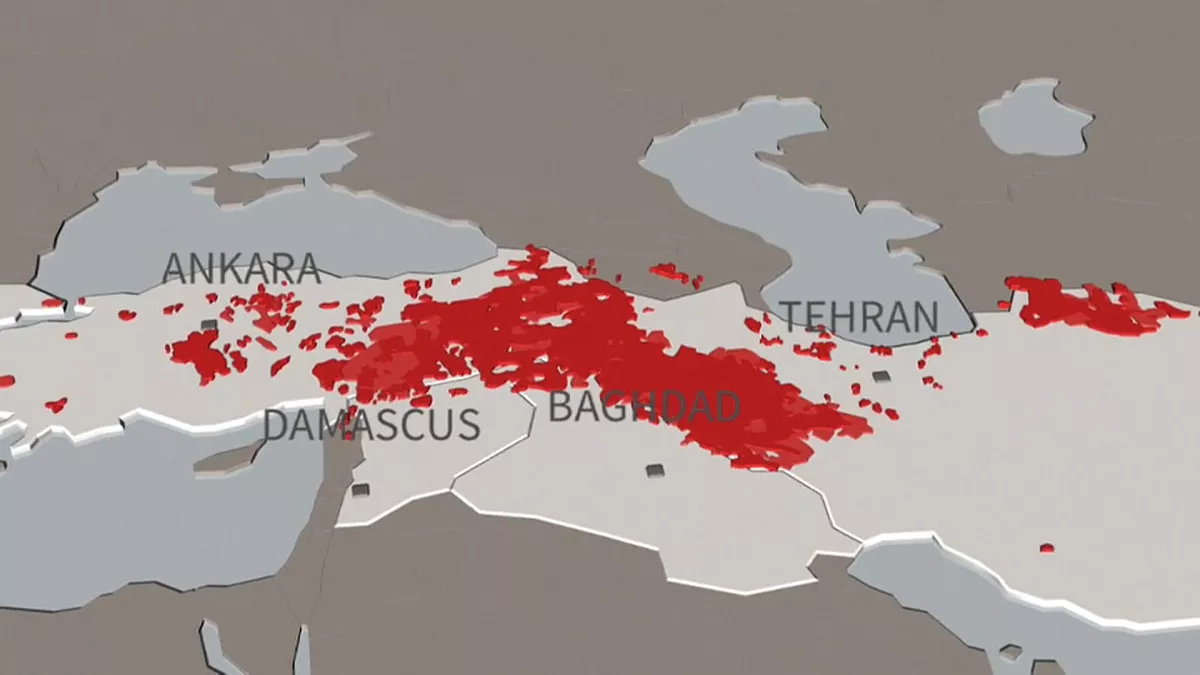

- Introduction
The Middle East has been witnessing bloody nationalist conflicts for decades that have left millions of victims and displaced persons and massive destruction on all levels. The Kurdish question represents one of the most important of these complex nationalist conflicts, as the Kurds are distributed across four main countries: Turkey, Iran, Iraq, and Syria, and their political, economic, and cultural conditions and circumstances differ in each country. The fundamental question here is: What is the real possible solution now for the Kurdish question and the national question in the region? Is it in building separate nation-states, or in struggling for a citizenship state and equal rights?
Yes, there was and still is blatant national oppression against the Kurds in most countries of the region, and this is an undeniable historical reality, as the national question and the Kurdish question cannot be addressed without clear and explicit recognition of the truth of this oppression that the Kurds and other national minorities have historically suffered in authoritarian states, whether of a nationalist or religious nature. This oppression was a systematic policy practiced by central states through forced denial of identity, banning of language, forced displacement, up to genocide, and we have bloody and stark examples of this:
• In Iraq, brutality reached its peak during the era of Saddam Hussein through the brutal Anfal campaigns that disappeared tens of thousands in mass graves, and the crime of bombing Halabja with chemical weapons in which they annihilated thousands of civilians in moments, in parallel with “Arabization” policies and forced demographic change.
• In Syria, the two regimes in the eras of Hafez and Bashar al-Assad imposed a nationalist blockade represented in the Arab Belt to isolate Kurdish areas, and the unjust 1962 census that stripped hundreds of thousands of their nationality and their right to citizenship, with a comprehensive ban on language, culture, and political activity. Today, in January 2026, this trajectory is renewed through the military attack launched by the Syrian army and militias allied with it on areas controlled by the Syrian Democratic Forces – SDF -, in a clear continuation of policies of repression and militarization, and pushing civilians once again to be victims of power and hegemony struggles, far from any just democratic solution to the national question.
• As for Turkey, the state has practiced for decades policies aimed at erasing the Kurdish national existence, classifying the Kurds under a humiliating designation which is “Mountain Turks,” and launched military campaigns that destroyed thousands of villages and displaced millions, with widespread criminalization of everything related to Kurdish identity.
• In Iran, the Kurds face compound repression under the yoke of the authoritarian theocratic regime, manifested in national repression and field and political executions, complete militarization of Kurdish cities, and economic marginalization of border areas to push their residents toward poverty and dependency.
These facts constitute an essential part of the modern history of the region and no serious leftist approach can ignore them. But fundamentally they represent one face of a comprehensive authoritarian policy pursued by those regimes, as they did not target the Kurds alone, but rather directed their repressive machinery against all citizens of those countries from all nationalities, as the dictatorship that crushes Kurdish identity is the same one that silences the overwhelming majority, throws opponents regardless of nationality, religion, and belief into prisons, confiscates their freedoms and exhausts their human dignity without exception, which makes the struggle against national oppression an integral part of the general struggle against class and political authoritarianism.
At the same time, recognizing the justice of the Kurdish cause and the right of Kurds to equality and dignity does not necessarily mean adopting all nationalist projects proposed in the name of this oppression. Confronting real national oppression is not achieved by replacing one dominant nationality with another, but rather by dismantling the foundations of the exclusionary nation-state itself, and building a democratic state based on equal citizenship, guaranteeing full national, cultural, and linguistic rights for all components, and putting a permanent end to cycles of mutual national injustice.
- From “Oppressed Nationality” to Ruling Authority Experience
As we see in the Kurdistan Region of Iraq, which constitutes a complete quasi-state situation, the “oppressed nationality” has transformed into a ruling authority facing widespread accusations of repressive practices and organized financial corruption. The two main parties, the Kurdistan Democratic Party (KDP) and the Patriotic Union of Kurdistan (PUK), have contributed to consolidating a family-tribal governance structure, in which they share power, wealth, and influence. A bloody Kurdish civil war broke out between the two parties that lasted from 1994 to 1998, claiming the lives of thousands of Kurds, and its cause was the struggle for influence and control of resources, not national liberation. Even after the end of the civil war, the conflict between them continued in other forms, and they transformed into a clear model of authoritarian hereditary family rule.
According to reports from international human rights organizations, the authorities in the Region have committed widespread violations of human rights. Financial corruption in the Region is rampant, as Region employees do not receive their salaries for months. The Region also witnessed widespread popular demonstrations against unemployment, corruption, authoritarianism, and salary cuts, which were suppressed in many cases, while the two ruling parties continued to consolidate their monopoly on the Region’s wealth and strengthen security and military tools to protect their narrow interests.
In Syria as well, the Syrian Democratic Forces “SDF,” which has ruled vast areas in northern and eastern Syria with American support since 2014, has transformed into an authority that concentrates political and military decisions in its hands, adopting policies with a clear centralized character, with limited space for political and intellectual pluralism. Despite implementing a set of important reforms of a progressive and civil nature, especially in some social and administrative aspects, and expanding women’s participation, these reforms remained governed by a certain class and political ceiling, and did not touch the essence of the power structure based on political monopoly and the dominance of a closed party apparatus. According to international reports, widespread human rights violations have been recorded against the SDF, including the continuation of child recruitment, and the adoption of strict security policies that included arrest, repression, and torture of opponents. In my estimation, the experience of Kurdish nationalist left, no matter how developed, is unlikely to exceed the level of reforms with a leftist and civil character, similar to the experiences of nationalist elites that ruled the region in the last century, which began with broad social and leftist promises, but their closed centralized structure ultimately led them to slide toward dictatorship, authoritarianism, and marginalization of popular will.
Through these experiences, in the Kurdistan Region of Iraq and in northern and eastern Syria, it becomes clear that the conflict that was marketed as a liberating nationalist conflict has practically transformed into a struggle for power, influence, and wealth between nationalist political forces of a bourgeois nature, ruling or aspiring to rule. The nationalist discourse here has emerged from being a tool of liberation, and transformed into an ideological cover to justify authoritarianism and suppress opponents, and reproduce the same relations of domination that the masses previously revolted against under unjust nationalist regimes, but this time with a local character.
The historical national victimhood, no matter how bitter, does not grant any nationalist authority a blank check to practice repression and oppression. The transformation of the “oppressed nationality” into a “tool of repression and authoritarianism” represents the great moral defeat of the liberationist project, and proves that the defect is not in the ruling elites, but rather in the structure of the exclusionary nation-state itself.
- Marginalizing Class Struggle and the Danger of National Civil Wars
Nationalist conflicts in the region carry a real danger of pushing societies toward national fanaticism and bloody national civil wars, in which the toiling masses are fuel for conflicts that do not serve their interests. The exclusionary nationalist discourse from some parties not only works to feed hatred and division, but also performs a clear political function of transforming the conflict from a social class conflict between the toiling masses on one hand, and the ruling classes and dominant bourgeoisies on the other hand, into a false national and identity conflict. In this sense, nationalist conflicts do not constitute an incidental deviation, but rather an effective tool to weaken class struggle and dismantle the social consciousness of the masses, and distract them from their daily issues related to rights, work, salaries, services, and social justice.
Under the cover of defending nationality or identity, class struggle is marginalized, exploitation is justified, and existing or aspiring authorities are immunized from any social accountability. Economic crises, corruption, and authoritarianism are transformed from the product of concrete class policies into secondary results of a fabricated national conflict, and the masses are pushed to line up behind ruling nationalist elites that do not differ in their essence from the rest of the ruling classes in the region. Thus nationalist conflicts lead to the escalation of war discourse, mobilization and hatred, emptying social struggle of its content, and cutting off any possibility of building a unified leftist class movement across nationalities and sects.
The mission of the left and progressives in this context is to rely on human and internationalist identity, and solidarity with the suffering of all civilian victims of dictatorship, wars, and armed conflict, regardless of race, religion, sect, or political orientation. Selective solidarity, which confines empathy to a specific race, sect, or political direction, and turns a blind eye to crimes committed against civilians of other components, is false inhuman thinking, and directly contributes to entrenching national and religious fanaticism, deepening social division, and weakening any real liberationist project based on social justice and equality.
- Is the Nation-State Possible Now?
Objective conditions are not suitable for the Kurdish nation-state project, as areas with a Kurdish majority are surrounded by hostile regional powers (Turkey, Iran, and the influence of Arab states), and Kurdish nationalist movements do not possess any serious real international support. American or Western support is circumstantial and linked to immediate interests.
Even if a Kurdish state were achieved, what guarantees its survival in light of being surrounded by several authoritarian states, or guarantees its non-transformation into a new dictatorial model? The experience in the Kurdistan Region of Iraq and in Syria is clear before us: tribal-party rule, authoritarian practices, widespread financial corruption, and widespread violations of human rights.
It is necessary to speak clearly about a demographic reality in many areas where nationalist projects are proposed: these areas are not all of a single national majority. How can a new nationalist project be built on lands where part of their population is from other nationalities? This demographic problem creates acute national tensions, and opens the door to accusations of practicing policies whether “Arabization,” “Kurdification,” and “Turkification” against other residents. It is difficult to build a nation-state or quasi-state on a national basis in multi-national areas without creating new national injustice.
- Betting on Major Powers, Especially America
Some of the current Kurdish nationalist movements in the region, at certain stages, have built and continue to build much of their projects on American support and its allies. America, as the largest capitalist power in the world, supports most reactionary and racist regimes, and has never been on the side of oppressed peoples or humanitarian and liberationist values. America’s presence in the region aims primarily to ensure its strategic interests and enhance its hegemony.
I believe that the United States’ alliance with Kurdish forces in Syria and Iraq came mainly to fill a vacuum resulting from the absence of large American ground forces, whether through regular forces or security companies, and therefore it has relied and continues to rely on Kurdish human military forces in implementing its agenda and enhancing its influence. Recently, this alliance in Syria has witnessed a clear shift toward Ahmed al-Sharaa and the central government. This alliance closely resembles the alliance of some Iraqi opposition parties with the United States before the overthrow of the Ba’ath regime. It is, in my opinion, a temporary and fragile alliance governed by American interests, lending legitimacy to American intervention and its practices. We see the repercussions of this clearly in Syria, and it cannot be ruled out that the same scenario will repeat itself in the Kurdistan Region of Iraq according to the interests of the United States and the arrangement of its priorities.
History proves that American policy stems from its strategic interests, not from a moral commitment toward peoples, as shown by many experiences in the region, and it is known for abandoning its allies when their role ends or when their interests conflict with its agenda. We have many examples of this, including what happened to the Kurds in Iraq in 1975, and what happened to the Afghans after the Soviet withdrawal. America’s strategic interests and relations with Turkey, Arab states, and other countries in the region remain the most important and fundamental. Betting on major capitalist powers, headed by the United States, is betting on a “political mirage.” These powers do not see nationalist movements as “allies,” but merely as “pawns” in a geopolitical chessboard, bought and sold in backroom deals as soon as corporate and oil interests require it.
- Citizenship State and Rights with Human Identity
There must be a clear distinction between demanding cultural, linguistic, and administrative rights for Kurds and other national minorities, and demanding a separate nation-state. These rights are legitimate and just demands that every leftist and progressive should support, from constitutional recognition of plurality to administrative decentralization, but the struggle for them under current geopolitical balances is more appropriate to be within the framework of an equal citizenship state transcending nationalities and religions. The possible alternative today is not in building new nation-states that reproduce divisions, but in a citizenship state that neutralizes nationality and religion from power, and restricts the formation of parties on national or religious bases, so that the focus of struggle is the rule of law, equality, and social justice, instead of mobilizing the toiling masses in national-religious conflicts that serve the interests of the bourgeoisies alone.
This transition is not a leap into the void, but rather a gradual path that requires clear constitutional mechanisms to ensure the non-return of abhorrent centralization, and from here emerges the model of geographical (administrative) federalism as a rational alternative to national federalism; so that regions are granted broad powers in managing their developmental and service affairs, which empties the conflict of its ethnic charge and transforms it into competition for welfare. This must be coupled with “comprehensive constitutionalization of identities” to guarantee the cultural rights of all components as inalienable rights, and building oversight institutions and an independent judiciary, which paves the way for the emergence of political currents competing over social, economic, political, and environmental programs.
International experiences, despite their different contexts, prove the possibility of building this model; Switzerland succeeded through decentralization in accommodating four official languages, South Africa chose citizenship instead of revenge, and even in India, Bolivia, and Spain, we find serious attempts to manage diversity through self-governance and recognition of plurality without dismantling the state. These examples are not perfect, but they confirm that the alternative to the exclusionary nation-state is not a utopian dream, and it is a project achievable through political will and continuous popular struggle that places human dignity and rights above all narrow national or sectarian considerations.
It is possible that a question may be raised here that the citizenship state is merely a utopian dream in light of the current reality of the region’s states, where authoritarianism is entrenched and national divisions are deep. But this objection ignores a fundamental fact: the separate nation-state project is more utopian under current circumstances. Talk of establishing an independent and stable Kurdish state surrounded by hostile states, without real international support, and in multi-national areas, is what resembles a far-fetched dream. As for the citizenship state, it is a realistic gradual project that begins with concrete steps: constitutionalizing national rights, building democratic institutions, implementing administrative decentralization, and strengthening the rule of law. These are steps achievable through continuous popular struggle, not a leap into the unknown. Modern history proves that democratic transformation is possible even in the most difficult circumstances. The issue is not in the “utopianism” of the project, but in the political will and organized struggle to achieve it.
This does not mean belittling the importance of national identity or hostility to legitimate national rights. There is no call here to abolish national identity or deny its specificity, but rather a call not to transform national identity into a basis for building power and the state and into a tool for discrimination and exclusion. National identity is a cultural, linguistic, and human right that must be protected, but the state must be built on the basis of equal citizenship, not on ethnic belonging. The issue is in opposition to using national identity as a cover to justify authoritarianism or to transform social conflict into a national conflict serving the interests of ruling elites. It is necessary to defend the essence of national rights by guaranteeing them constitutionally and institutionally for all components, instead of linking them to exclusionary national state projects that reproduce injustice in reverse. Kurdish national identity, like other identities, must be respected and preserved, but not as a tool to build national power.
- The Right to Self-Determination and Realistic Rationality
With my full support for the full and legitimate right of the Kurdish people and all peoples to self-determination, including secession, I do not see that global and regional conditions are now suitable for secession, independence, and declaration of new nation-states. We must reject forced unity between peoples and support coexistence and voluntary unity on the basis of equal citizenship, while at the same time we support and endorse the right to self-determination, including secession, if that will give more rights and equality, better life, better security, and fewer conflicts in the region.
This position does not mean hostility to Kurdish national liberation or belittling the justice of its historical cause; on the contrary, it is a defense of the essence of liberation itself from the distortion inflicted upon it by bourgeois nationalist projects when they transform liberationist struggle into power, authoritarianism, and corruption. Under current circumstances, I believe that the toiling masses are dragged into wars and national conflicts, and will face deeper economic and political crises for the sake of national entities, even if formed now, current circumstances and previous experiences suggest that they may face the danger of transformation into another authoritarian model in the region, and will not change anything in their lives.
As Marxists and leftists, we must deal with scientific rationality and study local, regional, and international conditions, class power balances and our capabilities from all aspects and the capabilities and strength of our “enemies,” and the realistic possibilities for achieving the solutions and policies we propose and their mechanisms. We must avoid participating directly or indirectly in dragging the masses into losing and destructive national wars, and avoid promoting or supporting them, as they will create nothing but great tragedies for civilians, especially workers of hand and mind, and great losses humanly, economically, politically, and militarily for all parties. Relying on rationality and realism is very necessary, not on “national heroics,” “national pride,” and “confronting the national enemy by all means and to the last bullet.” This discourse does not achieve victory in military and political battles, but rather drags the masses into more wars and destruction.
- Tasks of the Left and Building the Alternative Within the Citizenship State
Our mission as the left today in countries witnessing national problems is to separate our line from all parties to the national conflict, and struggle for a state based on citizenship, equal rights, social justice, and respect for human rights, not on a national or sectarian basis. The road is long and difficult, but it is the only road capable of reaching a real and sustainable solution to the national question, away from wars and conflicts that produce nothing but tragedies for the masses.
The left can organize itself practically within the citizenship state project by building political, trade union, and mass organizations transcending nationalities and sects, starting from the common material interests of workers of hand and mind, and linking the struggle for national rights with the social battle against exploitation, corruption, authoritarianism, and achieving the socialist alternative. This path requires complete political and organizational independence for the left from all forms of bourgeois forces with nationalist discourse, and daily work within society to unite the toiling masses around a concrete program for equality and the maximum possible social justice, democratic decentralization, and freedoms, as the realistic entry point for building this alternative.
The peoples in our region are not in a state of inherent conflict, nor were they born governed by hatred and division, but rather they are victims of organized national mobilization and recruitment operations, where the toiling masses from different nationalities are pushed into bloody national conflicts, so that popular sacrifices are transformed into fuel to secure the seats of bourgeois cliques that use nationalist discourse as a screen to protect their class interests. Our main battle is not to change national symbols, the color of the flag, or the language of the ruler, but rather to dismantle the chains of authoritarianism, exploitation, and fanaticism from their roots, and build a democratic socialist human space that accommodates everyone. The path to the rights and freedom of the Kurd inevitably passes through the rights and freedoms of his Arab, Turkish, Syriac, and Iranian neighbor, under a state that does not ask the citizen about his origin. And guarantees him his bread and freedom, and respects his human dignity.
