
 John Feffer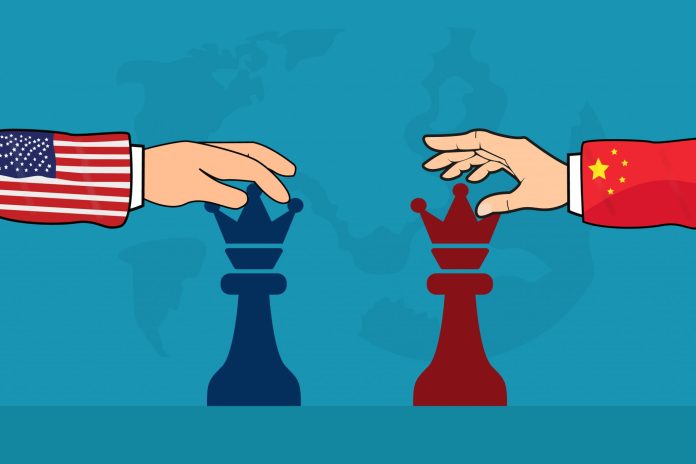

Rocks vs. Chips
When monsters square off, they are quick to showcase their asymmetrical superpowers.
Take Godzilla, for instance. Thanks to U.S. atomic testing in the Pacific, the dinosaur-like sea creature has explosive, radioactive breath that can destroy everything in its path. His archenemy Rodan, meanwhile, is a pterodactyl-like bird that can fly at supersonic speeds, a skill useful in avoiding atomic bad breath. Since the 1960s, the two giant monsters have duked it out across a series of Japanese films, causing much mayhem in the process.
Originally the product of Cold War fears of nuclear peril, these archetypal monsters can stand in for the principal geopolitical antagonists of today. Like their monster kin, China and the United States have very specific and complementary superpowers. China controls the majority of critical minerals in the world, with a special focus on rare earth elements. The United States has a technological edge when it comes to the most sophisticated semiconductors needed for artificial intelligence applications.
Put bluntly: China has the rocks, and America has the chips.
With these superpowers on display, the two countries have clashed in a series of trade negotiations, tense military standoffs, and high-level political meetings. They are engaged in a prolonged tug-of-war not to save the world — as in some comic-book universe — but in the service of their own national aggrandizement and transnational greed. While they dicker, the world slouches toward bedlam.
A Pause in Hostilities
When President Donald Trump met with Chinese leader Xi Jinping in Beijing in mid-May, the exchanges were unexpectedly cordial. The two countries had been engaged in an on-again, off-again war of tariffs since Trump had begun his second term, a conflict that threatened to spiral out of control. At the same time, the Chinese were deeply concerned about the impact of the U.S.–Israeli war against Iran on international stability, given spiking oil prices and their ripple effects on the global economy.
Yet, at this meeting in China, the two leaders converged on a common goal of “constructive strategic stability.” In order to forge this condominium of superpowers — a G2 — Trump was willing to delay arms deliveries to Taiwan. He also greenlighted the sale of sophisticated (though not the most advanced) Nvidia computer chips to China. In turn, China agreed to increase its purchases from the United States, including 200 Boeing aircraft and $17 billion of agricultural goods each year through 2028.
The hoopla surrounding the summit, generated by press offices on both sides, obscured the reality that the two countries completed few concrete bilateral deals. Trump did not secure long-term access to the critical minerals that China controls — specifically the rare earth elements that are essential to U.S. high-tech manufacturing and sophisticated military hardware — and the tech giants that accompanied Trump on the trip didn’t win any major concessions in the form of enhanced access to the Chinese market. Meanwhile, China failed to alter U.S. security policy in the Asia–Pacific region. The leaders of the new G2 might be expected to rethink or rework the global rules of the road, but this was not on the agenda in Beijing.
Still, the two superpowers stepped off the path of escalating confrontation. Perhaps more importantly, Trump has seemingly abandoned his earlier goal of decoupling the United States from the Chinese economy, which, along with ratcheting up containment of the “strategic competitor,” had become something of a bipartisan imperative.
For the time being at least, the world’s superpower monsters are not laying waste to the landscape around their feet. Given how much firepower they command, that’s no small achievement. The battle, however, continues to rage further afield in the mineral world.
Grabbing the Rocks
Rare earth elements, or REE, aren’t rare. But it can be quite difficult to extract any of these 17 unusual metals from their surrounding ores. The United States used to be the world’s leading extractor and processor of these resources, from a mine in California near the Nevada border. But that was back when REE were mostly used for such products as black-and-white televisions. The environmental damage caused by the extraction and processing — as well as the labor costs involved — impelled the United States, over time, to outsource operations to China.
By the time REE had become indispensable to the manufacture of very powerful magnets used in everything from wireless iPhone chargers to the F-35 fighter jet, China was controlling upward of 60 percent of the extraction and 90 percent of the processing. It has filed more patents for the latest processing techniques than any other country. It has also expanded beyond digging up its own territory and, through its Belt and Road Initiative — a globe-spanning collection of interconnected infrastructure projects — secured access to mines overseas.
In Tanzania, for instance, an Australian firm Peak Rare Earths discovered what may well be the largest untapped supply of REE in 2010. This is exactly what the United States and its allies had been looking for: ore that can be extracted and processed outside of China. Except that last year, the Chinese firm Shenghe Resources bought the Australian company — and the rights to the Tanzanian deposits — for a little more than $100 million. China is further cornering the market by importing ore from rare earth mines in Myanmar, exploiting new deposits in Brazil, and eying Malaysia and Indonesia for potential processing operations.
To guarantee access to the minerals that both the Pentagon and U.S. industry need, the Trump administration has ramped up the exploitation of U.S. REE deposits. Mountain Pass, the California mine previously shuttered after environmental lawsuits and Chinese outsourcing, restarted production in 2012, but it still couldn’t compete against China, which had flooded the market with REE to drive down prices. Last year, the Pentagon acquired a majority stake in MP Materials, the company that owns the mine, which now produces over 10 percent of the global supply of REE.
Trump has also pumped money into USA Rare Earths, which is developing the Round Top mine in Texas, which promises to rival the REE production of Mountain Pass. Even with an accelerated timeline, however, the new mine won’t start production before 2028. Meanwhile, the administration is playing the field: pouring money into a REE processing facility in Arizona, contracting with a similar operation in France, and hammering out supply contracts with a mining firm in Australia. This frenzied activity may lessen dependency on China but not eliminate it.
And it’s not just rare earth elements. China controls 95 percent of magnesium production, over 80 percent of tungsten, over 70 percent of graphite and silicon, and three-quarters of cobalt — minerals that are critical to pretty much all modern manufacturing. On the processing end, China is the leading refiner of 19 out of 20 of the most coveted minerals, with an average market share of 70 percent. And instead of being reliant on its control of raw materials and processed ores, China is also in command of the downstream production. For instance, it’s responsible for 94 percent of the manufacturing of the most powerful magnets that go into cars, computers, and medical equipment.
The new rush for “critical raw materials,” many of them essential for building out the infrastructure of a “clean energy” transition but also indispensable for the entire range of advanced military products to which the United States is addicted, has sharpened the competition between China and the United States throughout the mineral-rich Global South. Those countries generally see China as a willing provider of capital and finance. They view Trump — who has dismissed so much of the Global South as “shithole countries,” deported huge numbers of their citizens, and subjected nearly all of their governments to punishing tariffs — with considerable skepticism.
How long will it take for the United States to catch up and neutralize China’s mineral superpower? In the best-case scenario, America will only be able to meet half its need for rare earth elements by 2028, and it currently produces less than 1 percent of those powerful magnets. Until America catches up — or forges partnerships with other countries to meet its demand through initiatives such as the U.S.-led Pax Silica — China will be able to pinch off the supply of those key minerals more easily than Iran can close off the Strait of Hormuz.
Controlling the Chips
Silicon Valley has long been a byword for innovation: Apple’s iPhones, Google’s search engine, Facebook’s social media platform. But the heart of Silicon Valley was, at least originally, made out of silicon. Chips made the valley. In the 1980s, Japan produced semiconductors that were superior to anything American companies could get to market. Competition spurred Silicon Valley to leapfrog over Japan.
The chip-designer Nvidia began in the 1990s as a supplier of graphic processing units, or GPUs, for the video game industry. These Nvidia chips became, literally, the brain behind Microsoft’s Xbox. Later, they came to power Sony’s PlayStation 3, signaling that Silicon Valley had definitively surpassed its Japanese competitors.
Then Nvidia began developing the kind of hardware necessary for the next big tech revolution: artificial intelligence. The first major AI platform available to the public — ChatGPT — was built on the foundation of Nvidia’s next-generation GPUs. Suddenly, Nvidia was the most sought-after supplier and the most valuable company in the world, now worth more than $5 trillion.
It’s one thing to corner the market on the graphics necessary to play “Grand Theft Auto” or make the special effects of the 2021 “Godzilla vs. Kong” movie look terrifyingly real. It’s quite another to create the building blocks of the AI technology that is creeping into every corner of the economy, not to mention the military.
To maintain its economic and military edge, the United States has placed controls on the export of Nvidia’s most advanced semiconductors to China. It’s no surprise that, over the last six years, the People’s Liberation Army attempted hundreds of times to acquire those precious chips. To prevent China from producing their own, the Dutch also placed restrictions on the export of the machines used to print the chips.
There are two challenges to this strategy of restriction. The first is that, despite its name, Silicon Valley doesn’t actually manufacture the vast majority of these fancy computer chips. For more than 90 percent of advanced semiconductors, the world depends on Taiwan. It’s as if another monster has appeared on the scene with a superpower that can bring both Godzilla and Rodan to their knees.
The United States harbors a fear that the Chinese response to their chip dependency will be simply to invade Taiwan and take over its semiconductor industry. For its part, the Biden administration pushed through the CHIPS Act to re-shore computer chip manufacturing, which is turning Arizona into a real Silicon Valley. Intel and Taiwan’s TSMC are among the more than 75 firms building factories there, which will require considerable water (in a desert) and produce tons of “forever chemicals,” the synthetic compounds that do not break down naturally, polluting the environment and accumulating within people (amid a growing population).
Given Russia’s failure to seize Ukraine and the inability of the United States and Israel to achieve regime change in Iran, China is not likely to attempt a takeover of Taiwan any time soon. Instead, it has pursued a different approach, and this is the second problem with a restriction strategy. Prevented from acquiring Nvidia’s best chips, China is pouring money into making its own chip sector the best in the world.
Those considerable state investments produced a Sputnik moment in January 2025 when the Chinese company DeepSeek released its ChatGPT competitor. The big breakthrough, however, was behind the scenes: China was able to use its own domestically produced chips to create comparable AI results at a cheaper cost.
Private sector expenditures on AI in the United States still exceed China’s investments by a considerable margin. But the Trump administration’s cuts in science funding and restrictions on work visas will handicap U.S. technological progress for years and possibly decades. China, meanwhile, will likely have machines ready to produce what its AI models need by 2030, the target date Beijing has set to close the advanced chip gap.
*John Feffer is the director of Foreign Policy In Focus, where this article originally appeared.
Source: https://theintercept.com/2026/08/23/trump-china-ai-chips-rare-earth/