 Greg R. Lawson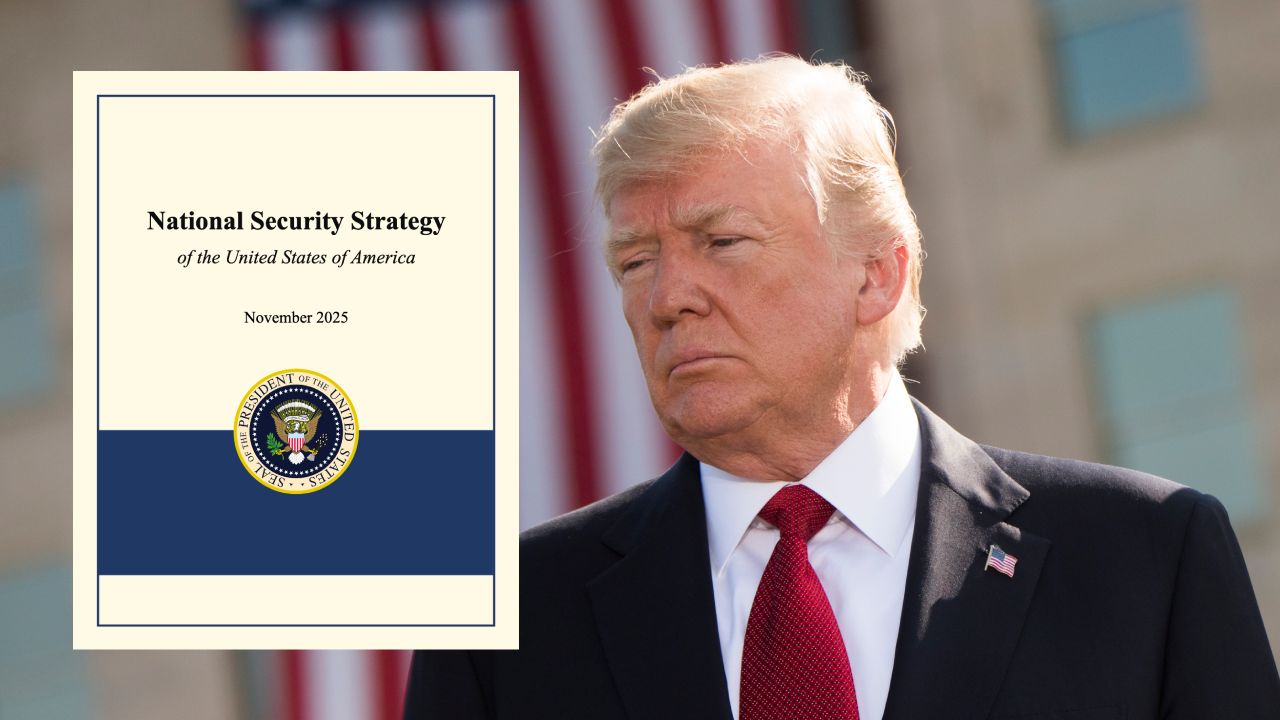

The Trump administration has rightly reoriented US foreign policy toward domestic renewal, more balanced alliances, and hemispheric protection.
For nearly a decade, a small but growing group of analysts has argued that American foreign policy needs a massive course correction. With the unveiling of President Donald Trump’s National Security Strategy yesterday, that broad-based course correction is at hand and clearly articulated.
While the United States cannot, and should not, retreat into isolationism, it has desperately needed a reorientation toward the world as it actually is. For too long, Western intellectuals, policy wonks, and political leaders bought into the “End of History” and “Unipolar Moment” framing of how the world would operate after the collapse of the Soviet Union in 1991.
Instead of continuing to act as if the United States could perennially play the role of Atlas holding up the world, a consistent theme emerged in realist policy analysis: the United States could no longer afford a foreign policy driven by ideological aspiration, institutional inertia, or the comforting illusions of unipolarity. The United States needed a realism fit for a new competitive age—not the caricature of realism that pretends America can withdraw behind its oceans, but a realism grounded in material strength, strategic triage, and an unsentimental view of how great-power politics actually works.
With the release of the 2025 National Security Strategy, it is fair to say that an American administration has finally produced a strategic document that fully embodies this worldview and does so unapologetically. The NSS contains a strategic sensibility that realists and America First-oriented analysts have been advancing for years—one that places geopolitical balance, economic resilience, and clear prioritization at the center of US statecraft, while discarding the moralistic overreach that defined the post-Cold War era. The result is a document that, while not perfect, marks the most significant intellectual advance in American grand strategy since the Nixon administration.
The first point of alignment is prioritization, something that has been the Achilles’ heel of US foreign policy since the end of the Cold War. The 2025 NSS does not mince words: China is the pacing challenge, and the Indo-Pacific is the priority theater. This is precisely the analytic structure outlined in some of my own previous work, which recommended cultivating a strategic framework linking the United States, India, Japan, and (under the right circumstances) Russia to prevent the emergence of a Sino-centric Eurasian order.
Likewise, the NSS’s emphasis on geoeconomics could have been lifted directly from arguments made by realists for years. It has long been evident that the United States has allowed its industrial base to atrophy even as global competition shifted from purely military confrontation to a contest over supply chains, technology platforms, and industrial capacity. The 2025 NSS not only acknowledges this shift—it places it at the center of American strategy. By linking national security to industrial policy, supply-chain resilience, advanced manufacturing, and technological leadership, the NSS essentially acknowledges that economic power is a form of strategic power. This is not a rhetorical shift. It is a recognition that strategy begins at home.
The NSS also takes a remarkably pragmatic approach to alliances. For years, alliances have been treated more as sacred relics than as strategic instruments. But alliances are tools, not ends in themselves. Allies should contribute materially to shared strategic objectives, rather than simply offering moral support or rhetorical solidarity. This is especially true of allies in Europe that the NSS rightly critiques for their history of free-riding on US defense spending while often lecturing US leaders on morality.
The NSS reflects this worldview almost exactly: it calls for real burden-sharing, for alliances tailored to functional missions, and for a sober reassessment of what partners can realistically deliver in a world where American resources are not limitless. This is not abandonment of the United States’ global role—it is reform, the kind necessary to ensure alliances remain sustainable and strategically coherent.
Perhaps most importantly, the 2025 NSS overall embraces a form of common-sense realism that has been absent from American strategy for too long. The document does not promise to remake the world in America’s image. It does not offer transcendent missions or moral crusades. Instead, it proposes a world where the United States advances its interests through strength, prudence, and selective engagement. This, too, aligns with a neo-Nixonian approach: a willingness to engage diplomatically, even with difficult states, to use leverage rather than lectures, and to prioritize outcomes over appearances.
There is, of course, one central area where the NSS does not go far enough: Russia. The United States needs to distance Russia from China to avoid the further consolidation of the Sino-Russian Axis, a true geopolitical nightmare that threatens the Eurasian and global balance of power. Such a move would conceptually replicate the triangular diplomacy that Nixon and Kissinger employed so effectively in the 1970s.
The NSS recognizes the need for stability with Russia and the danger of a consolidated Sino-Russian bloc. Still, it stops short of articulating the transactional diplomacy that will likely be necessary to achieve a strategic split. Washington continues to view Russia primarily through the lens of the Ukraine conflict, and while that view is understandable, it risks missing the larger structural stakes of Eurasian geopolitics.
The NSS also focuses on the Western hemisphere. However, this new “Trump Corollary’ to the Monroe Doctrine rightly seeks to combat major problems for the United States, including drug running, especially the fentanyl-based “reverse Opium War” waged by China, instability that leads to unconstrained immigration flows while seeking to reassert American dominance in its strategic backyard, rather than ceding critical territory to China. This certainly fits an America First geopolitical and defense-oriented strategy.
Still, these slight divergences should not obscure the larger point: the NSS and realist grand strategy share a remarkably similar and coherent worldview. Both see the world entering a period of intensified great-power competition. Both understand that America’s relative power must be underwritten by domestic renewal. Both reject ideological adventurism in favor of strategic restraint. Both prioritize shaping the balance of power in the Indo-Pacific. And both argue that alliances must be recalibrated, especially when it comes to a declining Europe—not discarded—to meet the challenges of a multipolar world.
For many years, America First foreign policy and defense analysts have rightly worried that the United States was drifting without a strategic compass, pulled by habit, ideology, and institutional inertia. The 2025 NSS is a sign that this drift may finally be coming to an end.
The document is not perfect, and how it is implemented will be far more important than how it is written. But for the first time in a generation, American grand strategy rests upon a foundation that is intellectually coherent, strategically realistic, and aligned with the geopolitical world as it actually exists, not in the imagination of naïve idealists.
Ultimately, the NSS is not merely a policy document. It is a strategic correction—one that realist analysts have long argued was necessary—and one that the United States can no longer delay.
* Greg R. Lawson is a contributing analyst with Wikistrat. He has previously contributed to The National Interest, RealClear World, and Eurasia Review. Follow him on LinkedIn and X @ConservaWonk.
Source: https://nationalinterest.org/feature/the-common-sense-realism-of-the-national-security-strategy