

 Adnan Boynukara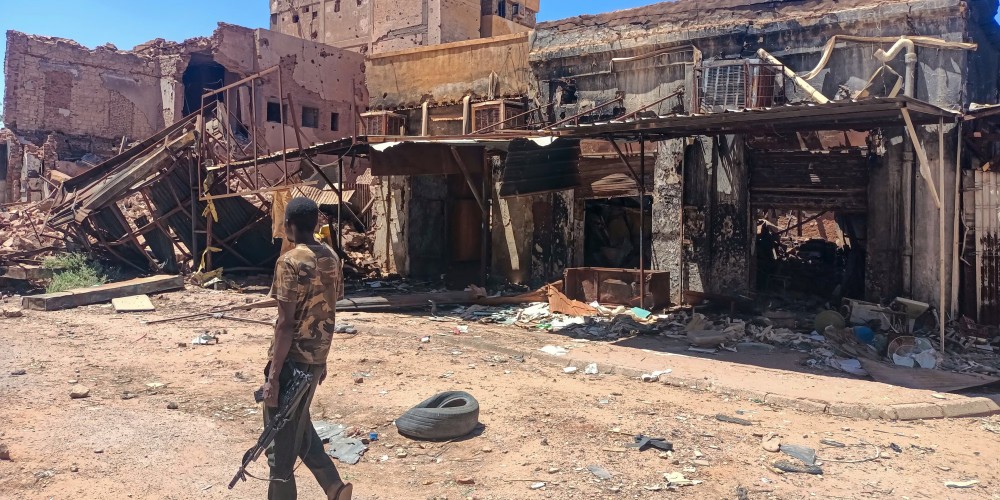

The war in Sudan has lasted for more than three years. During this period, millions of people have been displaced, cities have been reduced to ruins, and hunger has been turned into a weapon. Despite this, Sudan continues to remain on the margins of the global agenda. While wars in the Middle East, tensions among major powers, and geopolitical upheavals dominate the headlines, the cries from Sudan are fading into an ever fainter voice. In fact, this silence itself is the product of a political choice.
Characterizing what is happening in Sudan as a “civil war” is analytically insufficient. Today, Sudan has largely lost its capacity to determine its own fate and has turned into a proxy arena where the calculations of internal actors are intertwined with the rivalry of external actors positioned on the ground with differing interests.
Who Is Winning and Who Is Losing in This War?
The Sudanese Armed Forces (SAF) recaptured Khartoum from the Rapid Support Forces (RSF). This military advance was presented as the end of the war. Yet, although the SAF controls the capital, the war’s true center of gravity remains unchanged. The gap between the military reality and a political solution has not narrowed; it has merely become invisible. For years, I have met with Sudanese people on various occasions. The most painful thing I have learned from these conversations is that neither the word “war,” nor “crisis,” nor even “disaster” is sufficient to describe Sudan. Perhaps the most accurate word is “abandonment.” Abandonment both by the world and by their own governments.
After every conversation, the same question remains in my mind: Is this picture a tragedy, or is it a choice?
Two Generals, But the Real Issue Lies Elsewhere
The war in Sudan is often portrayed as “a power struggle between two generals.” This interpretation is both misleading and dangerous. It obscures the structural fractures that gave rise to the war and, in doing so, leaves room for neither genuine governance nor a lasting solution. The roots of the war run much deeper. The state structure established during the post-colonial era by the Khartoum-centered military-bureaucratic elites excluded the peripheral regions from the outset and suppressed ethnic and cultural diversity. While politics, the economy, the military, and the bureaucracy were confined to the center, the peripheral regions were left to grapple with poverty, inadequate infrastructure, and political exclusion.
The tradition of coups entrenched this inequality. The military became firmly established at the center of politics, and no unarmed actor was able to secure a place at the negotiating table. This system created a vicious cycle in which violence became both an instrument of governance and a basis for political bargaining. The state instrumentalized tribal militias and proxy armed groups to deal with internal conflicts. Over time, this choice led to the fragmentation of the security sector. The unresolved conflicts in Darfur and increasingly deepening foreign interventions were added to this picture. Consequently, the war extended far beyond internal dynamics.
The process that began in 2019 offered an opportunity to transform this structure. However, the civilian movement lacked the institutional capacity required to manage a broad social transformation. Moreover, this capacity gap was further deepened by the strategy of military actors—who were never genuinely willing to share power—to continuously delay and dilute the transition process. Consequently, the democratic transition inevitably remained dependent on military actors. The 2020 Juba Peace Agreement incorporated armed groups into the system, but it failed to disarm them. These groups preserved both their political and military presence. The line between politics and armed force became even more blurred. As a result, the narrative of “a power struggle between two generals” may offer an observation of how the war erupted on the surface. However, when this structural background is overlooked, it is insufficient to explain why Sudan has repeatedly been driven into armed fragmentation.
A Crowded Stage, An Empty Table
If these structural fragilities had remained confined solely to internal dynamics, perhaps a solution would have been easier to find. Yet today, Sudan is compelled to bear not only its internal contradictions but also the rivalry of external actors. A look at the map of actors reveals an unusually crowded stage.
Much has been said about the role of the logistical support provided by the UAE in shaping the course of the war. Behind this support lies not only economic calculations regarding access to the Red Sea, but also the determination to reshape regional power balances. However, viewing the Sudan crisis solely through the lens of the UAE narrows the picture. Sudan has also become the stage for an intra-Gulf confrontation. According to the reports of the UN Panel of Experts and claims frequently voiced in the international press, Riyadh’s support for the SAF and Abu Dhabi’s support for the RSF also reflect the deep rivalry between the two countries. In a sense, Sudan is paying the price for a power struggle that the Gulf has failed to resolve. In short, according to an assessment frequently emphasized in regional analyses, the UAE sees Sudan as a building block of its regional influence architecture, and securing the place of this block is not incompatible with the prolongation of the war.
Egypt’s position is shaped within a more complex dilemma. By aligning itself closely with the SAF, Cairo seeks to prevent instability along its southern border and possible refugee pressure. The issue of Nile waters and the continuing tension with Ethiopia also make Egypt dependent on a controllable Khartoum. Yet at the same time, Egypt avoids open confrontation with its Gulf partners so as not to jeopardize the UAE investments that sustain its economy. This contradiction has trapped Cairo in a dual fragility, leaving it unable to clarify its position.
Saudi Arabia is attempting to play the role of mediator through the Jeddah Process. Although Riyadh’s intention is to establish a framework for negotiations, the deep gulf between this intention and the realities on the ground significantly limits the effectiveness of Saudi mediation. It calls for a ceasefire, but lacks the mechanisms required to enforce that call on the actors on the ground. On the other hand, for Riyadh, the Sudan issue is a strategic calculation that directly affects its control over security and trade routes in the Red Sea. Riyadh’s calls for a ceasefire encompass both the pursuit of peace and the goal of preserving its own regional influence. This duality makes it difficult for Saudi mediation to find a binding response on the ground. For Saudi pressure to be effective, Riyadh must exercise genuine leverage over the actors in Sudan. Yet by using this leverage, Riyadh would also risk upsetting the balance of power within the Gulf.
Each regional actor occupies a position aimed at safeguarding its own interests in Sudan. But once global powers are added to the picture, the equation becomes even more complex.
For Russia, Sudan is a strategic bridgehead that would provide permanent military access to the Red Sea. The presence of Wagner on the ground in the early stages was the most concrete indication of this calculation. For Moscow, Sudan is a new front opened against the West, and it is the Sudanese who are paying the price for this front.
Alongside Russia, another actor seeking to enter the scene is Iran. Iran became visible on the ground through its support with unmanned aerial vehicles. This presence is also part of Tehran’s effort to consolidate its axis extending from the Red Sea into the interior of Africa. Iran’s presence in Sudan is neither humanitarian nor diplomatic. It is the first step in establishing a corridor of influence stretching to the Red Sea, and Sudan is nothing more than the foundation of that corridor.
The West is trying to shape the framework of the negotiating table in Sudan. But when others are supplying weapons to the battlefield, the claim of determining the terms of that table becomes increasingly less convincing.
A large portion of the actors fueling the conflict are also attempting to become actors at the negotiating table. This contradiction is the greatest structural obstacle to establishing a lasting political foundation for Sudan. Because within this crowded landscape, every actor has its own calculations and its own position. Yet the most striking element of the picture is not the presence of those on the stage, but the absence of the one that ought to be there: Türkiye. Despite being one of the few actors accepted by the parties and possessing legitimacy in the region, Ankara did not play a decisive role in this process.
Ankara’s Opportunity
From the very first days of the war, Ankara was one of the few actors that both sides viewed favorably as a mediator. Türkiye had established deep-rooted relations with the Sudanese state. Moreover, the humanitarian and economic ties maintained over many years had also provided Ankara with a broad base of social legitimacy. It also maintained communication with the RSF leader, who had served as Sudan’s Vice President before the war. These three pillars made Türkiye one of the few countries capable of engaging with all parties to the conflict.
However, Türkiye failed to capitalize on this opportunity. There are multiple reasons for this.
Foremost among them was the need to balance its relations with the Gulf. During the process of re-normalization with the UAE and Saudi Arabia, Ankara preferred to maintain a balanced stance. At the same time, the Syria, Ukraine, and Gaza dossiers were occupying its diplomatic capacity. Sudan, meanwhile, failed to secure sufficient priority amid the intensity of these agendas. But the decisive factor was that Türkiye viewed its Sudan policy as a track to be pursued only to the extent that other priorities allowed. In other words, the issue is not merely a matter of prioritization; it is the outcome of a structural equation in which regional positions shape Ankara’s room for maneuver.
This window of opportunity has not closed entirely. As Sudan seeks to manage its political transition process, it will require actors with mediation capacity. Türkiye remains one of the countries capable of meeting this need. But for this to happen, Ankara needs to update both its position on Sudan and its relations with the parties involved.
Who Is Losing?
The Sudanese people are the ones losing. As of 2026, 33.7 million people are in need of humanitarian assistance, 14 million have been displaced, and 29 million people are facing hunger. These are the figures. The state structure has collapsed, and civilian actors have been pushed aside. A political solution is not on the agenda. The indifference I see on the faces of those who are supposed to produce solutions is steadily exhausting what remains of hope.
So who is winning? To answer this question honestly, for now, no one is winning. But some are not losing. Egypt, for example, although it adopts an ambivalent stance because of its relations with the UAE, uses this ambiguity as a strategy. Perhaps for this reason, some Sudanese perceive Egypt as an actor that places its regional interests above Sudan’s stability. Although the Gulf countries are preoccupied with their own domestic priorities and their rivalry with one another, they continue to preserve the strategic gains they have derived from the proxy order in Sudan. Russia is seeking to consolidate its strategic position in the Red Sea. Iran, meanwhile, is currently occupied with its own agenda.
The West is attempting to shape the framework of the negotiation process without assuming a costly engagement on the ground. Washington declares on every platform that it has not forgotten Sudan. But in an order where rhetoric does not translate into political will, these reminders carry meaning not for the Sudanese people, but for the United States’ own future plans. There is no place in this equation for a concept such as accountability. None of those fueling the conflict are held responsible before an international mechanism. United Nations platforms issue statements of condemnation, but they have no impact whatsoever on the ground. Consequently, this dysfunction is also a matter of political will.
Indeed, H.R. 1939, the United States Participation in the Sudan Peace Process Act, which was introduced in the U.S. House of Representatives on June 9, 2026, identifies precisely this lack of political will. The bill contains sound assessments, but the text has not yet become law. For Sudan, however, the real issue has always been the will to resolve the problem.
A ceasefire, unimpeded delivery of humanitarian assistance, a transitional parliament and a transitional government, the establishment of conditions for political organization, and then elections. None of these steps are unknown. Yet despite this knowledge, nothing is being done. Because each step affects the interests of a different actor. For the side that has gained the upper hand on the battlefield, a ceasefire may carry the risk of freezing that advantage. For the side using siege as an instrument of pressure, opening humanitarian corridors may weaken the effectiveness of that instrument. For actors whose power derives from their armed presence, a civilian transition process may become synonymous with the risk of losing power. Therefore, this roadmap is not a matter of technical implementation; it is, fundamentally, a matter of political will. Sudan waits, while the world looks elsewhere.
Of course, the picture described here is not quite this simple and straightforward. The reality on the ground is far more layered, each actor’s calculations are interconnected, and dozens of technical and political obstacles stand in the way of every step. Yet there is value in simplifying the issue while remaining aware of this complexity. Because regarding Sudan, many circles bring up this complexity and use it as a justification for inaction. Against this tendency, simplicity should be preferred.
The Silent Disaster
The silence surrounding the disaster in Sudan is an expression of a political choice, strategic indifference, and the dysfunction of accountability mechanisms. Sudan’s invisibility is a consequence produced by the system. As long as this system continues to function without accountability, Sudan will not be the only example.
The Sudanese are not expecting a miracle from the world. They simply want to be taken seriously. They want to be given a place at the table, to have their names pronounced correctly, and to have the faces behind the numbers be seen. That is all. But so far, there has not even been a willingness to do that. Our view of Sudan has failed to move beyond a humanitarian aid reflex. Yet Sudan is not an object of aid; it is a people striving to determine their own destiny and paying a price for doing so. As long as we fail to recognize this distinction, what we say carries little significance. Because in a system where no one is held accountable, it is not surprising that Sudan remains invisible. What is truly surprising is that we have begun to accept this as normal.