
 Kenan Heydarov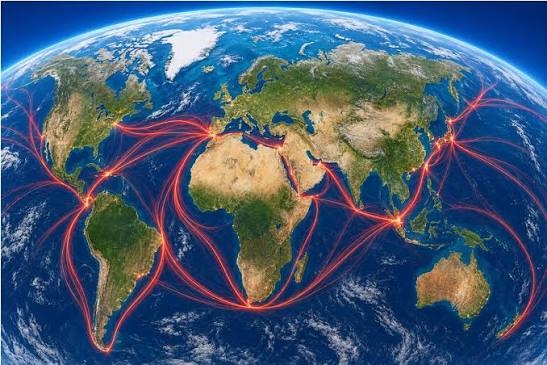

Abstract: Maritime chokepoints are commonly portrayed as critical vulnerabilities capable of triggering systemic disruption across the global economy. The concentration of trade and energy flows through corridors such as the Suez Canal, the Strait of Hormuz, Bab el-Mandeb, the Strait of Malacca, and the Panama Canal has reinforced concerns regarding the fragility of contemporary globalisation. This article argues that contemporary maritime chokepoints create significant strategic vulnerabilities, but they do not necessarily render the global trading system fragile. Drawing on recent disruptions, including the Evergiven blockage, the Red Sea security crisis, and operational constraints affecting the Panama Canal, the article distinguishes between exposure to disruption and systems’ capacity to absorb, adapt to, and recover from shocks.
Problem statement: Do maritime chokepoints necessarily make the global economy fragile, or do they merely expose it to higher levels of strategic vulnerability?
So what?: The distinction between vulnerability and fragility has important implications for policymakers, businesses, and security planners. Recent disruptions have demonstrated that maritime chokepoints remain significant sources of strategic risk, but they have also revealed a greater degree of adaptive capacity within global trade networks than is often assumed. The principal challenge is therefore not the elimination of all vulnerabilities, which is neither realistic nor economically efficient, but the management of exposure through diversification, redundancy, and strategic planning. For governments, this means focusing on resilience rather than pursuing the impossible goal of complete security. For businesses, it requires balancing efficiency with flexibility in supply chain design. More broadly, understanding that exposure does not automatically imply collapse allows decision-makers to assess maritime risks more realistically and avoid policy responses driven by exaggerated perceptions of systemic fragility.
The Geography of Exposure
Recent disruptions affecting the Suez Canal, the Red Sea, and the Panama Canal have renewed concerns regarding the resilience of the contemporary global economy. The blockage of the Evergiven in 2021, attacks against commercial shipping in the Red Sea, and climate-related restrictions on Panama Canal operations have all reinforced a common narrative: global trade appears increasingly vulnerable to disruption.[1], [2], [3]
This perception is understandable. Despite decades of globalisation, digitalisation, and technological innovation, international commerce remains heavily dependent on a relatively small number of maritime corridors. A substantial share of global container traffic, energy shipments, and industrial supply chains continues to pass through a handful of strategic chokepoints. Consequently, disruptions affecting these corridors can generate economic consequences that extend far beyond their immediate geographic locations.[4], [5]
Yet an important analytical distinction is often overlooked. Vulnerability and fragility are not synonymous concepts. A system may be exposed to disruption without being prone to collapse. Contemporary discussions surrounding maritime chokepoints frequently assume that exposure automatically implies systemic weakness. However, recent crises suggest a more complex reality.[6]
While disruptions have undoubtedly increased costs, delayed shipments, and created strategic uncertainty, they have rarely produced the catastrophic outcomes often predicted in public discourse. Instead, global trade networks have demonstrated an ability to reroute cargo, adjust logistics strategies, and absorb shocks through a variety of adaptive mechanisms.[7], [8]
This article argues that the strategic significance of maritime chokepoints lies not simply in their capacity to generate vulnerability, but in the widespread tendency to confuse vulnerability with fragility. Examining the Suez Canal, the Strait of Hormuz, Bab el-Mandeb, the Strait of Malacca, the Panama Canal, and emerging Arctic routes, the article demonstrates that contemporary trade networks remain structurally exposed yet exhibit greater resilience than conventional narratives often assume.
Rather than examining maritime chokepoints as isolated geographic bottlenecks, this article develops a broader analytical framework that places adaptation and resilience at the centre of contemporary maritime security. By distinguishing structural vulnerability from systemic fragility, it explains why repeated disruptions have generated considerable economic costs without fundamentally undermining the continuity of global trade. In doing so, the article moves beyond descriptive assessments of individual chokepoints and offers a conceptual perspective for understanding how geography, geopolitical competition, and adaptive capacity interact to shape the resilience of the contemporary global trading system.
Vulnerability Versus Fragility: A Conceptual Framework
Much of the contemporary debate surrounding maritime chokepoints implicitly assumes that exposure to disruption is equivalent to systemic fragility. While this assumption appears intuitive, it risks obscuring important differences between two distinct concepts.[9], [10]
Vulnerability refers to exposure to risk. A vulnerable system can be affected by disruptions, experience higher costs, suffer delays, or face operational difficulties. Fragility, by contrast, implies a limited capacity to absorb shocks and recover from them. A fragile system is one in which disruption produces cascading failures that threaten its broader functionality.[11], [12]
The distinction is particularly important in the context of global trade. Maritime chokepoints undoubtedly create vulnerabilities because they concentrate large volumes of commerce and energy flows within narrow geographic corridors. However, concentration alone does not necessarily imply fragility. The existence of alternative routes, strategic reserves, inventory adjustments, logistical flexibility, and market adaptation mechanisms can reduce the likelihood that localised disruptions evolve into systemic crises.[13], [14]
Recent events illustrate this distinction. The Evergiven blockage disrupted global shipping but did not trigger a collapse of international trade. Similarly, security challenges in the Red Sea and operational restrictions at the Panama Canal imposed substantial economic costs without fundamentally disrupting global supply networks.[15], [16], [17]
These cases suggest that contemporary trade systems may be better understood as vulnerable but adaptive rather than fragile and prone to collapse. This distinction has important policy implications. If vulnerability is mistaken for fragility, policymakers may overestimate the probability of systemic breakdown and underestimate the adaptive capacity of global markets. Conversely, recognising the difference allows for a more balanced assessment of maritime risk and a more realistic understanding of resilience in the contemporary global economy.[18], [19]
The Suez Canal: Strategic Exposure Beyond Geography
Few maritime corridors illustrate the relationship between geography and global commerce as clearly as the Suez Canal. Connecting the Mediterranean Sea with the Red Sea, the Canal provides the shortest maritime route between Europe and Asia and remains indispensable to international trade and global supply chains. Approximately 12 per cent of global trade and a substantial share of global container traffic transit through the Canal annually, reinforcing its strategic importance for international commerce, energy transportation, and the efficient functioning of global supply chains.[20], [21]
The canal’s strategic importance became particularly evident during the Evergiven incident in March 2021. The grounding of a single ultra-large container vessel temporarily blocked one of the world’s busiest maritime routes, delaying hundreds of ships and disrupting global logistics networks. The incident generated billions of dollars in economic losses, increased transportation costs, and exposed the concentration of international commerce within a limited number of critical maritime corridors.[22], [23]
Yet the strategic significance of the Evergiven incident extends beyond the temporary disruption itself. From an analytical perspective, the crisis illustrates the central argument of this article: vulnerability should not be confused with fragility. The blockage exposed significant structural vulnerabilities within global trade, but it did not trigger systemic collapse. Shipping companies rerouted cargo where possible, logistics providers adjusted operations, and commercial activity gradually recovered once navigation resumed. Rather than demonstrating that globalisation is inherently fragile, the incident revealed the adaptive capacity of modern trade networks to absorb and recover from localised disruptions. The Suez case, therefore, demonstrates that the greatest strategic challenge is not the existence of maritime chokepoints themselves, but the ability of global trade networks to adapt before localised disruptions evolve into systemic crises.[24], [25], [26]
While the Suez Canal illustrates the consequences of accidental disruption, the Strait of Hormuz demonstrates how geopolitical uncertainty may generate equally significant strategic effects even without an actual interruption of maritime traffic.
The Strait of Hormuz: Strategic Uncertainty and Energy Security
Among the world’s strategic maritime chokepoints, few exert greater influence over global energy security than the Strait of Hormuz. As the principal gateway for energy exports from the Persian Gulf, the Strait remains indispensable to international energy markets and the stability of the global economy. Approximately one-fifth of global oil consumption and a substantial share of liquefied natural gas (LNG) exports transit through this narrow waterway, meaning that even limited disruptions can rapidly influence energy prices, shipping costs, and market confidence.[27], [28]
The geopolitical significance of the Strait extends beyond its economic role. Persistent tensions between Iran and the United States, together with the presence of regional and extra-regional naval forces, have transformed Hormuz into one of the most militarised maritime corridors in the world. Recurrent incidents involving commercial vessels, naval patrols, and threats to maritime navigation have reinforced its strategic importance while highlighting the close relationship between regional security dynamics and the functioning of global energy markets.[29], [30]
Unlike other maritime chokepoints, the strategic influence of the Strait of Hormuz is not determined solely by the likelihood of physical closure. Energy markets respond not only to actual disruptions but also to credible perceptions of geopolitical risk. As a result, political crises, military incidents, or even heightened diplomatic tensions can cause significant fluctuations in oil prices, insurance premiums, and transportation costs despite uninterrupted commercial shipping.[31], [32]
From an analytical perspective, the Strait of Hormuz reinforces the central argument of this article. It represents one of the most significant structural vulnerabilities in the contemporary global energy system, yet repeated regional crises have rarely produced the systemic collapse that is frequently anticipated in geopolitical discourse. Strategic petroleum reserves, diversified export infrastructure, international naval deployments, and market adaptation mechanisms have repeatedly reduced the broader consequences of regional instability. Consequently, the principal impact of crises in Hormuz has been the creation of higher economic costs and strategic uncertainty rather than the disruption of the global energy system itself. The Hormuz case ultimately illustrates that strategic uncertainty can be as economically consequential as physical disruption, reinforcing the need to distinguish structural vulnerability from systemic fragility.[33], [34], [35]
Whereas Hormuz highlights the strategic consequences of uncertainty, the Red Sea crisis illustrates how sustained regional conflict influences the adaptive capacity of global supply chains.
Bab el-Mandeb: Regional Conflict and Global Supply Chain Adaptation
Situated between the Red Sea and the Gulf of Aden, the Bab el-Mandeb Strait has become one of the most strategically sensitive maritime corridors in the contemporary security environment. As the principal maritime gateway to the Suez Canal, it plays a critical role in facilitating commercial shipping, energy transportation, and supply chain connectivity between Europe, Asia, and the Middle East. A substantial share of global container traffic and petroleum shipments continues to transit this narrow waterway, reinforcing its importance to international trade and energy security.[36], [37]
The strategic significance of the Strait has increased considerably following attacks against commercial shipping conducted by Houthi forces in the Red Sea. These incidents disrupted established shipping routes, increased insurance premiums, and compelled numerous international shipping companies to reroute vessels around the Cape of Good Hope. Although this alternative significantly increased transit distances, transportation costs, and delivery times, global trade continued to function despite the disruption.[38], [39]
The Red Sea crisis illustrates an important characteristic of contemporary supply chains. Rather than demonstrating the collapse of international trade, it revealed the ability of shipping companies, logistics providers, and global markets to adapt rapidly amid heightened geopolitical risk. Alternative routes, revised shipping schedules, inventory adjustments, and strategic planning reduced the broader systemic consequences of regional instability, even though these adaptations imposed considerable economic costs.[40], [41]
From an analytical perspective, the Bab el-Mandeb case further supports the central argument developed throughout this article. The disruption exposed a significant structural vulnerability within global maritime trade, yet it did not produce systemic fragility. Instead, the crisis demonstrated that resilience in contemporary supply chains depends less on eliminating vulnerabilities than on maintaining sufficient adaptive capacity to respond effectively to disruptions. The Red Sea crisis, therefore, demonstrates that resilience depends less on preventing disruption than on preserving the adaptive capacity of global logistics systems under conditions of sustained geopolitical pressure.[43], [44]
Beyond regional conflict, structural dependence on critical maritime corridors becomes even more apparent in the Strait of Malacca.
The Strait of Malacca: Strategic Dependence and Great Power Competition
No maritime corridor better illustrates the intersection of economic interdependence and geopolitical competition than the Strait of Malacca. Serving as the principal maritime gateway between the Indian Ocean and the South China Sea, the Strait occupies a central position within the global trading system. Approximately one-quarter of globally traded goods and a substantial share of international energy shipments transit this narrow waterway each year, making it indispensable to both regional prosperity and the functioning of the global economy.[45], [46]
Beyond its commercial importance, the Strait occupies a central position in contemporary geopolitical competition. China’s rapid economic development has significantly increased its dependence on maritime imports of energy and raw materials, much of which passes through the Strait of Malacca. This dependence has given rise to the well-known “Malacca Dilemma,” reflecting Beijing’s concern that a disruption or blockade of this corridor could threaten China’s economic security and strategic autonomy.[47], [48] Consequently, the Strait has become an important element of China’s broader maritime strategy, including investments in alternative transport corridors, port infrastructure, and the diversification of energy supply routes.
At the same time, the Strait of Malacca has become increasingly significant within the strategic competition between the United States and China. For Washington, maintaining freedom of navigation and preserving an open maritime order remain fundamental objectives in the Indo-Pacific. For Beijing, reducing strategic dependence on a single maritime corridor has become an essential component of long-term national security planning. As a result, the Strait is no longer merely a commercial route but a geopolitical space where economic interdependence and strategic rivalry increasingly intersect.[49], [50]
From an analytical perspective, the Strait of Malacca illustrates that vulnerability is not determined solely by physical geography but also by strategic dependence. Although the concentration of trade and energy flows creates significant structural exposure, repeated regional tensions have not disrupted global commerce. Instead, governments and private actors have invested in diversification strategies, infrastructure development, and supply chain adaptation to reduce strategic risk. The principal challenge, therefore, lies not in eliminating dependence on maritime chokepoints but in managing that dependence through resilience, redundancy, and long-term strategic planning. The Malacca case, therefore, illustrates that excessive strategic dependence may constitute a greater long-term risk than the maritime chokepoint itself.[51], [52]
The Panama Canal: Climate Change and Emerging Strategic Risks
Unlike most strategic maritime chokepoints, the Panama Canal demonstrates that environmental pressures can become as strategically significant as geopolitical rivalry. Connecting the Atlantic and Pacific Oceans, the Canal remains an essential component of global maritime commerce by significantly reducing transit distances between major international markets. It continues to facilitate the movement of manufactured goods, agricultural products, energy commodities, and containerised cargo across the global trading system.[53], [54]
Unlike many traditional maritime chokepoints, the principal challenges facing the Panama Canal are increasingly environmental rather than geopolitical. Prolonged droughts, declining water levels in Gatún Lake, and changing climatic conditions have periodically reduced the Canal’s operational capacity, forcing authorities to limit daily vessel transits and impose draft restrictions. These operational constraints have increased shipping costs, extended delivery times, and required shipping companies to reconsider routing strategies.[55], [56]
The experience of the Panama Canal demonstrates that climate change has become an increasingly important factor shaping global maritime security. Environmental disruptions may not attract the same political attention as military conflicts or regional crises, yet their cumulative economic consequences can be equally significant. As climate-related pressures intensify, infrastructure resilience will be as strategically important as traditional security considerations.
From an analytical perspective, the Panama Canal reinforces the broader argument advanced throughout this article. The Canal’s recent operational difficulties exposed a significant structural vulnerability within global trade networks without triggering systemic collapse. Shipping companies adjusted schedules, selected alternative routes where economically feasible, and adapted logistics planning to accommodate new operational realities. Consequently, the Panama case illustrates that resilience within contemporary maritime trade depends not only on geopolitical stability but also on the capacity of critical infrastructure to adapt to long-term environmental change. The Panama Canal, therefore, demonstrates that the future of maritime resilience will increasingly depend on the capacity to manage environmental as well as geopolitical sources of strategic risk.[57], [58]
Emerging Arctic Routes: Diversification Rather Than Replacement
The emergence of Arctic shipping routes has reopened an important strategic debate concerning the future geography of global maritime trade. As climate change gradually reshapes navigational conditions in the High North, the Northern Sea Route and other Arctic corridors are increasingly viewed as potential complements to traditional maritime chokepoints. Their development has therefore attracted growing attention from policymakers, shipping companies, and strategic planners seeking greater diversification within the global trading system.[59], [60]
Despite this potential, Arctic routes should not be viewed as direct replacements for established maritime chokepoints such as the Suez Canal or the Strait of Malacca. Seasonal navigational constraints, limited port infrastructure, challenging environmental conditions, and geopolitical competition continue to restrict their commercial viability. Consequently, while Arctic shipping may provide valuable alternatives for selected trade flows, it is unlikely to fundamentally transform the structure of global maritime commerce in the foreseeable future.[61], [62]
From a strategic perspective, the emergence of Arctic routes illustrates that diversification does not eliminate vulnerability but redistributes it. New shipping corridors may reduce dependence on traditional chokepoints, yet they simultaneously introduce new operational, environmental, and geopolitical risks. Competition among Arctic states, rising military activity, and the need to protect fragile ecosystems demonstrate that expanding maritime trade into the Arctic will create new strategic challenges rather than eliminate existing ones.
The Arctic, therefore, reinforces the broader argument advanced throughout this article. The future resilience of global maritime trade will depend less on replacing existing chokepoints than on developing a more diversified and adaptable network of maritime connections. The Arctic case, therefore, illustrates that diversification changes the geography of risk rather than eliminating it, reinforcing the need for flexible and resilient maritime strategies.
Rethinking Maritime Resilience: Beyond the Chokepoint Paradigm
The case studies examined throughout this article demonstrate that contemporary maritime chokepoints remain among the most significant strategic vulnerabilities within the global economy. However, they also reveal a broader analytical insight: vulnerability should not be equated with fragility. Although disruptions affecting the Suez Canal, the Strait of Hormuz, Bab el-Mandeb, the Strait of Malacca, and the Panama Canal generated considerable economic costs, none resulted in the systemic collapse of global trade. Instead, these crises consistently triggered various forms of adaptation, including route diversification, logistical adjustments, strategic stockpiling, and institutional coordination.
This distinction has important implications for understanding the resilience of contemporary globalisation. The resilience of global trade should not be measured by the absence of disruptions, since no highly interconnected system can eliminate strategic risk entirely. Rather, resilience should be understood as the capacity of governments, markets, and logistics networks to anticipate, absorb, adapt to, and recover from disruptions while maintaining the overall functioning of international commerce.
At the same time, the evidence presented throughout this article suggests that resilience is neither automatic nor evenly distributed. States possessing diversified infrastructure, stronger institutional capacity, strategic reserves, and advanced logistics systems are generally better positioned to manage disruptions than countries with limited alternatives or high levels of external dependence. Consequently, resilience has become not only an economic characteristic but also a strategic asset that increasingly shapes geopolitical influence and national competitiveness.
The analysis also demonstrates that the future of maritime security will depend on a broader understanding of strategic risk. Geopolitical rivalry, regional conflicts, technological transformation, cyber threats, and climate change are increasingly interconnected, creating complex patterns of vulnerability that cannot be addressed through traditional security approaches alone. Managing these challenges will require greater international cooperation, sustained investment in resilient infrastructure, and more flexible policy frameworks capable of responding to multiple forms of disruption simultaneously.
Ultimately, the principal lesson emerging from contemporary maritime chokepoints is not that globalisation is becoming increasingly fragile, but that resilience has become one of its defining characteristics. Strategic vulnerabilities will remain an inherent feature of the international trading system. The critical question is therefore not whether disruptions will occur, but how effectively states, businesses, and international institutions can adapt to an increasingly uncertain maritime environment.
Future Outlook
The future of global maritime trade will be shaped not by the disappearance of strategic chokepoints, but by the evolving capacity of states, businesses, and international institutions to manage increasingly complex forms of risk. While the precise trajectory remains uncertain, several plausible developments are likely to influence the strategic landscape in the coming years.
One possible trajectory is the continued strengthening of resilience through diversification and technological innovation. Governments and private sector actors are expected to invest further in alternative transport corridors, digital logistics systems, resilient port infrastructure, and supply chain diversification. Under such conditions, traditional maritime chokepoints will remain strategically important, but their disruptive potential may gradually become more manageable as adaptive capacity continues to improve.
A second possibility involves the persistence of geopolitical competition. Strategic rivalry among major powers, particularly in the Indo-Pacific and the Middle East, may continue to increase pressure on critical maritime corridors. In such an environment, maritime security will become increasingly influenced by military deterrence, economic statecraft, and competition over critical infrastructure. Consequently, managing strategic uncertainty rather than eliminating risk is likely to become the principal objective of maritime policy.
A third scenario involves the growing interaction between geopolitical tensions and non-traditional security challenges. Climate change, cyber threats targeting port infrastructure, disruptions to digital logistics networks, and increasing pressure on critical maritime infrastructure may combine to create more complex and unpredictable patterns of disruption. Rather than replacing traditional geopolitical risks, these emerging challenges are likely to reinforce them, requiring more integrated approaches to maritime security and global supply chain governance.
Although it is impossible to determine which trajectory will ultimately dominate, one conclusion appears increasingly evident. The future resilience of global maritime trade will depend less on preventing every disruption than on strengthening the adaptive capacity of international trade networks to respond effectively amid persistent uncertainty.
Conclusion
Maritime chokepoints will remain fundamental components of the global economy for the foreseeable future. The continued concentration of international trade and energy flows through a limited number of strategic corridors ensures that disruptions affecting these locations will continue to generate significant economic and geopolitical consequences. However, the evidence examined throughout this article suggests that the strategic implications of maritime chokepoints have often been interpreted through an overly simplified framework that equates vulnerability with fragility.
The analysis presented here demonstrates that this assumption does not adequately reflect the behaviour of contemporary global trade networks. Recent crises affecting the Suez Canal, the Strait of Hormuz, Bab el-Mandeb, the Strait of Malacca, and the Panama Canal undoubtedly exposed important structural vulnerabilities. Yet these disruptions consistently resulted in adaptation rather than systemic collapse. Governments, shipping companies, financial markets, and international logistics networks repeatedly adjusted their operations through rerouting, strategic planning, infrastructure investment, and institutional coordination, thereby limiting the broader consequences of regional disruptions.
This distinction between vulnerability and fragility represents the principal analytical contribution of this article. While strategic vulnerabilities cannot be eliminated from an interconnected global trading system, they do not inevitably undermine its overall resilience. Contemporary globalisation should therefore be understood not as a fragile system vulnerable to inevitable breakdown, but as a dynamic network whose long-term stability increasingly depends on its capacity for continuous adaptation amid geopolitical uncertainty, environmental change, and technological transformation.
For policymakers, the implications are clear. The objective should not be to eliminate every potential disruption, an unrealistic goal in an increasingly interconnected world, but to strengthen the resilience of critical maritime infrastructure, diversify strategic transport networks, improve international cooperation, and enhance the adaptive capacity of global supply chains. Such measures are likely to prove more effective than attempts to remove vulnerability altogether.
Ultimately, the strategic importance of maritime chokepoints lies not in making globalisation inherently fragile, but in revealing how resilience is continuously tested and strengthened through repeated disruption. Understanding this distinction provides a more balanced framework for analysing maritime security, global trade, and the evolving relationship between geopolitics and economic interdependence in the twenty-first century.
Kanan Heydarov is a geopolitical analyst, international risk specialist and author of “The Munition Trap” doctrine.
Source: https://tdhj.org/blog/post/maritime-chokepoints-global-economy/
[1] United Nations Conference on Trade and Development (UNCTAD), Review of Maritime Transport 2024 (Geneva: United Nations, 2024), https://unctad.org/publication/review-maritime-transport-2024.
[2] Lloyd’s List Intelligence, Ever Given Supply Chain Disruption Analysis (London: Lloyd’s List Intelligence, 2021).
[3] Panama Canal Authority, Annual Report 2024 (Panama City: Panama Canal Authority, 2024), https://pancanal.com.
[4] World Trade Organization (WTO), World Trade Report 2023: Re-globalization for a Secure, Inclusive and Sustainable Future (Geneva: World Trade Organization, 2023), https://www.wto.org/english/res_e/publications_e/wtr23_e.htm.
[5] United Nations Conference on Trade and Development (UNCTAD), Review of Maritime Transport 2024 (Geneva: United Nations, 2024).
[6] Martin Christopher and Helen Peck, “Building the Resilient Supply Chain,” International Journal of Logistics Management 15, no. 2 (2004): 1–14.
[7] Christopher and Peck, “Building the Resilient Supply Chain,” 1–14.
[8] United Nations Conference on Trade and Development (UNCTAD), Review of Maritime Transport 2024.
[9] Christopher and Peck, “Building the Resilient Supply Chain,” 1–14.
[10] Nassim Nicholas Taleb, Antifragile: Things That Gain from Disorder (New York: Random House, 2012).
[11] Christopher and Peck, “Building the Resilient Supply Chain,” 1–14.
[12] Taleb, Antifragile.
[13] United Nations Conference on Trade and Development (UNCTAD), Review of Maritime Transport 2024.
[14] Christopher and Peck, “Building the Resilient Supply Chain,” 1–14.
[15] Lloyd’s List Intelligence, Ever Given Supply Chain Disruption Analysis.
[16] United Nations Conference on Trade and Development (UNCTAD), Review of Maritime Transport 2024.
[17] Panama Canal Authority, Annual Report 2024.
[18] Christopher and Peck, “Building the Resilient Supply Chain,” 1–14.
[19] Taleb, Antifragile.
[20] Suez Canal Authority, Annual Report 2023–2024 (Ismailia: Suez Canal Authority, 2024), https://www.suezcanal.gov.eg.
[21] United Nations Conference on Trade and Development (UNCTAD), Review of Maritime Transport 2024, https://unctad.org/publication/review-maritime-transport-2024.
[22] Lloyd’s List Intelligence, Ever Given Supply Chain Disruption Analysis.
[23] United Nations Conference on Trade and Development (UNCTAD), Review of Maritime Transport 2024.
[24] Lloyd’s List Intelligence, Ever Given Supply Chain Disruption Analysis.
[25] Christopher and Peck, “Building the Resilient Supply Chain,” 1–14.
[26] United Nations Conference on Trade and Development (UNCTAD), Review of Maritime Transport 2024.
[27] U.S. Energy Information Administration (EIA), World Oil Transit Chokepoints (Washington, DC: U.S. Department of Energy, 2024), https://www.eia.gov.
[28] International Energy Agency (IEA), Oil Market Report (Paris: International Energy Agency, 2024), https://www.iea.org/reports/oil-market-report.
[29] United Nations Conference on Trade and Development (UNCTAD), Review of Maritime Transport 2024, https://unctad.org/publication/review-maritime-transport-2024.
[30] U.S. Energy Information Administration (EIA), World Oil Transit Chokepoints.
[31] International Energy Agency (IEA), Oil Market Report.
[32] U.S. Energy Information Administration (EIA), World Oil Transit Chokepoints.
[33] Christopher and Peck, “Building the Resilient Supply Chain,” 1–14.
[34] U.S. Energy Information Administration (EIA), World Oil Transit Chokepoints.
[35] International Energy Agency (IEA), Oil Market Report.
[36] United Nations Conference on Trade and Development (UNCTAD), Review of Maritime Transport 2024.
[37] U.S. Energy Information Administration (EIA), World Oil Transit Chokepoints.
[38] United Nations Conference on Trade and Development (UNCTAD), Review of Maritime Transport 2024.
[39] United Nations Conference on Trade and Development (UNCTAD), Review of Maritime Transport 2024, https://unctad.org/publication/review-maritime-transport-2024.
[40] Christopher and Peck, “Building the Resilient Supply Chain,” 1–14.
[41] United Nations Conference on Trade and Development (UNCTAD), Review of Maritime Transport 2024.
[42] Christopher and Peck, “Building the Resilient Supply Chain,” 1–14.
[43] Taleb, Antifragile.
[44] United Nations Conference on Trade and Development (UNCTAD), Review of Maritime Transport 2024.
[45] United Nations Conference on Trade and Development (UNCTAD), Review of Maritime Transport 2024, https://unctad.org/publication/review-maritime-transport-2024.
[46] Ian Storey, “China’s ‘Malacca Dilemma,’” China Brief 6, no. 8 (2006).
[47] Storey, “China’s ‘Malacca Dilemma.’”
[48] Marc Lanteigne, “China’s Maritime Security and the ‘Malacca Dilemma,’” Asian Security 4, no. 2 (2008): 143–161.
[49] Lanteigne, “China’s Maritime Security and the ‘Malacca Dilemma,’” 143–161.
[50] Storey, “China’s ‘Malacca Dilemma.’”
[51] Christopher and Peck, “Building the Resilient Supply Chain,” 1–14.
[52] Taleb, Antifragile.
[53] Panama Canal Authority, Annual Report 2024 (Panama City: Panama Canal Authority, 2024), https://pancanal.com.
[54] United Nations Conference on Trade and Development (UNCTAD), Review of Maritime Transport 2024.