 Kritik Bakış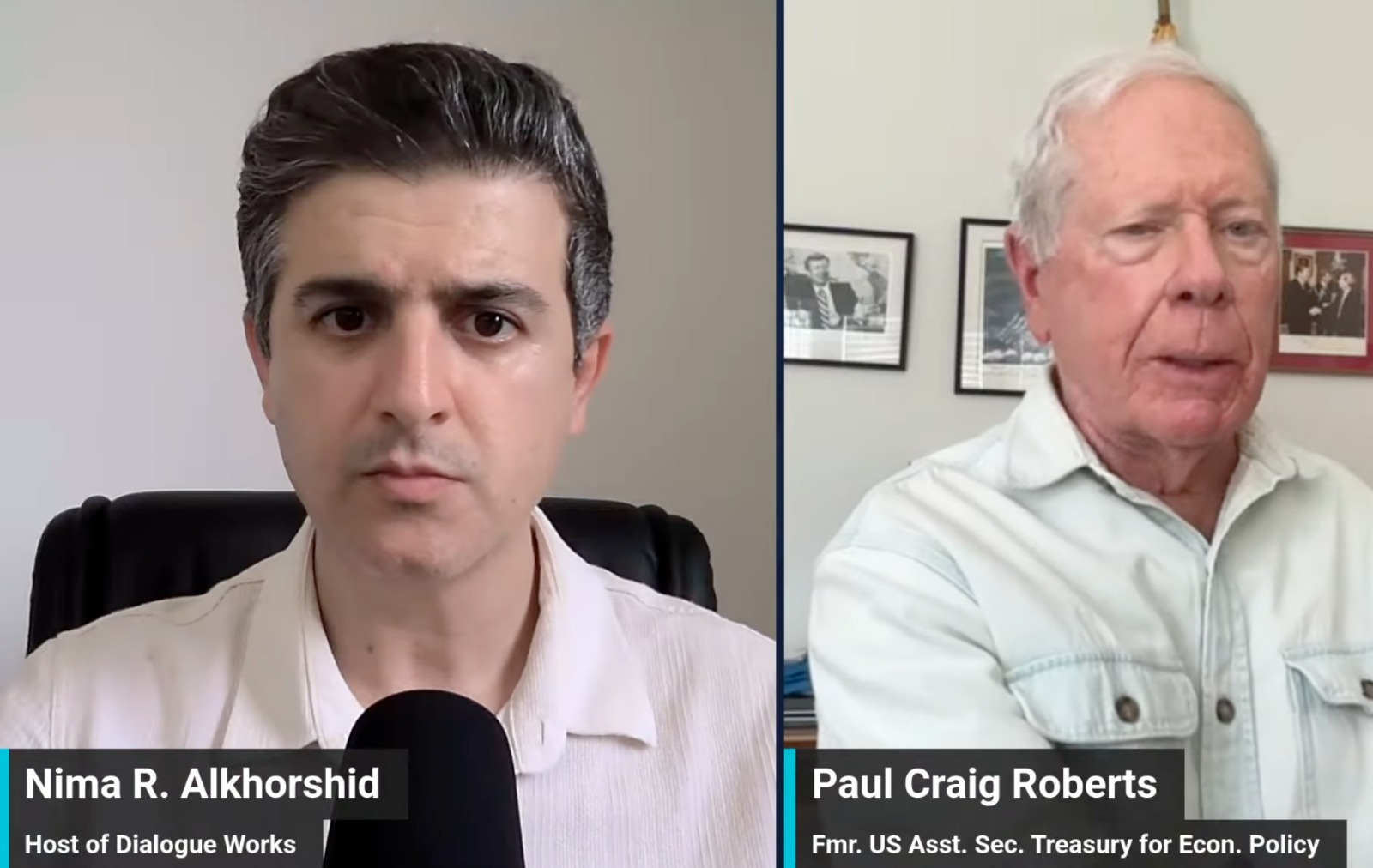

The following is the transcript of a live interview with Paul Craig Roberts, conducted by Nima R. Alkorshid, host of Dialogue Works, and broadcast on February 23, 2026.
In this extensive conversation, Roberts examines escalating U.S.–Iran tensions, the role of Israel in shaping American Middle East policy, and the broader geopolitical implications surrounding the concept commonly described as “Greater Israel.” The discussion addresses recent statements by U.S. officials and explores the strategic and political risks of a potential military confrontation.
This text is a cleaned but complete transcript of the original broadcast. Minor verbal repetitions, false starts, and spoken-language irregularities have been edited for clarity, while preserving the full substance, meaning, and context of the speakers’ remarks. No arguments or substantive statements have been added or removed.
We are publishing the transcript to provide readers with direct access to the arguments as presented during the live discussion, at a moment of significant geopolitical volatility.
The full original broadcast can be viewed here:
https://www.youtube.com/live/r5OG9uEdVgs
Kritik Bakış
——————
Nima: Hi everybody. Today is Monday, February 23rd, 2026, and our dear friend Paul is here with us. Welcome back, Paul.
Paul: Thank you, Nima.
Nima: Before we start, please hit the like button. It helps us reach more people.
Paul, let’s begin with the current situation between Iran and the United States. Anyone watching this escalation between the two parties might conclude that war is coming between Iran and the United States.
Here is what Steve Witkoff said yesterday about the way Donald Trump is thinking about the conflict between the United States and Iran.
Clip – Steve Witkoff
Interviewer: Red lines here from the U.S.—how about over with Iran?
Witkoff: The president asked me that this morning. I don’t want to use the word “frustrated.” It’s almost that he understands he has plenty of alternatives—but he’s curious. He’s curious as to why they haven’t—I don’t want to use the word “capitulated”—why they haven’t capitulated.
Under this sort of pressure, with the amount of sea power and naval power that we have over there, why haven’t they come to us and said, “We profess that we don’t want a weapon, so here’s what we’re prepared to do”?
And yet it’s hard to get them to that place.
Nima: Paul, what would be your answer to what the president is asking? What does “capitulation” mean in this context? Do you see capitulation coming from the Iranian government?
Paul: Well, Nima, what the Trump–Iranian peace talks were supposed to be about was achieving an agreement in which Iran agreed not to make nuclear weapons—something Iran had previously agreed to, only to have that agreement later jettisoned by Washington.
There is no obstacle to Iran again agreeing not to make nuclear weapons. As far as I can tell, the Iranian government has made it completely clear that they are willing to enter such an agreement. They have never claimed they wanted nuclear weapons.
So from the standpoint of the original purpose of the negotiations, there is no problem.
What happened in the middle of these negotiations is that the Israeli prime minister came to Washington and inserted another demand. That demand is that Iran must also give up its conventional military capability—its missiles—turn them over, and cease producing them.
That was not what Iran agreed to negotiate. And it makes no sense whatsoever for Iran to render itself defenseless against an Israeli attack.
It’s clear that Netanyahu knows that if Trump accepts this added condition, the negotiations will fail.
As I wrote some days ago, Trump crawled out on a limb with threats and deadlines, and Netanyahu came up behind him and sawed the limb off.
If Trump tells Iran that it is not enough to forego nuclear weapons—that they must also give up conventional missiles—then the negotiations collapse. At that point, Trump must either back down from his threats or carry them out. And carrying them out would mean attacking Iran, which is what Netanyahu intends.
We do not yet know whether Trump has decided to include this demand. The Wall Street Journal reported that the administration is discussing whether to add the missile requirement. That indicates Netanyahu has made progress, but no final decision has been made.
Apparently, there is opposition within the Trump administration to expanding negotiations beyond nuclear weapons.
So we will see.
The neoconservatives will want the missile provision included. The military-security complex understands that adding it corners Trump—either he backs down or he attacks. And they assume he won’t back down. War means profits.
So the key question is how influential the voices are within the administration who oppose adding Netanyahu’s demand.
We don’t know that war is coming. We will know when we see whether Trump adds the missile condition. That would signal the collapse of negotiations.
Trump understands that if negotiations fail, he must either retreat from his threats or follow through. Everyone in his administration must understand that accepting Netanyahu’s demand likely means war with Iran.
There are several determining factors.
First: Is Trump comfortable standing up to the Israel lobby and the military-security complex? Does he feel secure enough to do that?
Second: Do they fully grasp the risks of war with Iran?
Iran demonstrated in the so-called 12-day war with Israel that it has effective conventional capability. Its missiles penetrated the Iron Dome and inflicted enough damage that Israel requested a ceasefire.
There may be even greater risks if former British diplomat Alastair Crooke is correct. He has reported that China may have provided Iran with a battlefield control system—satellite-based, full-spectrum battlefield management.
If that exists and Iran possesses it, then no American aircraft within 700 kilometers of Iran would be safe. They could be destroyed before reaching Iranian territory. That includes stealth fighters and bombers.
No American naval vessel—aircraft carrier, destroyer, anything—would be safe. U.S. bases in the region could be targeted and destroyed. Many are not heavily fortified against this kind of attack.
If that assessment is correct and Trump understands it, then he must consider the possibility of severe losses. If the U.S. suffers heavy losses, the demand for revenge will be enormous. The only form of escalation left would be nuclear.
And then the question becomes: Can he do that? Can he get away with it? What would Russia and China do? What would regional allies do?
These questions have not been seriously debated publicly.
So I do not believe a final decision has been made.
There are also logistical constraints. Forces cannot remain on station indefinitely. Troops wait, supplies diminish, readiness deteriorates. Aircraft cannot sit in combat posture forever.
Time pressures are pushing toward a decision.
At this point, I don’t think anyone can reliably predict the outcome.
I remain hopeful that Trump will stand up to Netanyahu, because the cost of resisting him is far lower than the cost of war.
Nima: What sort of threat is Iran posing to the United States that Donald Trump—who ran on a peace platform, promising fewer wars, more domestic production, bringing jobs back, “Make America Great Again”—would go this far and risk starting a new war in the Middle East?
Many Americans voted for that message because it resonated with them. They wanted change. So what threat does Iran pose that would justify such a move?
Paul: First of all, it’s not a new war.
It has been going on since 9/11 in 2001, when the World Trade Center attacks were used to justify the use of American blood and money to clear opponents to Greater Israel out of the Middle East.
Iran just happens to be the last real barrier to the expansion of Israel from the Nile to Pakistan.
So this is not a new war. It is an ongoing war that has been underway for a quarter of a century. It has destroyed Libya, Iraq, Syria, Somalia, Sudan, and done considerable damage to Lebanon.
There is nothing new about it. It is a continuation.
Now, what has Iran done to the United States?
Nothing whatsoever.
There have been no threats. No attacks. Nothing.
So why is Iran designated a terrorist state by Washington? Because the Israel lobby demands it.
If you are setting up a country to be destroyed by the Americans—as Israel has been trying to do for decades—you need a justification. So you persuade the Americans to designate Iran a terrorist state.
But who does Iran terrorize?
Who are the real terrorist states?
The United States and Israel.
The United States kidnaps heads of state, brings them back to America, and imprisons them. Israel routinely assassinates Iranian leaders, Lebanese leaders, Houthi leaders. They are constantly carrying out assassinations.
Think about the number of assassinations Israel has conducted in recent years.
Who has Iran assassinated?
Can you name a terrorist act by Iran?
I cannot think of one.
The Israelis argue that Hamas, Hezbollah, and the Houthis are Iranian proxies.
Nima: Iranian proxies, you mean.
Paul: Yes, Iranian proxies.
But does Hamas have no independent reason to oppose Israel, given what has happened in Palestine since 1947?
Do the Houthis have no independent reason to oppose Israel?
Is Hezbollah’s opposition to Israel not grounded in repeated Israeli incursions into southern Lebanon?
To claim that these groups act only for Iranian purposes is nonsense—utter nonsense.
You might say Iran supplies them with weapons; therefore, they are proxies.
But the United States supplies weapons to Israel.
Does that make the United States an Israeli proxy?
If Hezbollah is a proxy of Iran, then the United States is a two-bit proxy of Israel. You cannot logically have one without the other.
So the entire notion of Iran as an enemy is, in my view, a hoax. It has been created by Israeli propaganda and institutionalized through American policy.
There has not been an independent American Middle East policy since 9/11.
Nima: Do you feel the Pentagon is giving the president the correct assessment regarding conflict or war with Iran? We remember during the Biden administration that the Pentagon resisted allowing long-range missile transfers to Ukraine, warning of escalation. How do you see the Pentagon today?
Paul: I don’t know.
What I do know is that there are some officers who understand that we do not really have a dispute with Iran—that this is Israel’s dispute.
They also understand that the risks involved are unpredictable and difficult to control. You do not want to enter a war of choice when you cannot control escalation.
This war is not being forced on the United States by Iran. It is being forced by Netanyahu.
And yet it carries dangers that are unpredictable and not controllable.
Apparently, some officers have made their concerns known to elements within the Trump administration who are hesitant to expand the negotiations to include Netanyahu’s demand that Iran be completely demilitarized—not just prevented from developing nuclear weapons, but denied any ability to defend itself.
Whether those voices will be influential enough for Trump to stand up to Netanyahu, I cannot say.
Historically, Trump has done what the Jewish lobby wanted. For example, moving the U.S. embassy to Jerusalem—implying that Jerusalem is exclusively a Jewish city rather than a shared city. That move was unnecessary except as a response to Netanyahu’s wishes.
So we do not know how this will unfold.
There are also time constraints—not just Trump’s 15-day timeline—but logistical constraints. Attack forces cannot remain on station indefinitely.
Within three or four weeks, there will likely be a decision. If it is the wrong one, the consequences could be catastrophic.
It could even be that Netanyahu wants catastrophic consequences.
Imagine if Alastair Crooke is correct and Iran possesses this battlefield control system. Suppose the United States loses aircraft carriers, stealth fighters, and bombers—blown out of the sky—while Iran suffers minimal damage.
The demand for revenge in the United States would be enormous. People would be screaming about those terrible Iranians and Muslims. Soon they would be blamed for 9/11. Then the cry would come: “We have to nuke them.”
That is what Netanyahu wants.
He may be putting vast numbers of people at risk of annihilation in order to clear the path for Greater Israel.
You have to understand: this is of utmost importance to the Zionist vision.
The claim is that God gave them all the land from the Nile to the Euphrates. That claim has now been expanded by elements within the Israeli government to extend all the way to Pakistan.
That would mean there is no Saudi Arabia.
This goal has been pursued step by step for decades.
And now they may see an opportunity.
That is the real reality—not the manufactured narrative that Iran is attacking us.
Everybody thinks Iran is doing something to us, but no one can explain what it is.
I have asked people: “What have they done?”
There is no answer.
But they believe it.
That is perilous.
It also shows a complete breakdown of the American foreign policy establishment. Look at Foreign Affairs, the Council on Foreign Relations, the universities.
There is no sign of serious intelligence about what is actually happening.
It is make-believe.
“Iran is a terrorist state.”
But the aggression comes from Israel.
And no one says that.
They may not even realize it. They are so indoctrinated they cannot think outside the narrative.
That means there is very little support for those military officers who understand the danger.
I always hope intelligence prevails.
It seldom does.
Nima: I think part of the pressure you’ve mentioned from Netanyahu on Donald Trump is also coming from within the United States. Tucker Carlson recently interviewed the American ambassador to Israel, Mike Huckabee. In that interview, he revealed something about the mindset of Christian Zionists and how they are willing to sacrifice American interests for Israel.
How do these people—who were born and raised in the United States—come to identify as “Israel first” rather than “America first”? And how are they so influential, especially at a time when the global balance of power is shifting and the United States faces major strategic challenges elsewhere?
Do they truly care about the future of the United States?
Paul: There are two main factors.
First: money.
Israeli interests can financially support their allies and politically destroy their opponents. They have demonstrated this for decades. They can influence congressional races. They can reach into universities and block tenure for critics. They can end media careers overnight.
No one in the mainstream media can speak against Israel and keep their job.
Second: narrative.
The Holocaust has been used to frame Israel as a permanent victim. And in modern psychology, the victim can never be guilty. The victim is always the one who suffers wrong.
So Israel is always portrayed as the victim—even in Palestine, even in Gaza.
This narrative has been drilled into generations of Americans. It is generational indoctrination.
And the latest slogan among conservatives is this: you cannot be an American if you do not love Israel.
These are the same conservatives who once opposed foreign entanglements.
Over decades, this has shaped how Americans perceive Israel. At the same time, anyone who criticizes Israeli dominance of American foreign policy has faced punishment.
Very few people are in a position to speak openly.
I do not believe there is a single university professor who would dare say publicly what I am saying. They would lose tenure and be labeled antisemitic.
As we speak, there is an effort in the Texas legislature to mandate that schoolchildren and educational institutions be instructed in Israeli narratives—Holocaust framing, permanent victim status, and so forth—as a compulsory part of education.
Texas, of all places.
That shows enormous power.
The Israel lobby will support candidates financially if they vote the “right” way. If they vote the “wrong” way, funding goes to their opponent.
That is how the lobby operates.
And the ADL—the Anti-Defamation League—functions as the slander mechanism. Anyone who says something contrary to Israeli interests is labeled antisemitic.
Discussion becomes nearly impossible.
I doubt the Secretary of State, the Secretary of Defense, or the National Security Council could speak in these terms.
You certainly could not publish this analysis in Foreign Affairs.
So it becomes nearly impossible to explain the risks.
Why should the United States risk everything for Greater Israel? We have no real stake in that outcome.
Even a four-star general would see speaking this way as career suicide. Post-retirement prospects would disappear—no consulting contracts, no defense board positions, nothing.
So the probability of a bad decision is much higher than the probability of a good one.
If Trump refuses Netanyahu, the lobby will turn on him. If he complies and loses a war, the pressure to escalate—possibly to nuclear weapons—would be enormous.
These are the real stakes.
And yet almost no one understands them—or is allowed to say them.
Foreign Affairs would not publish this. The Wall Street Journal would not publish it.
But I am independent.
So I can say it.
And it should frighten us deeply.
Nima: I’m sure you watched Tucker Carlson’s interview with Mike Huckabee. Let’s play that clip.
Clip – Tucker Carlson & Mike Huckabee
Carlson: Genesis 15 says Abram—before Abraham—was promised that his descendants would inherit the land from the Euphrates to the Nile. That would include essentially the entire Middle East—Israel, Jordan, Syria, Lebanon, and parts of Saudi Arabia and Iraq.
Huckabee: It would be a large piece of land. The point is that Israel is land God gave through Abraham to a chosen people. It was a people, a place, and a purpose.
Carlson: You’ve said three times that God gave that land to this people. So what land are we talking about? Genesis says from the Nile to the Euphrates. Does Israel have a right to that land?
Huckabee: It would be fine if they took it all.
Paul: What Huckabee is doing is confirming Greater Israel.
Israeli leaders speak openly about Greater Israel. Netanyahu has held up maps labeled “Greater Israel.” Later ministers said the maps were amended—first including half of Saudi Arabia, then extending toward Pakistan.
So when people call Greater Israel a conspiracy theory, I say: it is an Israeli claim. Huckabee just acknowledged it as a divine mandate.
It explains the War on Terror.
The War on Terror removed Arab states that stood in the way: Iraq, Libya, Syria.
And it is not over. Lebanon, Iran, Saudi Arabia—they remain.
Israel cannot achieve this alone. They use the United States.
What terror acts justified the War on Terror? None.
Huckabee said it openly.
And I am confident Trump aligns with that perspective.
The George W. Bush administration initiated the clearing out of the Middle East. 9/11 served as the pretext. It created the “new Pearl Harbor” that neoconservatives said was necessary.
Norman Podhoretz wrote about seven countries to be destroyed in five years.
Years later, General Wesley Clark confirmed that such a plan existed.
The goal was obvious: clearing the Middle East for Israel.
Look at what remains of the Arab world—fragmented states, small oil monarchies hosting American bases.
Greater Israel is practically already achieved in geopolitical terms.
Iran is the last obstacle.
Iran cannot avoid being a target unless it capitulates.
There is no agreement short of surrender that would permanently remove the threat.
That is the realistic picture.
Everything else is illusion.
And that is why this situation is so dangerous.
Nima: As you mentioned, General Wesley Clark spoke publicly about the “seven countries in five years.” People can find that on YouTube.
Paul: Yes, but that same idea was discussed earlier by Norman Podhoretz in Commentary magazine. It was also reflected in neoconservative documents such as the Project for the New American Century. It was openly discussed.
Americans simply do not know this. They have no comprehension of the risks they are being pushed toward.
If Trump stands up to Netanyahu and refuses, my respect for him would increase. I would be pleasantly surprised.
If he were to say, “I came here to ensure they do not develop nuclear weapons. You are sabotaging the negotiations. Go away,” that would give us hope.
But if he does that, the Israel lobby will turn on him with fury. And the Americans who believe you cannot be American unless you love Israel will turn on him as well.
He is trapped.
If he stands up to Netanyahu, he risks losing political support.
If he does not stand up, he risks losing a war.
And if the war goes badly, the cry will be: “Nuke them.”
Then everything escalates very quickly.
Who is the instigator?
Zionist Israel.
Not all Jews are Zionists. Historically, Zionists were a minority. But within Israel today, they appear to be the majority.
Even Israeli Jews who oppose these policies are marginalized. They are labeled “self-hating Jews.” That label carries an implicit accusation of sympathizing with Hamas or Iran.
There was once a group called Israelis Against Home Demolitions. They tried to prevent settlers from entering Palestinian villages with heavy American-manufactured Caterpillar equipment used to destroy homes and uproot olive trees.
Members of that group came to the United States and appealed to the Presbyterian Church to divest from Israeli companies involved in settlement expansion.
I hosted some of them.
The church was too afraid to take a stand.
The group eventually diminished.
I even nominated their leader for the Nobel Peace Prize. It went nowhere.
So I am not speaking without exposure to Israelis who oppose these policies.
Some of them see current Israeli policy as morally destructive—even contrary to the biblical narrative.
When Genesis is cited regarding land promises, what is rarely mentioned is that later in the Bible, God expels the Israelites from the land for wrongdoing. The Jewish people were dispersed among the nations. The nation of Israel was destroyed.
That happened after the Genesis promise.
That promise was revoked because of sinfulness.
That is in the Old Testament.
The modern Zionist project involved persuading Britain—when Palestine was a British protectorate—to transfer control. Britain granted only part of it initially. Expansion continued year by year.
With Syria, Iraq, and Libya destroyed—with American assistance—the expansion continues.
We return to the starting point.
Iran is the target.
There is no agreement Iran can make, short of surrender, that will remove that target.
I doubt Iran fully understands the theological and ideological framework driving this hostility. They know they are hated—but they may not understand why.
Everything I have said reflects my assessment of the truth.
Nima: Thank you, Paul, for being with us today. It’s always a pleasure.
Paul: Thank you, Nima. Send me the URL.
Nima: I’ll send it right away.
Paul: Goodbye.