 Karam Nama

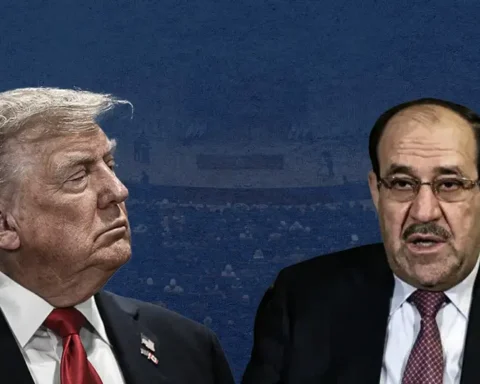
Nouri al-Maliki has never been the solution for Iraq. Not during his eight years in power. Not in the decade that followed his departure. And not during the country’s long collapse since 2003. He has always been part of the problem, never the solution. Today, amid growing talk of his potential return to the premiership, Iraq seems to be deliberately heading back towards the very tragedy it has spent 22 years trying to escape. It is as if two decades of failure, corruption and institutional decay were not enough to convince the political class that ruin cannot be recycled. Al-Maliki’s return is not a routine political development; it is a historical relapse that takes Iraq back to square one — to the moment when all its crises began: sectarianism, corruption, state collapse and the rise of ISIS.
This week, I reviewed an American study with limited circulation that offers a stark and detailed picture of the disaster awaiting Iraq should al-Maliki return to power. The study states: ‘Al-Maliki no longer holds the influence he once had, and his current alliances are the product of Iranian pressure rather than his own political strength.’ This sentence encapsulates the situation perfectly: al-Maliki is returning not because he is capable, but because he is required — by Iran and its militias in Iraq. He is returning not with a vision, but as a component of a larger project. He is the weakest link in Iran’s chain of influence — a figure that Tehran prefers precisely because he is malleable, not independent. This alone makes his comeback a recipe for renewed instability. Iraq does not need a weak man driven by sectarian resentment; it needs a state capable of protecting itself from such individuals.
Even within the Coordination Framework—the umbrella of Iran aligned parties and militias—al Maliki is not a “leader of the moment,” but a burden of the past. The study states: “Al Maliki’s return will trigger protests and intra Shiite tensions that could escalate into armed confrontation.” One must remember that Muqtada al Sadr still carries a deep resentment toward al Maliki—first for fighting him militarily, and second for blocking him from forming a government after his electoral victory. This is an accurate description of al Maliki’s standing within his own camp: he is a fierce enemy of the Sadrist movement, a nemesis of the October protest generation, and a symbol of corruption and Iranian subservience. His return would reignite fault lines within the Shiite community itself, turning Baghdad into a battleground for factions united only by mutual hostility. Al Maliki does not understand that today’s Shiites are not the Shiites of yesterday—no longer captive to the mythology of sectarian rule—and that the October generation will not accept the return of a man who embodies the worst of Iraq’s political system.
For Iraqis, al-Maliki is more than just a politician; he is a symbol of a dark era. The study notes: ‘Al-Maliki represents a retaliatory state that practised exclusion under the banners of de-Baathification and the criminalisation of Sunni communities.’ This is not merely an academic observation — it describes a wound that has never healed. His return would revive exclusionary politics and sectarian rhetoric, creating the sense that the state belongs to one group alone. This alone would be enough to push Sunnis towards one of three responses: withdrawal, boycott or uprising. All three would recreate the conditions of 2013–2014, the years that paved the way for ISIS. Al-Maliki has never understood that exclusion does not build a state, but rather a monster waiting beneath the rubble.
The Kurds know al-Maliki equally well. They are familiar with his volatility, broken promises and confrontational approach to oil, territory and federal authority. The study warns: ‘Al-Maliki’s return could push the Kurds once again towards independence.’ This is not an exaggeration, but a sober reading of history. The man who triggered the 2014 crisis with Erbil and helped drive the Kurds towards the 2017 referendum is fully capable of reopening the same wound. Al-Maliki does not understand that Iraq cannot be governed through an overbearing central authority and that the Kurds will not accept political blackmail again.
The available indicators also suggest that Iran does not want al-Maliki because he is strong, but rather because he is weak enough to be controlled. As the study puts it: ‘Iran is pushing al-Maliki forward on the condition that he remains weak and under its supervision.’ Therefore, his return is not an Iraqi decision, but part of Tehran’s attempt to recalibrate its influence after regional setbacks. To Iran, al-Maliki is not a leader, but an instrument — someone who can achieve what others cannot and who can be discarded once he is no longer useful. This alone makes his return dangerous for Iraq, which does not need a prime minister who functions as a political proxy for a foreign state.
The entire region would pay the price if al-Maliki returns. The study warns: ‘Al-Maliki’s return will push Saudi Arabia and the UAE to freeze investments, Turkey to escalate militarily, and the United States to impose sanctions.’ This would mean Iraq entering a phase of regional and international isolation once again, precisely as it did under al-Maliki’s previous tenure. He does not understand that the world has changed and that Iraq cannot survive in isolation. No economy can grow while clashing with every major regional and global actor.
The study outlines four possible scenarios for al-Maliki’s return, all of which are bleak: a weak and besieged government that collapses within two years; renewed sectarian violence, including clashes between Shiites and Sunnis; an impossible national reconciliation that contradicts his entire record; or a deceptive international consensus that leads to prolonged regional conflict. None of these scenarios is hypothetical — they are the natural continuation of his previous rule. Al-Maliki does not understand that time does not move backwards and that the Iraq he left in 2014 is not the same country he would return to today.
The conclusion is clear: al-Maliki’s return is not just a political mistake; it is a historical sin. It would be the resurrection of a period that produced ISIS, empowered militias, exacerbated divisions and brought Iraq to the brink of collapse. What Iraq needs today is a state, not a man living in a lie of his own making. It needs a national project, not a leader driven by sectarian hostility towards the majority of his own people. Iraq needs a future, not a replay of the events that once destroyed the country. Al-Maliki’s return is not an option — it is a step backwards, a return to the tragedy that Iraqis believed they had left behind, only to see it reappear in a more fragile, dangerous and explosive form.
Source: https://www.middleeastmonitor.com/20260125-nouri-al-maliki-the-old-disaster-in-a-new-wrapper/