

 Ahmet Demirhan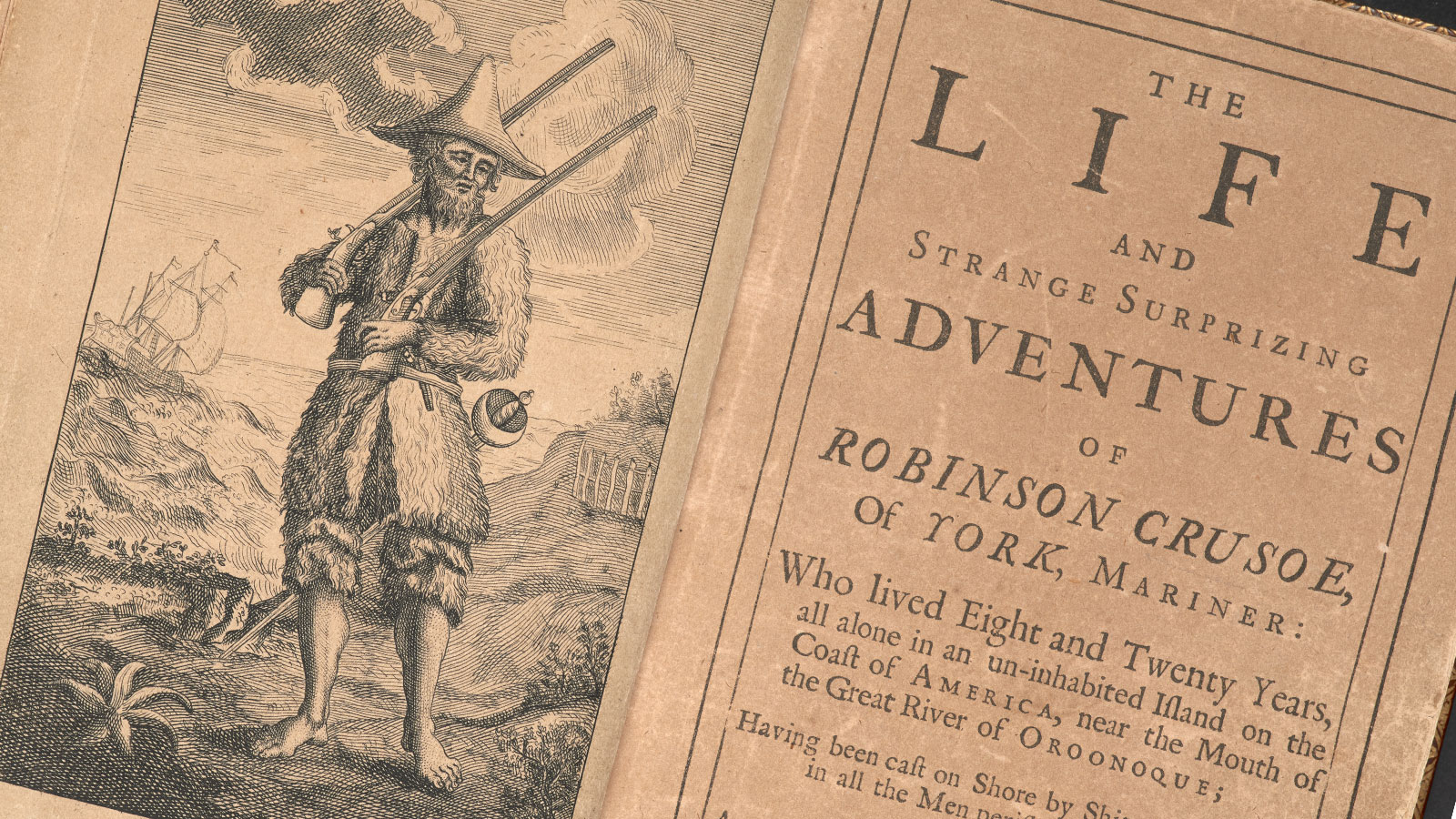

Daniel Defoe published his work in April 1719 under the long title The Life and Strange Surprizing Adventures of Robinson Crusoe, of York, Mariner: Who Lived Eight and Twenty Years Alone on an Uninhabited Island on the Coast of America, near the Mouth of the Great River of Oronoko; Having Been Cast on Shore by Shipwreck, Wherein All the Men Perished but Himself; With an Account of the Strange Story of His Deliverance by Pirates, Written by Himself. In later years it came to be referred to, in shortened form, as The Life and Strange Surprizing Adventures of Robinson Crusoe, of York, Mariner; yet in our own time—since it has acquired the status of the first novel of what is called Western literature (that is, of world literature, and more specifically of its English beginning)—it has been presented under the almost neutralized name Robinson Crusoe. To undertake a critical reading of a novel that has been dissected in every respect will not be easy. Beginning with questioning how the successive choices of title have passed through a process of canonization; how certain elements of the novel have been pushed into the background while others have been brought to the fore; how it has reached the present day as if passed through a sieve—like the “quite useful” sieve Robinson fashioned (p. 143), since none was among the tools he salvaged from the ship, in order to separate the flour of wheat from the bran when making bread—being sifted and diluted along the way; how it has today been reduced to such elements as the island, solitude, individualism, survival under harsh conditions, and the economic individual; how it has been turned into everyone’s novel, a novel that tells the story of everyone, thereby confronting any critical reading of Robinson Crusoe today with a vast cluster of problems—this much is beyond dispute. Indeed, how could the adventures of a mariner from York—whose father was not even originally from there—have become everyone’s story? Especially when, as the novel’s original title makes clear, in the shipwreck “everyone” dies and only one man, Robinson Crusoe himself, survives?
Akşit Göktürk, the Turkish translator of Robinson Crusoe, offers an explanation for this in the preface he wrote for his translation: Robinson Crusoe is “the epic of the ordinary person—of ‘everyone’—who, in the Age of Enlightenment, stands before the universe, striving to break with traditional rigidities and to transform the world through the power of reason” (p. 14). Ian Watt, too, in The Rise of the Novel, his study of Defoe, Richardson, and Fielding, endorses Göktürk’s notion of this “everyone,” albeit in a further diluted form, and defines the novel as the novel of “Crusoe (and indeed of all of us)” (p. 137); yet his “everyone” is the “economic individual.” Katherine Clark, who has also written one of the most interesting biographies of Defoe, in her work Daniel Defoe: The Whole Frame of Nature, Time and Providence, offers yet another “everyone,” writing it with a capital letter as if to draw the claim that Crusoe is “everyone” in bolder strokes: “By imposing his will upon the natural world and learning to submit to the all-encompassing will of God within it, Crusoe becomes Everyone” (p. 113).
Three elements stand out in these definitions of “everyone”: the Age of Enlightenment, the economic individual, and a Puritan character who imposes his own will upon nature while submitting to the will of God. Therefore, approaching Robinson Crusoe as a novel within the framework of universality, island consciousness, and the nature of the personality that produces this consciousness—and evaluating these particularly in relation to their counterparts in philosophical traditions in order to show how the novel has been subject to different interpretations over time—is of particular importance for any attempt to approach Robinson Crusoe. This method will, on the one hand, make it easier for us to confront the problems generated by the vast body of scholarship on the novel, and on the other, enable us to demonstrate how the novel has been passed through a sieve, abstracted and universalized, and—so to speak—how a figure who in fact has a place and a homeland has been presented as if rootless and placeless and thereby claimed for “everyone.”
Of the three elements, placing Robinson Crusoe within a “robinsonian” (robinsonade) framework in relation to the Age of Enlightenment, and thereby abstracting it, is a frequently employed method. The most famous example of this comes from Jean-Jacques Rousseau. For Rousseau, Robinson Crusoe—stripped of its excess burdens (that is, of all the narratives outside the island)—serves as a reference book both for his own autobiography and for the pedagogy of Émile, in which he recounts the stages of the educational life, from infancy to adulthood, of a child whose tutorship he undertook in order to demonstrate how education ought to be. However, for Rousseau the novel begins on the island and ends on the island; indeed, the adjective “robinsonian” derives precisely from this: a hermit condemned to live alone on an island. Rousseau’s Reveries of the Solitary Walker is devoted to such “robinsonian” wanderings and signifies, for Rousseau, an autobiographical Robinsonhood. Moreover, his taking refuge on a small island in a lake near Geneva—after he was forced to flee when his house in Neuchâtel was stoned—is presented as both the happiest and at the same time a “sweetly sorrowful” period of his life, not merely as an imaginary but as an actual Robinsonhood (pp. 80–94). Rousseau’s autobiographical Robinsonhood emerges in bolder lines in another work, Judge of Jean-Jacques: Dialogues, in which he judges himself in the form of a Socratic dialogue and where, in fictional terms, a “Frenchman” poses the questions and Rousseau provides the answers. There Rousseau says of himself: “In him I perceived a unique and almost unbelievable condition: in the middle of Paris, a solitude greater than that of Robinson on his island.” Rousseau identifies with Robinson Crusoe to such a degree that it might even be said that he “knowingly assisted those who persecuted him [that is, those who conspired the ‘universal plot’ against him] in making him more isolated.” While others “worked ceaselessly to keep him apart from other people, he too withdrew ever further from others and from them” (pp. 128–129). In this respect Rousseau is a double Robinson: both a voluntary and an involuntary Robinson.
However, the attitudes generally adopted toward him in the circles in which he lived, the intrigues carried out behind his back—what he called the “universal conspiracy,” and which has sometimes been explained, for example, through Voltaire’s attitude toward him—also compel him toward a robinsonian condition. According to Rousseau, “whatever the motive that provoked the formation of the conspiracy, a conspiracy there is” (p. 81); yet in Reveries of the Solitary Walker he attributes this to an interesting cause, a celestial will. That is to say, the reason for his robinsonian condition is celestial: “The convergence of so many unexpected circumstances in order to form a common conspiracy, the rise of my most ruthless enemies—so to speak by a twist of fate—the inclusion, as if specially selected, of all the rulers of the state, all those who shape public opinion, all persons of authority and influence, all those who secretly bear me ill will, in this common conspiracy—this universal accord was far too extraordinary to be mere chance. A single person opposing the conspiracy, a single event standing against it, a single unforeseen obstacle would have been sufficient for its failure. But all individual wills, all necessities, fortune itself, and all profound changes strengthened the efforts of men; and the incredible convergence of circumstances left me no doubt that the complete success of their designs was the eternal will of Heaven.”
This means that the “universal conspiracy” that persecutes Rousseau is at the same time the command of a “celestial and eternal will,” and Rousseau, precisely because it is so, assists it himself, surrendering with his own hands to that will. In this sense the distance between Rousseau and Crusoe is not very great; for Crusoe too, even if he does not call it a conspiracy, explains what happens to him as something ordained for him by Heaven, and thus almost meets Rousseau—who experienced changes of faith, first Calvinist, then Catholic, and then Calvinist again—at the same point. [Here it may be useful to open a parenthesis and refer to a remark by Paul de Man in Blindness and Insight: de Man argues that what Romanticism places opposite the subject and calls “nature” is in fact “Providence” in Protestantism, or at least that the prehistory of Romanticism cannot be thought without thinking “Providence”; he situates Rousseau within this framework and, moreover, in the relationship between Robinson and Rousseau, he places Daniel Defoe not in the camp of modern realism but in that of “the Puritan religious element to which Rousseau was responding” (pp. 216–259).]
However, the most striking aspect of Rousseau’s Crusoe is that, apart from the autobiographical Crusoe, he also constructs a pedagogical Crusoe. In Émile, or On Education, Rousseau begins by saying, “I do not like books; they speak only of things we do not know.” Yet, since a child’s education cannot be without books, he searches for a single book that could bring together all the others and states that he has found it: “Since we must have books, there is one which, in my opinion, is the supreme book of natural education. This will be the first book my Émile will read, and for a long time it alone will constitute his entire library.” What is this rare, “extraordinary” book? “Is it a book by Aristotle? By Pliny? By Buffon?” The answer is none of these; it is Robinson Crusoe. For “the surest way to overcome one’s prejudices and to arrange one’s thoughts according to the true relations of things is to put oneself in the place of an isolated man and to evaluate everything exactly as this man would evaluate it, taking his own benefit into consideration” (pp. 204–210). This means that the surest way for “everyone” to free themselves from their prejudices and to order things according to their real relations is for “everyone” to place themselves in the position of the “isolated man” and to evaluate “everything” as Robinson would evaluate it, considering it in terms of his own benefit. At this point we move away from the novel and approach Kant.
Whether Kant actually read the novel would require separate investigation; nevertheless, we know at least that he was aware of it from the references he makes to it in The Critique of the Power of Judgment. Although these references appear in different contexts, they can still be considered interconnected. According to Kant, the desire to escape society, the desire to remain alone, and the desire to live self-sufficiently on an island or on a farm “is regarded as something sublime if it rests on ideas that disregard all sensory interest.” The essential condition here is not to flee society, but rather to be able to rise above the need for society: “To be self-sufficient, therefore not to need society, and yet to be so without being unsociable, … without fleeing society—this is something that approaches the sublime.” Comparing this form of escaping society without fleeing it, which befits the sublime, with misanthropy and anthropophobia, Kant considers the desire to withdraw from society that arises from these motives to be “something repulsive and, to some extent, contemptible.”
However, there is also a condition mistakenly called misanthropic, which constitutes an exception: “There is undoubtedly a misanthropy (very improperly so called) toward which many well-thinking people frequently show an inclination as they grow older; although it is certainly sufficiently philanthropic as far as benevolence is concerned, through long and painful experience it has moved far away from delight in human beings. The evidence of this lies in a tendency toward seclusion, a dreamlike wish for some distant rural retreat, or (in the case of the young) the fantasy of happiness spent on an island unknown to the rest of the world with a small family—a dream that novelists or writers of Robinson stories [Robinsonaden] know very well how to exploit” (p. 139). This means that the desire for social withdrawal without seeking any advantage from it, without expecting any benefit from it, in a philanthropic spirit—such as the desire for an imaginary adventure of withdrawing from society for one reason or another while remaining philanthropic, as told in robinsonian narratives—is different from the desire to flee society out of hatred of humanity or fear of human beings. One of these is sublime, whereas the other is repulsive.
However, what constitutes the difference between these two? Unlike the first two Critiques, which posit the transcendental conditions of knowing and willing a priori, the feeling of the beautiful discussed in the third Critique—where the conditions of the faculty of judgment must necessarily be derived from the empirical—and the concept to be obtained from it can be reached “only in society.” Yet since a priori knowledge cannot be social, but concerns human beings only insofar as they are rational beings, how will a transcendental construction of the social use of the faculty of judgment be possible? Clearly through what Peter Szendy—marvellously naming it in his Kant in the Land of Extraterrestrials—calls the “cosmetic motive” (p. 61). Kant says in the Critique of the Power of Judgment: “A man abandoned alone on a deserted island would adorn neither his hut nor himself, nor would he seek flowers or cultivate them in order to decorate himself with them; rather, it would occur to him only in society to be not merely a human being but a refined human being according to his kind (the beginning of civilization); for we judge someone to be such who is both inclined and able to communicate his pleasure to others, and who cannot be satisfied with an object if he cannot share the liking for it with others” (p. 164).
The metaphor of the deserted island here does not very strongly evoke Robinson Crusoe. For we know that Robinson, while on the island, made various “cosmetic” arrangements beyond meeting his basic needs: he decorated the environment in which he lived and even created for himself a kind of summer residence. Nevertheless, the adjective “deserted,” used mostly to qualify an island but sometimes also a desert, appears several times in the Critique of the Power of Judgment. For instance, the example of the “deserted island,” which Kant employs in order to object to the claim that tastes cannot be disputed and to show that the beautiful, even in its subjectivity, carries a dimension capable of forming a general judgment on behalf of humanity—a judgment arising from the empirical yet not itself empirical—works in this direction (while also noting the strangeness of the example of an Indian chief in Paris): “If someone asks me whether I find the palace before me beautiful, I might say that I do not care for things made merely to be gaped at; or I might answer like that Indian chief who in Paris liked nothing so much as the taverns; or, in Rousseau’s manner, I might reproach the vanity of the great who squander the sweat of the people on such unnecessary things; finally, I might easily persuade myself that if I found myself once again on a deserted island, without hope of ever returning among human beings, and if by mere wishing I could bring such a splendid structure into existence, I would not trouble myself with it at all, provided I already had a sufficiently comfortable hut” (p. 55).
The deserted island here too is “cosmetic.” If others exist, if I am within society, then my conception of beauty has a value. A human being left entirely on his own, even if he counts among rational beings, is deprived of the gaze of others and may therefore be likened to a hut—or to an Indian chief brought to one of the most important centers of civilization who, instead of admiring the beauties around him, prefers a kebab shop.
But how can such a point of view be attained? How can one, while living in society, behave as if one were not living in society—as if one were living on a deserted island or in a desert—and thereby reach that sublime of the faculty of judgment? While Kant indicates that what is “sublime” points to behaving as though one had withdrawn from society while still existing within it, he adds something further: “To be self-sufficient, therefore not to need society and yet to be so without being unsociable, … without fleeing society—this is something that approaches the sublime; just as it is to look down upon one’s needs.” Yet how far one must look down from above is difficult to determine in Kant’s case; behind this difficulty lies not only the question of whether one may attain the felicity of reaching the vastness of the “cosmopolitan” point of view he proposes while considering “universal history” with a “cosmopolitan aim.” In fact, from this perspective Kant’s universe opens so widely toward the cosmos that, in Anthropology from a Pragmatic Point of View, when he approaches “anthropology” from a “pragmatic point of view,” he notes that classifying the human being as a species would be impossible without another rational species comparable to it; in that case the middle term of comparison would be lacking, and thus he opens the problem onto the cosmos itself: “If we compare a species of being known to us (A) with another species of being unknown to us (non-A), how can we hope or demand to indicate a character of the former when the middle term of comparison (tertium comparationis) is lacking for us?—The highest concept of species may be that of the terrestrial rational being; yet we shall not be able to name its character, because we possess no knowledge of non-terrestrial rational beings that would make it possible to display the characteristic property of the terrestrial.—Thus it appears that the problem of indicating the character of the human species is absolutely insoluble; for the solution would have to be found through the experience of comparing two species of rational beings, but experience does not present this to us” (p. 225).
Where, then, can the limit of Kant’s own critique be drawn? For example, by inviting into thought—at least through the power of association—rational beings that are not terrestrial or earthly, say extraterrestrial or alien ones? Or by attaining a cosmopolitan, cosmetic, or pragmatic point of view through living in society as though one were not living in it—looking down upon one’s needs and living like a hermit, or in a robinsonian manner? Kant probably knew Robinson Crusoe through Rousseau, and for him too the novel began on the island and ended on the island.
Yet there is a passage in the novel that comes close to Kant’s “sublime.” In the second of the essays titled “Daniel Defoe,” included in the collection Essays, Articles, Reviews, James Joyce compares a passage from the novel Robinson Crusoe—which he describes as the true symbol of the British conquest of the world: “European criticism, for several generations, tried with not altogether benevolent persistence to illuminate the secret of the immense conquest of the world achieved by that hybrid race which, living a hard life on a small island in the northern sea, had been granted neither Latin intelligence, nor Jewish patience, nor German zeal, nor Slav sensibility … [Yet] the real symbol of the British conquest is Robinson Crusoe, who on the deserted island where he has fallen with a knife and a pipe in his pocket becomes architect, carpenter, grinder, astronomer, baker, shipbuilder, potter, saddler, tailor, umbrella-maker, and priest”—with the vision in which Saint John, on the island of Patmos, witnesses the apocalyptic destruction of the universe and then the shining rise of the walls of the eternal city, the Kingdom of God. Yet this passage concerning the “bare footprint in the sand,” which Crusoe sees as “the single miracle he beheld in all creation,” recalls Kant in two ways.
First, after so many years spent on the island, the moment Robinson sees “the footprint of a naked human foot,” a single footprint whose cause he does not know, which suddenly appears before him and for which, despite searching, he cannot find another like it, he behaves as if he has encountered something truly “sublime.” He is so frightened, so anxious before this causeless trace that not only his capacity for sound judgment but even his entire existence on the island is shaken. While moving among various thoughts—from seeing the footprint as a trick of his imagination to interpreting it as a sign of the Devil, even as the trace of “some other being in human shape” (p. 176)—he releases the animals he has domesticated, disrupts the order he has established on the island, and takes measures to double his security. The footprint, which lifts him from the ground as though it were the sublime itself, increases what Tony C. Brown, in The Primitive, the Aesthetic, and the Savage: An Enlightenment Problematic, calls Robinson’s “anthropological insecurity,” leading him constantly to believe that the “destruction” he often expects because of his “original sin” has finally arrived (p. 186). So much so that whereas previously his chief sorrow had been “to be condemned to a silent life, far removed from human society, entirely alone, surrounded by endless seas, as someone whom God did not deem worthy to join among His living servants or other creatures,” and whereas seeing “one of his fellow human beings” would have seemed to him “like rising from the dead,” he now trembles with fear at the mere possibility of “seeing a human being” (p. 178).
Yet he begins to overcome this fear of seeing another human being by accepting something that will ultimately lead him back among human beings. In the end he comforts himself with the thought that the footprint may have been left by savages who occasionally come to a part of the island he rarely visits in order to hold cannibal feasts, and thus he regains his “anthropological security.” Indeed, even the savages from whose hands he will accidentally rescue Friday—although he is disgusted by their feasts of human flesh—he comes to judge differently: he concludes that he has neither the “right nor the authority” to regard these men, whom “God has for ages tolerated without punishing and has allowed to execute His judgments upon one another,” as criminals and to punish them by killing them (pp. 192–193). Robinson, a terrestrial creature, escapes the anxiety caused by a single footprint—which drives him toward an extraterrestrial fear (and, of course, toward the sublime)—not like the “ordinary person who, in the Age of Enlightenment, stands before the universe, striving to break traditional rigidities and transform the world through the power of reason,” but by adopting a view that hierarchically divides humanity in order to secure his anthropological safety.
But did he truly do this as a terrestrial—or earthly—creature, even while he was on a deserted island?