 James Bloodworth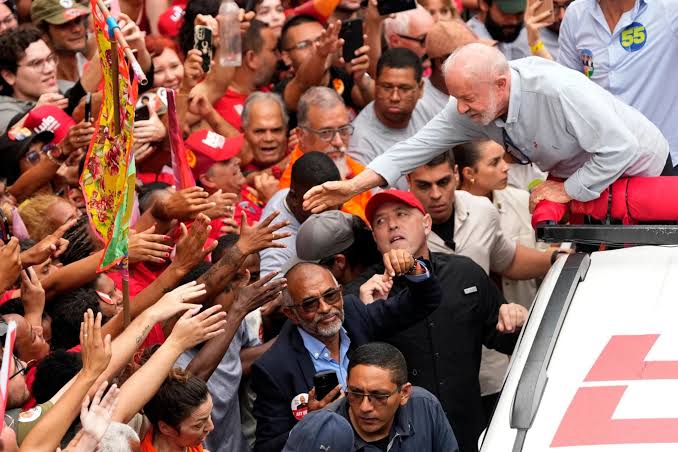

Corruption. Anger. A man called Lula and a man called Bolsonaro. But the main issue—on both sides—was corruption. The collapse last year of the financial services firm Banco Master was arguably the country’s biggest financial scandal in history, and caused over $10 billion in losses. It led to revelations that its owner, Daniel Vorcaro, had financial ties with the Bolsonaro family, Jair’s former chief of staff, former Lula cabinet ministers, several Supreme Court justices, and multiple members of Congress from the left, center, and right. Recordings of Flavio demanding over $20 million from Vorcaro for a biopic about his father threatened—though ultimately failed—to sink his campaign back in May. By then, the scandal had become so widespread that it touched nearly every corner of Brazil’s political system, and made corruption feel endemic.
Flavio Bolsonaro, the son of former Brazilian president Jair Bolsonaro, finished first in Sunday’s presidential election with 47 percent of the vote. He beat incumbent President Luiz Inácio Lula da Silva—known universally as Lula—on 45 percent, while his right-wing Partido Liberal (PL) also dominated the votes for both houses of Congress. Brazilians will now head for a runoff election between the two men on October 25.
Despite being a country where citizens say they are angry at the status quo and want change, Brazil just voted in favor of… rerunning essentially the same political fight it saw in both 2018 and 2022. The country’s politics, in other words, is stagnant.
To understand how we got here, we need to go back a few years. Lula, a union leader who became a political activist during Brazil’s cold war dictatorship, has been on the presidential ballot directly or indirectly in every election since 1989. He served as president from 2003 to 2010, and in 2009 was called “the most popular politician on Earth” by Barack Obama.
After Lula successfully helped his preferred successor, Dilma Rousseff, get elected to the presidency in 2010, the country saw the rise of anti-corruption protests, Rousseff’s impeachment, and the growth of a populist right-wing movement. Lula’s defenders say that the political right took advantage of his leaving the presidency to destroy what he had built. Lula’s critics say his left-wing policies of unsustainable social spending and support for clientelism (and outright corruption) came home to roost.
It was Jair Bolsonaro, a backbench member of Congress, who took advantage of the anti-incumbent moment to present himself as a political outsider who could bring security and traditional values back to the country. In 2018, Bolsonaro courted agribusiness and the evangelical community. Lula, meanwhile, spent 580 days in prison on a corruption conviction that would be annulled a few years later on procedural grounds. Lula was barred from running in 2018, and his stand-in candidate lost to Bolsonaro.
Yet the same public anger that led to Jair Bolsonaro’s presidency in 2018 also led to him being a relatively unpopular president. He didn’t help himself through numerous unforced errors, including the fact that he mismanaged Covid, got mired in corruption scandals, broke the country’s budgeting rules, and behaved clownishly on social media. Lula, out of prison and eager to retake power, narrowly defeated Bolsonaro in late 2022. After Lula was inaugurated at the beginning of 2023, Bolsonaro supporters protested in Brasilia, invading and defacing government buildings—Brazil’s version of January 6. Except, unlike in the United States, Brazil took a different path, investigating, arresting, and prosecuting Bolsonaro for leading the riots and attempting a coup.
Enter Flavio. At forty-five, Jair named him as the family’s candidate after the former president was detained and barred from running this year. While much of Brazil’s right would have preferred a more establishment candidate, the field largely cleared to avoid splitting the vote. Flavio ran on his father’s themes of crime and traditional values, with an even closer embrace of Trump. He met Trump at the White House in May, discussed tariffs and rare earth minerals, and pledged to join Trump’s “Shield of the Americas” alliance if elected.
This election was also about Lula’s fitness for office, a story which closely parallels Joe Biden’s in the United States. Now 80 years old, Lula faces health issues. The country has struggled with inflation under his presidency. And even though homicide levels have declined to their lowest levels in over a decade, he was blamed for the perceived worsening of the security situation. Furthermore, he never successfully cultivated a successor, choosing to run in this year’s election believing he was the only person who could win against the Bolsonaro family.
But the main issue—on both sides—was corruption. The collapse last year of the financial services firm Banco Master was arguably the country’s biggest financial scandal in history, and caused over $10 billion in losses. It led to revelations that its owner, Daniel Vorcaro, had financial ties with the Bolsonaro family, Jair’s former chief of staff, former Lula cabinet ministers, several Supreme Court justices, and multiple members of Congress from the left, center, and right. Recordings of Flavio demanding over $20 million from Vorcaro for a biopic about his father threatened—though ultimately failed—to sink his campaign back in May. By then, the scandal had become so widespread that it touched nearly every corner of Brazil’s political system, and made corruption feel endemic.
More than anything else, it’s this issue that will become the anchor weighing down the next government. If Flavio wins the second round, as he is favored to do by betting markets, he will take office with two open inquiries into his dealings with Vorcaro. Meanwhile, his party—now the largest in both chambers—will likely launch messy impeachment proceedings against the Supreme Court justice who oversaw his father’s conviction and detention in 2025. They will also likely attempt to crush the investigations currently underway against Flavio.
On the other hand, if the aging Lula pulls off an upset and wins, he will govern a polarized and angry country, with his own Senate leader under investigation for corruption, and his opponents holding the largest bloc in Congress—a recipe for a failing final term for the longtime leftist icon.
The real losers are Brazil’s voters. No matter which candidate wins, the country will end up rehashing the same old fights it has suffered through for years. Politicians who are too busy in-fighting and dodging corruption investigations rarely make the effort to rewrite the rules that would reform the system itself. Which sets the stage for new outsider populists to run in 2030 against whatever mess is left behind after the next four years.
For those interested: https://kritikbakis.com/en/brazil-the-bells-toll-for-you/
James Bosworth (Boz) is the author of the Latin America Risk Report and a non-resident fellow at the Stimson Center’s Latin America Program.
Source: https://www.persuasion.community/p/in-brazil-absolutely-nothing-changes