 Slavoj Žižek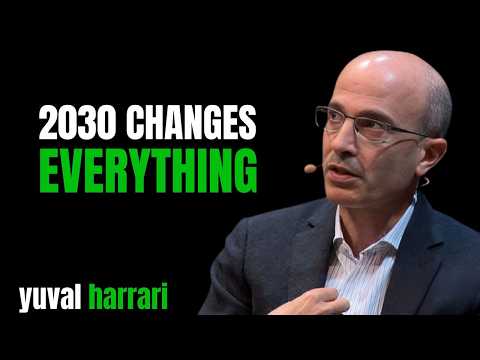

Every big technological breakthrough opens up a path towards new barbarism.
In his short talk, “By 2030, the World Will Be Unrecognizable,”1 Yuval Noah Harari presents his position on how the explosive development of AI will affect our lives in such a clear and succinct way that the talk itself offers an object of critical analysis. He provides a quite detailed vision of our world in 2030, which he characterizes as “unrecognizable” for those of us still rooted in traditional notions of humanity. However, to make my point brutally clear, I think that the reality of 2030 will be unrecognizable also for those who endorse Harari’s vision of 2030.
Harari’s premise, which I share, is that what is going on today is something most of us are not fully aware of: the end of humanity as we knew it, beginning around 10,000 years ago, when Stone Age tribes began to use language. With the rapid rise of artificial intelligence, language is no longer a tool used by humans for communication and interaction; it acquires full independence and begins to function as its own agent, cutting off the umbilical cord that linked it to vulnerable apes called humans. Here I encounter the first problem: does a language without subject(s), a language that acts as its own agent, still function as language? Furthermore, can language really be reduced to its two functions, intellectual calculation and the expression of emotions? But I have dealt with this elsewhere.
Harari elaborates three big cuts that mark the end of humanity as we knew it:
— First, there is the immense apparatus of AI: it contains knowledge that by far surpasses human memory and is instantly available. This knowledge includes knowledge about individuals who dwell in AI. In this sense, as is often said, AI knows us better than we know ourselves. Plus, AI not only gathers knowledge and performs cognitive operations—reasoning—on it: it is no longer just a tool, a machine that follows orders and does what it is told to do; it is already an agent ready to enact autonomous decisions, decisions for which it was not programmed. It not only learns and transforms itself to perform its tasks; it is already able to redefine these tasks themselves.
My reaction here is double. First, of course we do not know ourselves well because we have an Unconscious—that is, because our very subjectivity implies that we are not recognizable to ourselves. As for decisions, human deciding is free in the precise sense that its most basic dimension is what Freud called the death drive: the choice of nothing. In both cases, the question remains open: to what extent does AI display these dimensions—subjectivity, death drive, unconscious?
Source: https://slavoj.substack.com/p/hararis-2030s-a-new-age-of-repressive?