

 Ahmet Özcan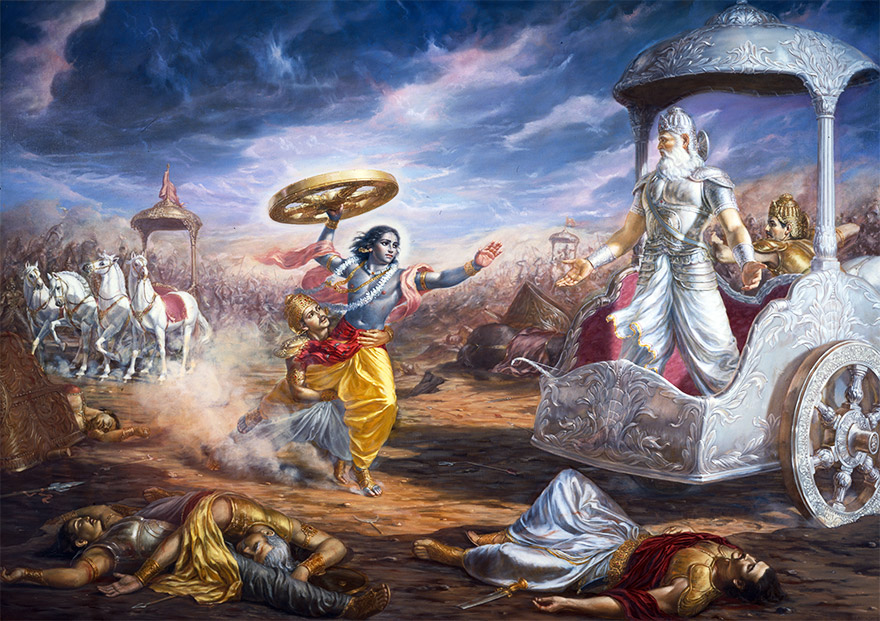

First Publication: 2009
The famous epic of Eastern wisdom, the Bhagavad Gita, tells of a great war between two related dynasties in ancient India who could not share a kingdom. According to legend, in this first world war of history, two armies led by distinguished commanders confront each other. The Bhagavad Gita, which in Sanskrit means “Sacred Song” or “The Song of God,” begins precisely at this point. Just as the war is about to begin, Arjuna, the renowned commander at the head of one of the armies, tells his charioteer Krishna to stop the chariot somewhere between the two armies. He then silently watches the battlefield at length. He trembles at the sight before him, contemplating the futility of war. Suddenly, losing all strength, he drops his bow and arrow. He collapses into his chariot in the middle of the battlefield. He will not fight.
Krishna, Arjuna’s charioteer and friend, tries to dissuade him from his decision not to fight. Between them, first about war and then increasingly about life, death, God, and existence, a deep discussion begins. The epic continues through this metaphor of dialogue. The battlefield is in fact the world, even the universe itself. One of these two dynasties, bound by blood yet enemies to each other, symbolizes order, the other chaos.
War is life itself, that is, ‘living’. Arjuna’s inner conflict is the inner war of humankind. Krishna is Arjuna’s guide (in accordance with Hindu mythology, Krishna later assumes a divine identity, transforms into the God Vishnu, and in the final stage is understood to be Brahman, the infinite spirit itself). The discussion between Arjuna and Krishna is essentially the conflict between the infinite spirit within the human being and the finite self.
The epic is full of striking dialogues, wise answers, theological explanations of Indian philosophy, and profound inquiries into the meaning of life. By metaphor, as a figure of responsible humanity, Commander Arjuna and Krishna, both the voice of the infinite spirit, the human subconscious, and a divine breath, begin to speak:
Arjuna: “I see signs of evil, Krishna. I do not know what glory there could be for me in killing my own relatives in battle.”
“Even if I myself were to die, I do not wish to kill them, Krishna. I could not do this even for the sake of three kingdoms of the earth, let alone a kingdom of the world.”
“What pleasure can there be left in life after killing our own kindred in war?”
“I seek neither victory nor kingdom, nor the pleasurable life that a kingdom provides. Of what use are kingdoms, pleasures, or even life itself?”
“Did we not desire all this for those who have put their lives and wealth on the lines to fight here? Moreover, we do not even know which side’s victory would be more righteous. If we kill our relatives who have taken battle formation against us, will we still have the will to live?”
Krishna smiles at Arjuna, who stands despairingly between the two armies, and says:
“You suffer needlessly. If a person is wise, he does not grieve for the living or the dead. For there has never been a time when you, or I, or any of those gathered here did not exist. Nor will there ever be a time when we cease to exist forever.”
“Just as within our mortal body there is an essence that passes from childhood to youth and from youth to old age, so too does this essence pass into another body after death. Pleasures and pains, like heat and cold, belong to the sensory world and are transient. Overcome them, Arjuna.”
“The person who is unaffected by these changes, who remains the same in happiness and suffering alike, is truly wise and attains immortality.”
“That which is unreal can never be exist. That which is real can never cease to be. Those who can see the distinction between these two have seen the truth.”
“This reality that governs everything in the universe cannot be destroyed. No one can bring it to an end. The body is mortal, but the essence within the body is immortal and infinite. Therefore, Arjuna, fight in this battle. In this battle there will be neither one who kills nor one who is killed. Those who think so are mistaken. For the infinite within a human being neither kills nor is killed.”
“You were never born and you will never die. You have never changed, nor will you ever change anything. Because you are unborn and eternal, when the body dies, you will not die. How can one who knows that the human essence is unborn, eternal, unchanging, and indestructible kill another or be killed?”
“Swords cannot cut this essence, fire cannot burn it, rain cannot wet it, and wind cannot dry it. Beyond the power of sword and fire, rain and wind, that infinite essence is one and eternal. Mortal eyes cannot see it. It is beyond all thought and all change. If you know this, you should not grieve.”
“Do not grieve in vain over the death of that which will never die, Arjuna. On this path, nothing is ever wasted, and there is no such thing as failure. The only aim of the one who walks this path is to reach the end of the road.”
“Those without purpose, however, are lost among the endless options of life…”
The epic continues in this vein… The uniquely demagogic games of reason found in Indian philosophy provide surprising answers to humanity’s ancient questions. The most important characteristic of this style of wisdom, which relies less on logical consistency and more on cleverly constructed language games, is not the content of the answers it gives, but the paradoxical certainty with which it approaches problems. Indian thought offers contradictory answers, in a definite and absolute tone, to all the questions that wound the human soul. The boldness of the discourse conceals the ambiguity of the answers. The condescending tone of the style balances the deep agnosticism of the content. Perhaps history has found a way, for this very reason, to flow on the Indian subcontinent without changing.
The conversations between Arjuna (Adam) and Krishna (God), the main characters of the Bhagavad Gita, offer an orthodox response to the fundamental question in the history of philosophy -a debate about being and existence- and to the movements that emerged demanding the reform of Brahmanism… Reformist movements proposed stepping outside what exists in order to reach the end of the ‘path.’ Brahmanism, however, says; what exists is only you, and there is no ‘outside’ that you could step into. Born of this great divergence in Indian thought, the epic of the Bhagavad Gita is, on the one hand, a theological text, but politically it is a philosophical depiction of the established order and the objection raised against it.
The counterpart of these seemingly complex issues in the Mesopotamian–Mediterranean basin is the relationship between authority/state and the human being.
In this geography, where existence unfolds within the master–slave dialectic and within the state–opposition equation, all problems are expressed through a politicized religious language. The state is the shadow of God on earth and therefore the name of an omnipotent, singular, indivisible, and holistic willpower. In this context, the state is not merely a religious authority, but the very religion itself. The human being, in turn, is the servant of the state. He is obliged to obey, to fulfill his responsibilities, and not to disturb order and stability. Rebellion against the state, objection, opposition, is the greatest sin. The messages of Abraham, Moses, Jesus, and the Prophet Muhammad (pbut), as religious reforms, sought to repair this ancient equation from the point where it had broken down: obedience, but on the condition of justice; responsibility, but on the condition of freedom; order and stability, but on the condition of not committing oppression…
The fundamental contradiction of the Mesopotamian–Mediterranean basin is not class-based, ethnic, or religious, but political, and politics is precisely the negotiation of these conditions between the parties. If the state does not comply with these conditions, rebellion is legitimate. If rebellion does not demand these conditions, it is illegitimate. God-state, god-king, the shadow of God on earth, divine order… The most obvious characteristics of Mesopotamian–Mediterranean civilizations have been shaped by this conception of the sacred state. Without understanding the concept of the state in this geography, the meaning attributed to it, and its historical trajectory, nothing can be properly understood.
The translation of the Bhagavad Gita into the political reality of the Mesopotamian–Mediterranean basin reveals an interesting picture.
If we read the epic in the language of this basin, Arjuna can be translated as the social conscience that objects to the state, while Krishna–Brahma can be translated as the state that demands unconditional obedience. Their discussion can be interpreted as the tension between power and opposition, people and state, reason and conscience, ideal and reality. What does this tension, experienced by humanity throughout history in different forms, tell us today?
First of all, let us note the fact that the Mesopotamian–Mediterranean basin (Assyrian-Egyptian-Roman) and the Indo-Iranian basin are two different civilizational blocs. In the former, order and stability and thus the state and law, are primary; in the latter, order within chaos, and thus wisdom, philosophy, and paradoxical realities, take precedence. In the Indo-Iranian basin, the state is not a unified authority. Alongside the state apparatus as a bureaucratic mechanism, and often more effective than it, there are two other centers of autonomous authority: the clergy and the aristocracy. This characteristic structure has also existed in Catholic Continental Europe since Western Rome.
In the Mesopotamian–Mediterranean world, the situation is exactly the opposite. Here, ‘God’, that is, the single sovereign power in the name of God, by divine authority, or as the shadow of God, is the state. Religion, aristocracy, the army, intellectuals, all are within the state. More precisely, the state is within everything. The conception of an omnipotent God is the theological expression that ensures the singularity of authority. This has been the case since pagan and Orthodox Eastern Rome.
These two historical experiences and two different blocks of knowledge must be taken as a basis in every scenario to be constructed for the future of the world, our region, and our country; Türkiye.
Both basins have comparative advantages over one another.
Historically, they have also been parties to intense competition. Yet within the synthesis of these two basins lies a great civilizational dynamic.
From the 2nd millennium BCE to the 19th century, as the main geographical region through which history flowed, the fundamental contradiction of the various ethnic, political, and religious powers that dominated these basins was constructed along this axis. Like two tectonic plates, the powers concentrated in these basins entered into competition, conflict, and war with one another, and these great clashes shaped the main course of history. Great migrations, population movements, religious–philosophical schools, political formations, technological developments, and economic relations; everything took shape within this main current.
The synthesis, composition, in other words, the effort to unite of these two blocs is the fundamental political objective of the Abrahamic tradition, and the birth of major religions such as Religion of Moses, Christianity, and Islam is an expression of this objective. These religions provided answers to humanity’s ontological questions-concerns and ensured that the historical flow continued not along the path of conflict, but toward harmony, synthesis, that is, peace and justice.
The conflict of these basins, on the other hand, has produced dozens of heretical sects, schools, and orders by clinging to fragments of holistic truths, such as Brahmanism, Zoroastrianism, Buddhism, Judaism, Manichaeism, Yazidism, Babylonian traditions, Kabbalism, Esotericism, Hashshashin, Druze beliefs, and Nusayrism. These are tragic schools that arise from conflict and defend incomplete, fragmented, fractal truths against the whole.
Abrahamic religions represent order and stability, while heretical schools represent chaos and disorder.
For example, the birth of Religion of Moses ended the Aryan/Hittite-Assyrian/Egyptian wars; the birth of Christianity ended the Sasanian–Roman wars; and the birth of Islam ended the Iranian–Byzantine wars. However, after a time, these major wars continued as civil wars within the new orders established on the basis of these religions. The Sadducees–Pharisees schools of Judaism that is distorted version of the Religion of Moses, the Orthodox-Catholic interpretations of Christianity, and the Sunni-Shia conflict in Islam can be interpreted as examples of these internal wars. Not only politically, but also theologically, the ways of thinking of the opposing sides in these internal conflicts-their perspectives on the world, objects, and events-are like renewed continuations of one another. The saying; history repeats itself has not been uttered in vain.
From the 19th century onward, the center of gravity of the world power shifted to Europe, and later to the Atlantic. Now it has begun to shift toward the Pacific. With modernization-that is, the scientific and technological revolution-the ancient centers of historical flow have moved to the margins, and the great historical current has begun to continue on a global scale. From the perspective of deep history, the playing field has expanded; the actors of the game, the technologies they use, their mobility, speed, and other quantitative components have multiplied, increased, and been renewed. But the game is the same game. The rhythm of history continues to beat according to the same laws, along the same metaphysical and political axes of tension. What has changed is the quantity of geopolitical basins.
In the 20th century, America, and in the 21st century, China, have taken the stage on the margins of this deep tectonic dialectic, but they do not possess a quality that would change the fundamental contradiction; rather, they represent its expansion as new parties to this contradiction.
The fundamental dialectic continues today at every level. Humanity’s inner war; the contradiction between our infinite and finite sides, between ideal and reality, master and slave, authority and opposition, justice and oppression, freedom and domination, continues. The new basin defined as the West has neither the intellect, nor the comprehension, nor the spirit to resolve this ancient contradiction of humanity. For this reason, it can be said that humanity’s historical march will continue by once again setting foot in the ancient basins.
It is predicted that the center of gravity of the 21st century will be Eurasia. If this forecast comes true, the dialectic of the new century will, in accordance with the deep flow of history over long periods, return once again to the Mesopotamia–India axis.
If a new world is to be established today-and the necessary condition of the “new” in the expression “new world” is that it emerge from a non-Western basin-this world will be either the product of the Indo-Iranian basin, the Mesopotamian–Mediterranean basin, or the common synthesis of the two.
What we call the West today, which is in reality nothing more than the spread of the civil war between Anglo-Saxon-Protestant (Aryan) tribes and Latin-Catholic tribes across the world, is living its last century. In this sense, unless the West abandons its effort in the 21st century to carry its internal war into Eurasia and the Pacific, and to resolve its problems/questions not through universal wholeness but through ideological alienations based on fragmented truths, it will turn into a mere parenthesis in deep history.
The reemergence of the ancient dialectical tension of history between Mesopotamia and the Indian basin will truly enable the opening of a new page in human history.
The tension experienced in the war between chaos and order described by the Bhagavad Gita is the real dialectic of ‘our’ world. This genuine equation that covered over through Western mediation or made to appear as merely the outcomes of Westernization, should now be expected to emerge onto the stage in its own natural course over the coming decades. This equation is the essence of a profound history that divides false dialectical tensions of the finite, produced by Western experience, such as the East-West conflict, class struggle, and the struggle of nations into two and that ontologically bringing together the like in one place and the unlike in another, and that connecting worldly contradictions to ontological contradictions, thus grounding the effort to reach a real foundation that is the infinite.
The tension between the finite (Beşeri) and the infinite (the Adamic, Âdemî) within the human being is the genuine ground for reconsidering religious, ethnic, and class contradictions within a higher wholeness and on a political plane. This ground expresses the essence of all issues, that is, the effort to become truly human.
The finite diminishes the human being, fragments him, and pulls him downward. The infinite, on the other hand, elevates, matures, and completes him… To be human is the effort to cling to the infinite within a finite world.
The new Eurasia/Pacific-centered dialectic will ensure that this ancient war of humanity continues from where it left off. Then, not only capitalism and its related problems, but also all racist, ethnic, idolatrous customs of ignorance that exhaust our minds and souls, steal our time, and sacrifice our children to filthy wars will once again be thrown onto the garbage heap of history.
A new Türkiye, a new regional order, a new world can primarily be built through discussions that begin on such a ground and at this depth…
Arjuna and Krishna seem likely to continue their debate, from where they left off, throughout the 21st century.
First Publication: haber10.com – 2009
Source: Yenilmiş Asilere Çiçek Verelim, Ahmet Özcan, Yarın Yayınları, 2016.