 Jonah Raskin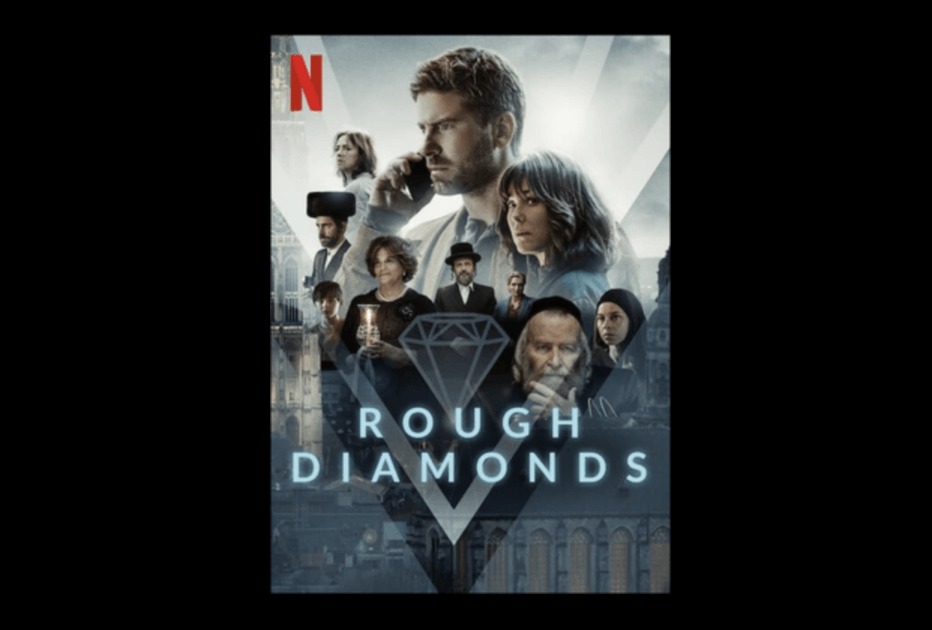

There is no ceiling on the number of bad Jews in history and in public life here and in Israel: Roy Cohn and Benjamin Netanyahu, the European Jews who collaborated with Nazis and then going all the way back to Jeroboam and the kings who erected golden calves and said “Here are your gods, O Israel, which brought you up from the land of Egypt.” (1 Kings 12:28). There are many bad Jews, most of them Hasidic, on a new Netflix series titled Rough Diamonds, which is about contemporary diamond merchants in Antwerp, Belgium. These fictional bad Jews turn to crime and criminality to help save their beleaguered company and who bring down doom and disaster on their own orthodox heads. If they were Christians, they would inhabit the Ninth Circle of Dante’s Inferno.
Rough Diamonds is a co-production from Israel’s Keshet International, Belgium’s De Mensen, and Vlaamse Radio-en Televisie organisatie (VRT). It received funding galore.
If the series has a major flow it’s the absence of a narrative about the origins of the jewels in countries like South Africa, Angola, Botswana and the Congo where they aren’t only rough. They’re also bloody and mined and traded in areas where armed conflicts ruled rough shot, and diamonds buy guns and bullets. The Netflix series moves from Antwerp to London and New York so it could also move to say Luanda or Brazzaville. That would not be a stretch.
I’m surprised that Jewish groups have not denounced the series as “anti-Semitic’ and have not called for censoring and boycotting it. The co-creators, Rotem Shamir and Yuval Yefel, are both Israelis but not Belgians, nor from “ultra-Orthodox backgrounds” they have said. But they struck a valuable vein when they came up with the idea for the series which first aired in April 2023.
In the last scene in the eight-part series, the members of the Wolfson family sit in pews in a synagogue during a Yom Kippur service wearing yarmulkes and all the appropriate garb for the high holidays. In unison they chant and confess, “We have been violent…we are guilty…we have deceived…we have lied…we have stolen…we have slandered.” Their kind of confession is called a “viduy.” It’s a prayer that’s woven into the service on Yom Kippur. The Wolfsons —wolves in human form— aren’t making up all that terrible shit. They’ve been violent, they have lied and cheated and slandered and stolen. They mean to atone for their sins. But it’s not that easy.
In Judaism it’s not enough to confess. One has to make amends, alter one’s behavior and change one’s character. So an orthodox friend told me. Maybe in the next episodes, which have not yet been broadcast, the Wolfsons will mend their ways, turn their backs on the paradise they have lost through their own misdeeds and enter a paradise they will create anew.
Possible. But not likely. Hell is more intriguing than heaven and sinners more captivating than saints.
I was initially drawn to the series because I lived in Antwerp in the late 1980s and taught American literature. I gathered more information than I imparted to the students: observed the Hasidic Jewish community, attended a reform synagogue and learned about the diamond trade. I also visited a club where neo-Nazis gathered and met an American racist who owned and operated a bar. I interviewed the Dutch writer, Harry Mulisch, who had a Jewish mother and a Nazi father and who boasted, “I am the Second World War.” Prostitutes sold themselves openly near the port.
My landlady, Mrs. Schellermanns, covered all the bases, called me “Herr, Doctor, Professor,” and took me shopping once a week. Her daughter complained, “The Jews are taking over Antwerp.” Mrs. Schellermann’s oldest son ran cash around the city. Her youngest son took me to what he called a “detention center” where Jews were incarcerated before they were shipped to Auschwitz. A sign at the center described an insurrection led by a man whose last name was “Rasquin.” He was shot and killed. A relative, I assumed.
In Antwerp, the Flemish speakers didn’t talk directly to the French speakers and the French speakers didn’t directly talk to the Flemish speaker. English was the lingua franca. A language war raged. A colleague at the University of Antwerp insisted that King Leopold, who “owned” the Congo, was really very kind and good to the natives.
My own time in Antwerp initially drew me to the Netflix series Rough Diamonds. I went on watching it because the action and the characters drew me in and held my attention. I wanted to see how bad the bad Jews could really be. Very bad indeed.
Of course, Hollywood movies have long depicted criminals who break major and many minor laws, as well as the Ten Commandments. Some of them, as in Coppola’s Godfather movies and in Mario Puzo’s novel of the same name, have been Italians and Italian Americans. But never before, at least not in my memory, have Jews been depicted on the screen as bad — no, as evil— as the characters in Rough Diamonds. If they have some redeeming characteristics – family loyalty, respect for traditions and love for their children—their virtues don’t override their veniality.
Rather late in life I learned about the Jews who ran Murder, Incorporated and about Jewish mobsters like Meyer Lansky and Bugsy Siegel. I knew Jews weren’t all angelic.
Even more horrible than the Jews, the producers and directors would have us believe, are “the Albanians, “ though they are merely minor characters and never fully developed. The spot light illuminates the Jews of Antwerp —men and men, young and old, parents and children, some of them less sinful and more virtuous than others, including Gila ( Marie Vinck), the beautiful widow of a Jew who turns to crime and then commits suicide. That act provides the opening scene in a movie in which the actors speak Hebrew, Yiddish, English, Dutch and French.
The main character, the “black sheep of the family,” a young handsome, muscular fellow named Noah returns to Antwerp and with his wits and his fists aims to save his family and its reputation by stealing, lying, deceiving, slandering and seducing. Kevin Janssens, the actor who plays Noah, is Belgian but not Jewish. He doesn’t really fulfill the role he’s assigned. Yes, he’s a male animal, but not a mensch, and meant to be a Jewish version of Michael Corleone, the World War II vet who returns to the family fold, and carries on the work of the godfather, played by Marlon Brando, a man both loved and feared. If you want to see and hear bad Jews on the screen, watch Rough Diamonds. Crime is an equal opportunity employer.
*Jonah Raskin is the author of Keeping the Beat Alive.
Source: https://www.counterpunch.org/2026/09/09/bad-jews-rough-diamonda-netflix-series/