

 Larry Gondelman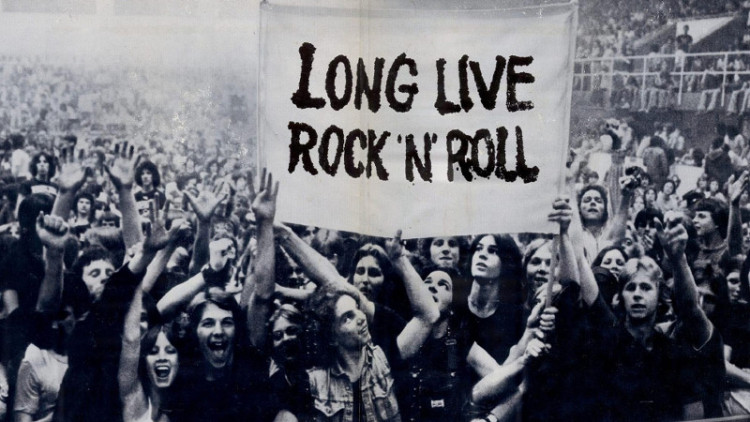

Having your son or daughter as your rock ‘n’ roll buddy is a wondrous thing. The music we have heard and the memories we have created—like rock ‘n’ roll—will never die.
If you’re a Boomer like me, you can’t help but view your teenage years as the golden age of rock ‘n’ roll. The Beatles, The Beach Boys, The Rolling Stones, Jimi Hendrix, and so many more were recording one great song after another, music that sounds as fresh today as when we first heard it. My fate as a rock ‘n’ roll die-hard was sealed on September 14, 1964, when I was 12 years old and the Beatles came to Pittsburgh, where I grew up. My father pulled some strings and wangled a backstage pass, and I actually met the Fab Four. The thing I most remember is how short they were; I had expected these larger-than-life musicians to be, well, larger than life.
By the time I got out of high school, I had seen, if you’ll allow me, The Smothers Brothers, The Temptations, Little Anthony and The Imperials, Vanilla Fudge, The Doors, The Guess Who, Three Dog Night, and Led Zeppelin—all bands we Baby Boomers knew well. In college I saw The Moody Blues (with Van Morrison as the opening act), Neil Young, James Taylor and Carole King, Ike & Tina Turner, The Who, The Rolling Stones, and the Grateful Dead. During law school, Bruce Springsteen and Billy Price and the Keystone Rhythm Band offered respite from the grind of reading cases.
On the theory that the music of my youth could never be topped, I stopped listening to new music once I got out of law school. But one day when I was about 40 years old, I was driving a young colleague home from a basketball game when he switched the radio to Washington, D.C.’s “alternative” station. To my happy surprise, I discovered that good, even great, new music did not stop when I graduated law school. A whole new universe of music was open before me.
About five years later, when my son was 6 months old, he and I were listening to R.E.M.’s Automatic for the People. When their upbeat song “The Sidewinder Sleeps Tonite” came on, Sam bopped happily on my knees. Then came “Everybody Hurts,” a slow song where the pain was palpable. Sam stopped dancing, listened, and burst into tears. I knew then that, like me, rock ‘n’ roll spoke to his soul.
My daughter, Eva, was born five and a half years after Sam. When they were younger, I rarely had the time to go to concerts. Music took a backseat. Fast-forward to 2007. I was reading an article by Steve Stecklow of The Wall Street Journal about taking his 13-year-old son to his first Springsteen concert. I immediately bought two tickets to Springsteen’s upcoming Magic Tour, and off Sam and I went. Nearly two decades later, my son and I have attended 114 concerts together. Few things we’ve done together have brought us closer.
Like any good parent, I did my best to treat my children equally. Alas, Eva’s taste in music was vastly different from mine—think: Taylor Swift and Nicki Minaj—and I was never going to be a Swiftie. But when I witnessed her blissful reaction to seeing her favorite artists, and watched her singing along to her favorite songs—just like I had done practically my whole life—I was soon eagerly taking her to shows by performers that she loved, so that I would have more opportunities to spend a couple of joyous hours with her. And, of course, cementing my position as Father of the Year.
These experiences taught me an important lesson. Having your son or daughter as your rock ‘n’ roll buddy is a wondrous thing. The music we have heard and the memories we have created—like rock ‘n’ roll—will never die.
There was a second thing that rock ‘n’ roll was teaching me: I loved passing on my knowledge to others. There was a young woman associate whose office was next to mine. She often saw me leaving the office, wearing the T-shirt of some band as I headed off to a concert. She would ask me the next day how the show was. I soon realized that she was still stuck on the music of her college days, just like I had once been. I knew more about new music than she did, so I became her music mentor. Each week I assigned her an album to listen to. We then discussed it the following week. Some of the albums were from the ’60s and ’70s; others were more current.
One album I assigned her was Panic! At the Disco’s Death of a Bachelor and the song “Crazy = Genius.” The chorus goes like this:
She said you’re just like Mike
Love but you wanna be Brian Wilson, Brian Wilson
She said you’re just like Mike
Love but you’ll never be Brian Wilson
Never mind Panic! At the Disco! I spent that day explaining that Wilson was the genius behind The Beach Boys—something she had never known. My experience with my colleague made me realize that I had an aptitude for teaching someone about rock ‘n’ roll.
By then, I was in my early 60s. I had started to read articles about how to prepare for retirement. One theme that cropped up again and again was that you should start planning for retirement several years before you retire. Another was that retirement should be the time in life when you embrace your passions. I took this advice to heart. Music had been my passion throughout my life. I decided that when I retired I would explore a different artist each week. I would read about the artist, listen to their albums, and learn their lyrics. And, as always, I would endeavor to discover new music.
I had these notions in mind when I visited my mother in Florida in 2018, shortly before I retired. She told me about some classes she was taking that were geared to older adults. The organization that offered the classes was the Osher Lifelong Learning Institute (OLLI). This national organization sponsors local branches in cities throughout the U.S. that partner with local universities. The teachers are all volunteers who have a passion for a subject. During my visit, she took me to a foreign film class, which I very much enjoyed. And that’s when it hit me: I should teach a class on rock ‘n’ roll!
I titled it, somewhat grandly, A History of Rock ‘n’ Roll. Putting together the curriculum was a revelation: I still had an awful lot to learn. Like how Sister Rosetta Tharpe, who played gospel songs with an electric guitar, caused people (including Chuck Berry) to call her the Godmother of Rock ‘n’ Roll. I learned about how the rivalry between Leo Fender and Les Paul gave us the electric guitar. I uncovered wonderful stories about the inspiration for various songs. A whole new world opened before me.
Before I knew it, I kept finding new topics for new classes. While researching my history course, I found references to albums that were integral to the growth of rock ‘n’ roll. That led to my second class, Iconic Albums, where I delved into Pet Sounds by The Beach Boys; where I debated which Beatles or Bob Dylan album was most iconic; where I tackled the discography of the Rolling Stones, The Who, The Band, and Springsteen; and where I explored the great albums by women like Aretha Franklin, Carole King, Joni Mitchell, Patti Smith, and Lauryn Hill.
From albums I went on to teach about lyrics; about songwriters; about record labels; about how artists borrow ideas, lyrics, and music from other artists; and about the black godmothers of rock ‘n’ roll, like Tharpe, Ma Rainey, and Memphis Minnie. I even taught a class called Songs of Sex, Drugs, and Rock ‘n’ Roll, where each week focused on songs about a particular topic. Not surprisingly, it was quite popular, so much so that I put together a sequel: Songs of Sex, Part 2. While the 10 topics I explored in that class did not include songs of sex, I kept sex in the title, knowing that it would catch people’s attention. (It did.) I’m currently teaching a class on One-Hit Wonders (remember “Itsy Bitsy Teenie Weenie Yellow Polka Dot Bikini”? Or how about “Louie Louie” by The Kingsmen, with that lyric all of us teenage Boomers listened for?). For the spring semester, I’m working up a class on The Great Guitarists of Rock. I have ideas for enough new classes to carry me through 2029.
As I tell my students, I don’t teach these classes for them; I teach them for myself. Each class encompasses a subject that I want to learn about. Teaching the class provides a lot of the motivation and structure for my research. But more importantly, at the age of 73, it provides motivation and structure for my life. The “motto” of OLLI in Washington, D.C., is “curiosity never retires,” which strikes me as a worthy motto for anyone who’s retired, whether or not they are teaching, or taking, a class.
My children don’t yet have children of their own. But when they do, this rock ‘n’ roll professor will be ready to rock out with them too.
Larry Gondelman is a retired lawyer-and a rock ‘n’ roll scholar- who lives in Washington, D.C.
Source: https://www.thefp.com/p/ancient-wisdom-me-my-kids-and-rock
