 Fabrizio Tassinari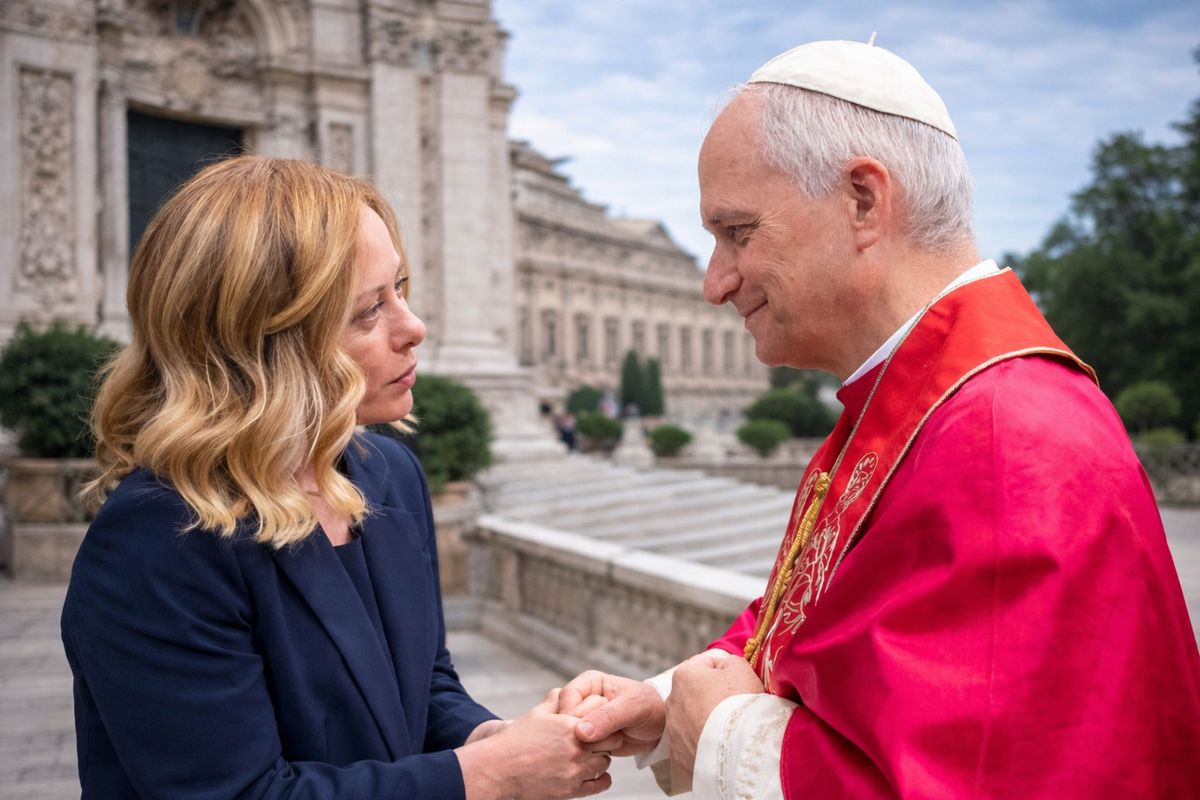

There are moments when a deep well of individual feeling reveals something important about political history. One such moment happened when Italian Prime Minister Giorgia Meloni responded to US President Donald Trump’s attacks on Pope Leo XIV.
The American president had described the Pope as “weak” and “terrible for foreign policy,” before doubling down in an interview with Italian newspaper Corriere della Sera. Meloni considered these remarks “unacceptable” and added a sentence that deserves to be read carefully: “Frankly, I would not feel comfortable in a society in which religious leaders do what political leaders tell them.”
Whether off-the-cuff or calculated, Meloni’s statement encapsulated one of the most distinctly European principles that can be articulated. To appreciate this, it is worth revisiting a text written 23 years ago, at the dawn of another epochal transatlantic rift.
It was February 2003, and across Europe millions of people were taking to the streets against the war in Iraq that George W. Bush’s America would launch the following month. On that occasion, two of Europe’s greatest public intellectuals—the German philosopher Jürgen Habermas, who passed away just a month ago, and the Franco-Algerian philosopher Jacques Derrida—co-wrote an article titled “February 15, or What Binds Europeans Together.”
Those demonstrations, they wrote, could one day be remembered as “a sign of the birth of a European public sphere.” It was an intuition about the possibility of Europe becoming a truly unified polity through a shared awareness of its values, rather than merely through treaties.Formun Üstü
Among the constitutive traits of Europe’s identity, Habermas and Derrida homed in on the relationship between the state and religion, and how secularism took hold across Europe through centuries of conflicts and compromises. There is no single, uniform model, the authors acknowledged: “In modern Europe, the relation between church and state developed differently on either side of the Pyrenees, differently north and south of the Alps, west and east of the Rhine.”
And yet, within this variety, a common thread exists. Religion, they argued, occupies “a comparably unpolitical position” in contemporary European society. “We may have cause to regret this social privatization of faith in other respects, but it has desirable consequences for our political culture.”
It would be wrong to project Trump’s mindset onto all Americans. The United States has a tradition of separation between church and state rooted in the First Amendment of the US Constitution. That tradition is alive, and Trump is not America.
Trump’s behavior is, however, an extreme symptom of a tendency that Europe has historically overcome. In a thinly veiled reference to America, Habermas and Derrida observed that for Europeans, “a president who opens his daily business with open prayer, and associates his significant political decisions with a divine mission, is hard to imagine.”
But Trump is not content merely to pray: he has himself portrayed in AI-generated messianic imagery healing the sick. He has preachers lay hands on him and bless him in the White House. These are manifestations of a severe civic short-circuit.
The contrast with Italy is striking. No Italian prime minister would ever close a speech with “God bless Italy,” which is a ritual form in the US. Meloni leads a right-wing government in a culturally Catholic society, where the Church’s support is still avidly courted by all parties in order to win elections or to retain power. And yet even those Italians, like Meloni, who ground much of their political identity on the defense of the “Christian roots” of the West, do not feel that they can cross the line of dictating an agenda to a religious leader. This is not a conservative or progressive principle: it is a European principle.
Of course, Meloni was not shunting aside political calculation. Her defense of Pope Leo XIV may strain her relationship with Trump and his administration of acolytes, which she surely knew before she spoke. But it is just as likely to help her domestically, by creating some distance from her increasingly unpopular association with Trump.
What is remarkable is that this outcome materialized in so staunch, if unwitting, a defense of European values. America has always played a role in the construction of modern Europe, whether as a steadfast supporter of European security and “ever closer union” or as a mirror image. This time it happened both in support of the first American Pope and against a mercurial American president. Habermas and Derrida, one suspects, would have looked puzzled at who they were agreeing with, but would have nodded in agreement with Meloni all the same.
*Fabrizio Tassinari is Founding Executive Director of the European University Institute’s School of Transnational Governance and the author of The Pursuit of Governance: Nordic Dispatches on a New Middle Way (Agenda Publishing, 2021).