 Kevin J. McNamara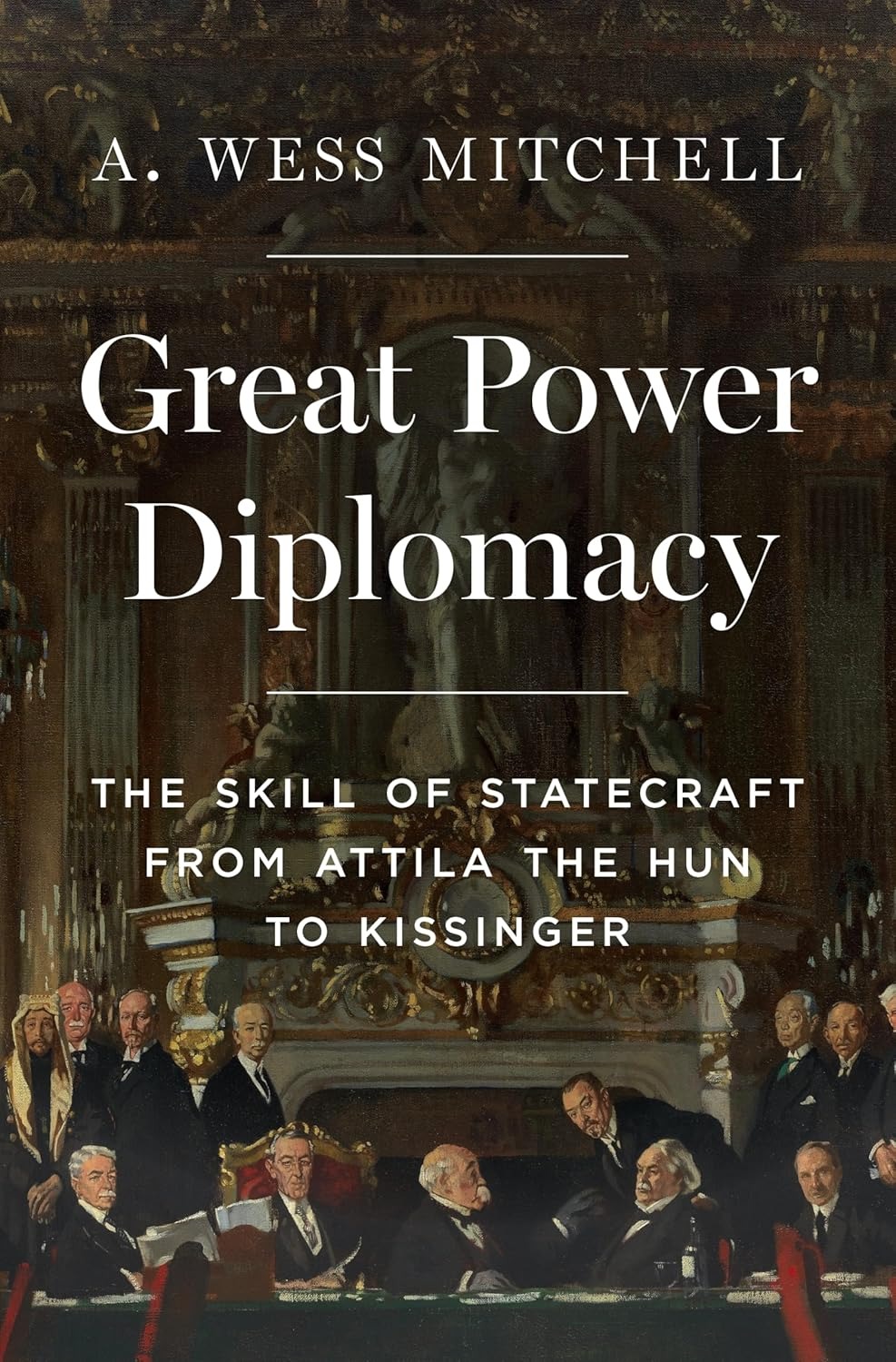

By seeking the good of the nation, it can create global peace and prosperity.
The United States today faces a number of hostile allied great powers, and it lacks the raw military might to deter them all. So A. Wess Mitchell’s new book Great Power Diplomacy lands in our hands at a critical moment.
This work of history and strategy points an intelligent way forward, in part because the author’s grasp of diplomacy differs enormously from the sense of diplomacy as talk for its own sake, or for the sake of the Holy Grail of “global order,” or humanitarian causes, all of them substitutes for a foreign policy that advances the national interest.
Mitchell, a historian and diplomat, is a sixth-generation Texan who earned his doctorate from the Freie Universität Berlin. He served as U.S. Assistant Secretary of State for European and Eurasian Affairs in the first Trump administration, where his portfolio included fifty countries, NATO, and the EU. Before that, he served as president and CEO of the Center for European Policy Analysis, Washington, D.C., a think tank he founded at age twenty-eight. Fluent in German, he has authored three previous books.
Across nine chapters, Great Power Diplomacy offers eight studies of how strategic diplomacy rescued a major power from rival, threatening powers it was not prepared to meet in war. The studies focus on countries in the West, due to modern diplomacy’s European origins; on great powers, whose foreign policies have the greatest impact; more specifically on status-quo powers, excluding powers like Hitler’s Germany, which use diplomacy as a form of nonviolent warfare; powers whose foreign policies are linked to key individuals, such as Richelieu, Metternich, Bismarck, Chamberlain, or Nixon and Kissinger; and, finally, on historic moments in time that really mattered for large regions of the world.
The case studies, if we can use that term, range chronologically from the contest between Sparta and Athens in the Peloponnesian War to the U.S. diplomacy that played Maoist China against Soviet Russia during the Vietnam War. The other studies focus on the successes—and failures—of the Byzantine Empire (threatened by Attila the Hun), the maritime Venetian empire, pre-Revolutionary France, Habsburg Austria, Bismarck’s German Empire, and the British Empire in the run-up to both world wars.
Ending with the Nixon–Kissinger opening to China, this work cannot but remind one of Kissinger’s own 1994 history, Diplomacy. While Kissinger’s theme was, then and later, “world order,” Mitchell’s theme is strategy, and his work is more usefully focused as a result. This is not your grandfather’s diplomacy, which Will Rogers once summarized as “the art of saying ‘Nice doggie’ until you can find a rock.” But more on dogs below.
In Mitchell’s preferred world of diplomacy, diplomats and generals sit at the same table to formulate national strategy, matching national means to national ends, with the primary goal being national survival. The generals and the diplomats would simply use different tools for the same ends, perhaps with the diplomats batting first, guided by a coherent strategy, which—quoting the estimable American strategist, five-time U.S. diplomat, and Austrian émigré Robert Strausz-Hupé—“is diplomacy’s elder brother.”
This contrasts with reflexively antiwar leftists who turn to diplomacy either because war is unthinkable or because they assume conflict is based on misunderstanding. It also contrasts with diplomats who pursue agreements on legal or moral principles, for their own sake, regardless of the effect on the national interest. Mitchell’s take on diplomacy does not assume human virtue or a natural commonality of interests among peoples.
To Mitchell, diplomacy is not the opposite of war, nor always even an alternative to war, since diplomacy can best be deployed to delay a war until such time as it can be fought and won. Diplomacy is, instead, a tool, and an important one, yet a tool that has been a wasted asset in recent decades. Instead of having U.S. national strategy as its goal, American diplomacy has too often been wasted in pursuit of world order, international law, or solving other people’s problems—settling disputes among smaller powers.
Mitchell cites the Austro-Hungarian Empire, a realm that lasted four hundred years despite systemic exposure in the middle of Europe to often hostile, often contiguous rivals on all sides, as an example of diplomatic achievement—notably, informed by Vienna’s past wars. “That Austria endured for so long,” he says, “was the result of effective diplomacy. Austria’s wars habituated her leaders to conceptualizing diplomacy as a component of strategy and to practicing it at a high level of proficiency.”
Another example is Otto von Bismarck, who united German kingdoms and people into the German Empire chiefly through his deliberate execution of three distinct wars, against Denmark, Austria, and France. Yet he devoted the rest of his career to the avoidance of a European war. As a result, while no one has ever heard of the great European war of 1887–88, the bloody war that erupted twenty-six years later is infamous, not least because it destroyed four imperial regimes, Germany’s included. Bismarck’s diplomacy avoided the first war (where the focus would have been Bulgaria), but once he was gone from the scene, a war erupted in 1914 over Serbia.
This demonstrates the underappreciated value of diplomacy but also reveals why it can be unappreciated. Mitchell does not fully address this point, since he aims to encourage diplomacy, not discourage it. Diplomacy’s Achilles’ heel is that it requires character traits in world leaders that are largely if not always unrewarded, such as thoughtfulness, subtlety, self-discipline, patience, persistence, and a willingness to forego credit for the war that one has managed to avoid or delay. When the dogs of war are muzzled and leashed, there is no barking or fighting vying for our attention. As one wit described it, “Diplomacy is the art of letting someone else have your way.”
Diplomacy’s medium-term goals are to build winning alliances, splinter enemy coalitions, and, when necessary, make peace with your bitterest foes. The methods to achieve these goals can aim to either deflect or appease an opponent, or to engage them in détente. Indeed, a salutary effect of this study may be to get a second hearing for the currently disreputable notion of appeasement—but not the appeasement practiced at Munich in 1938 by British Prime Minister Neville Chamberlain, where it became synonymous with abject surrender. Instead, appeasement can be carefully used in ways that will constrain one’s opponent and not empower or embolden them.
The subtext of this seminal work of history and strategy—its utility and ultimate point for current U.S. foreign relations—is clear enough: The United States needs to engage in a vigorous marathon of diplomacy to protect itself from the combined efforts of its adversaries, China and Russia, in alliance with Iran and North Korea, a gang that Angela Stent at the Atlantic Council characterizes as “the CRINK.”
Our adversaries embody systemic weaknesses, which Mitchell does not delve into. But given the consequential collapse of the Austro-Hungarian, Ottoman, and Soviet empires for Vienna, Istanbul, and Moscow, it is notable that three of the United States’ four CRINK adversaries remain ambitious empires hobbled by ethnic and religious fault lines, all of them ruled by brittle regimes that rely on brute force to remain in power.
Iran’s dominant Persians are a minority in measures of geography, demographics, and linguistics, repressing a plurality of Azerbaijanis, Kurds, Arabs, Lurs, Gilaks, Mazanis, Turkmens, and Baloch. In China, the majority Han are a minority in the large, restive territories of Tibet and in Muslim-majority Linxia and Xinjiang (where more than one million Uyghur Muslims are held as prisoners). Putin’s one-man regime insists on the primacy of Russian ethnicity for its legitimacy to rule a vast land where Russians comprise not much more than 70 percent of the population, while it remains trapped in a failed war to absorb Ukraine, long a constituent part of Moscow’s empire. For its part, North Korea is an isolated, impoverished, amputated half of a country, under another one-man dictatorship which depends heavily on its leader, a country whose performance cannot but be compared to Western-allied South Korea, which is both prosperous and free.
Diplomacy can be an inherently defensive and conservative endeavor, according to Mitchell, which ought to appeal to a Trumpian right that is allergic to overseas adventures and entanglements, despite Trump’s rising tide of interventions abroad. Mitchell reminds us that diplomacy can curb national emotions, buy time to consider our options, constrain our adversaries, render neutral our adversary’s potential allies, and can place limits on the extent of war itself, should it come. Like most conservative approaches to policy, it is designed to avoid worse outcomes, which are often unimagined by those ever-present Americans who seem to think the present is always worse. What would in fact be worse is a strategic U.S. defeat at the hands of China, which would lead to seismic shifts in global power, all to our disadvantage.
“Diplomacy seeks not to transcend struggle but to carve out islands of stability amid its dangers and contradictions,” Mitchell says. Perhaps channeling his inner Adam Smith from The Wealth of Nations, he concludes, “The ultimate paradox of diplomacy is that by seeking that most selfish of ends—state survival—it has made possible the greatest moments of prosperity and peace in the human story. That task remains as difficult, but also necessary, in the 21st Century as it was in bygone eras.”
Source: https://modernagejournal.com/the-paradox-of-great-power-diplomacy/254628/