

 Sinan Tavukçu
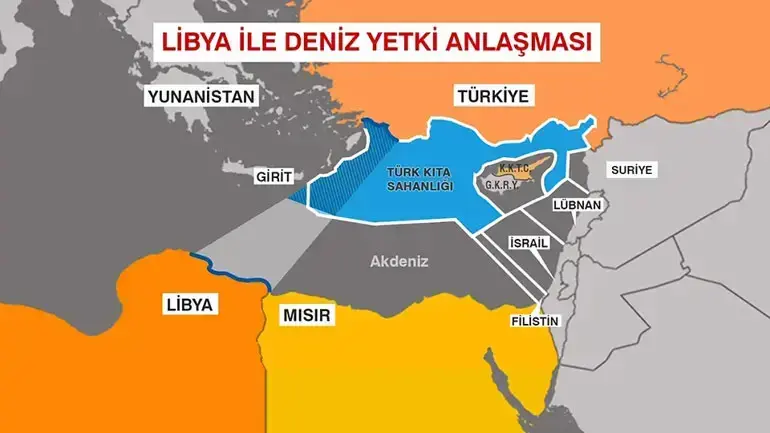

The Libyan House of Representatives, meeting in Benghazi, made international headlines when it unanimously ratified, on October 20, 2026, the Memorandum of Understanding on the Delimitation of Maritime Jurisdiction Areas signed on November 27, 2019, between Türkiye and the Government of National Accord (GNA) in Tripoli. It also revoked the boycott measures it had imposed against Ankara in 2020.
The approval, seven years later, by the eastern parliament backed by General Khalifa Haftar swept aside claims that the memorandum had been signed by an administration that did not represent all of Libya and was therefore legally invalid. This development paved the way for a new status quo that upended calculations across the Eastern Mediterranean.
Türkiye’s Libya policy—which halted bloody clashes between the parties and encouraged agreement on national interests—and its management of the process with strategic patience played a significant role in reaching this point. While Türkiye’s policies were undoubtedly instrumental in securing this outcome, the timing also requires consideration of the momentum generated by the Mecca Defense Alliance, which emerged from the principle of regional ownership.
Background to the Crisis: Libya’s Civil War and the Division of the Country
To appreciate the scale of the achievement in Libya, it is necessary to recall the conflicts experienced by the country after it descended into chaos following the Arab Spring, as well as the calculations of international actors.
After Muammar Gaddafi was overthrown and killed in 2011 following NATO-backed uprisings, central authority collapsed in Libya, and the country descended into civil war. The National Transitional Council (NTC) governed the country during the 2011–2014 period. Following the elections held in 2014, militias with different ideological orientations and regionally and tribally based armed groups began fighting one another across the country to preserve their authority and secure a share of its resources. As a result, the country formally split in two: two separate parliaments, two governments, and their affiliated armed forces emerged, one based in Tripoli and the other in Tobruk.
In the west, the Tripoli-based Government of National Accord, led by Fayez al-Sarraj and recognized by the United Nations as internationally legitimate, was established. Its armed forces consisted of the Misrata Brigades, the Tripoli Protection Force, and various militia groups. Türkiye, Qatar, and Italy were this government’s principal supporters.
In the east, the House of Representatives, based in Tobruk, emerged under Speaker Aguila Saleh. The Libyan National Army (LNA), commanded by General Khalifa Haftar, served as the parliament’s armed force. The Tobruk government was supported by the United Arab Emirates (UAE), Egypt, Greece, Israel, Russia—through Wagner mercenaries—and France.
The Military Balance and Diplomatic Moves
In April 2019, Khalifa Haftar and the LNA launched a major offensive to overthrow the internationally recognized GNA administration in Tripoli and laid siege to the capital. The bloody siege was broken through Türkiye’s military intervention and its support for the GNA. Following the fighting, Haftar’s forces were forced to withdraw from the outskirts of Tripoli. The front lines became locked along the Sirte–Jufra axis, establishing a military balance between the two sides.
Following the Permanent Ceasefire Agreement signed under United Nations auspices in Geneva, Switzerland, on October 23, 2020, large-scale frontline fighting and bombardments ceased completely across Libya. The UN-led Libyan Political Dialogue Forum convened. In March 2021, this process led to the establishment of a single interim Government of National Unity under Abdul Hamid Dbeibah, tasked with leading the country to elections. However, national elections could not be held because political and military actors failed to reach agreement and external powers intervened. The country’s dual administrative and military division persists, and lasting reunification and a unified national army have yet to be fully achieved.
Türkiye’s Strategy for an Undivided Libya and Its Effects on the Ground
Nevertheless, the eastern and western administrations developed a greater capacity to act together on the basis of national interests. Türkiye’s policy of preserving an undivided Libya, pursued after the ceasefire, played a major role in this development. By establishing balanced relations with both administrations, Türkiye made significant progress toward the goal of an inclusive and unified Libya.
Visits to Benghazi by Turkish officials and the head of Türkiye’s National Intelligence Organization (MİT) opened direct channels of communication with the Tobruk administration. Reactivating the Consulate General in Benghazi was a confidence-building step toward the eastern administration, enabling Türkiye to reestablish its diplomatic and commercial presence in eastern Libya.
Türkiye also succeeded in bringing military personnel affiliated with Libya’s previously warring western and eastern administrations together under one roof. The joint participation of personnel from both administrations in Turkish-hosted events such as Exercise EFES 2026 confirmed Türkiye’s credibility with both sides.
The Maritime Jurisdiction Memorandum and the Historic Agreement
On November 27, 2019, Türkiye and the UN-recognized Libyan Government of National Accord signed the “Memorandum of Understanding on the Delimitation of Maritime Jurisdiction Areas in the Mediterranean.” The memorandum was registered with the United Nations on September 30, 2020, pursuant to Article 102 of the UN Charter. At the time, however, the eastern Libyan House of Representatives refused to ratify it and decided to sever political relations with Ankara.
Taking advantage of Libya’s divisions, other countries, particularly Greece, opposed the memorandum, arguing that it had not secured the approval of the eastern parliament, did not represent an internal Libyan consensus, and was therefore invalid. On August 6, 2020, Greece and Egypt signed a separate agreement on the partial delimitation of their maritime jurisdiction areas.
Over time, however, direct relations with Türkiye helped change the Libyan House of Representatives’ position. On October 20, 2026, it unanimously approved the Memorandum of Understanding on the Delimitation of Maritime Jurisdiction Areas in the Mediterranean and revoked the boycott decision it had adopted against Ankara in 2020.
Before the session, the departure of Speaker Aguila Saleh—who had maintained his distance from Türkiye and blocked parliamentary approval of the 2019 agreement—and his replacement by al-Salihin Abdulnabi, former chairman of the Türkiye–Libya Friendship Committee, drew attention as an indication of the changing relationship. Another notable detail was the presence of MİT Director İbrahim Kalın in Libya when the agreement was ratified. These developments, which brought the two governments closer together, resulted from the close relations Türkiye had cultivated with both the western and eastern governments.
The Greek Foreign Ministry strongly rejected the eastern Libyan parliament’s approval, describing the Türkiye–Libya Memorandum as illegal and null and void. The European Union also expressed support for Greece: Ursula von der Leyen and António Costa stated that they did not recognize the eastern parliament’s decision and maintained that the memorandum was invalid. Nevertheless, its ratification decisively blocked unilateral moves by Greece and Southern Cyprus in the Mediterranean.
Which Plans Did the Memorandum Disrupt?
The maritime jurisdiction memorandum signed between Türkiye and Libya’s Government of National Unity and ratified by the House of Representatives established the Türkiye–Libya maritime boundary. This connected the Turkish and Libyan Exclusive Economic Zones (EEZs), creating a “maritime shield” or corridor along an east–west axis in the Eastern Mediterranean.
This maritime shield will overturn energy, geopolitical, and infrastructure projects through which Greece, the Greek Cypriot Administration, and Israel have sought to exclude Türkiye from the Eastern Mediterranean.
The principal projects affected by the memorandum are as follows:
The EastMed Pipeline Project: The proposed route of the EastMed pipeline, intended to transport Israeli and Greek Cypriot gas to Europe through Greece, directly crosses the Türkiye–Libya boundary line. Under the United Nations Convention on the Law of the Sea, this has made construction of the project without Türkiye’s permission legally and practically impossible.
The EuroAsia and EuroAfrica Electricity Interconnectors: The route of the €1.9 billion EuroAsia/EuroAfrica electricity interconnectors, intended to connect Israel, the Greek Cypriot Administration, and Greece through submarine cables, passes through Türkiye’s registered continental shelf, making their construction directly subject to Turkish permission.
Exploration and Drilling Projects: The boundary drawn between Türkiye and Libya undermined Greece’s claims that the islands of Kastellorizo and Crete should receive full continental shelf entitlements. Some areas divided into blocks or licensed by the Greek Cypriot Administration and Greece overlap with Turkish–Libyan jurisdiction areas, rendering legally uncertain the status of exploration and drilling licenses unilaterally granted to international energy companies such as Chevron, ExxonMobil, Total, and Eni.
The new maritime regime in the Eastern Mediterranean has increased Türkiye’s geopolitical weight along trade routes connecting Israel’s Mediterranean ports, including Haifa and Ashdod, to Europe and Western markets. This will prevent Israel from pursuing unilateral trade projects in the region. Meanwhile, Türkiye’s connection of its EEZ with Libya’s, together with its strengthening of the Blue Homeland strategy to protect its legal maritime rights, will restrict the Eastern Mediterranean operating space of Israel’s already weak navy.
Conclusions and a Vision for the Future
Türkiye has demonstrated a successful model by making substantial efforts to prevent conflict between people of the same country in Libya, reconcile the parties, enable joint action in pursuit of national interests, and seek avenues for shared governance based on the principle of territorial indivisibility. The maritime jurisdiction agreement with Libya’s western and eastern administrations emerged as a result of these efforts.
If Türkiye reaches an agreement with Egypt on maritime jurisdiction areas after Libya, it will be able to develop a new maritime geopolitical framework that protects the interests of all three countries against efforts by Greece, the Greek Cypriot Administration, Israel, and France to exclude it from the Eastern Mediterranean.
Meanwhile, the Mecca Defense Agreement signed by Türkiye, Saudi Arabia, and Pakistan has generated renewed enthusiasm and momentum in the region. Although Egypt is not yet an official member of the alliance, it is effectively acting as its fourth major ally. At present, at least ten Muslim countries are known to be ready to join the Mecca Defense Alliance.
The security and cooperation umbrella provided by this broad defense alliance will encourage countries to move closer together, transcending narrow national interests. The desire to become part of this alliance has played a significant role in bringing Libya’s two governments closer and enabling armies that were fighting until recently to conduct joint exercises.
The Mecca Joint Defense Agreement, together with Egypt’s and Libya’s rapprochement under this security umbrella, will deepen Israel’s isolation along the Eastern Mediterranean–Red Sea axis.
Ultimately, the shared understandings among Türkiye, Libya, and Egypt on cooperation in the Eastern Mediterranean and the delimitation of maritime jurisdiction areas will fundamentally reshape the regional status quo and the distribution of resources, offering the countries concerned substantial geopolitical advantages.
Source: sde.org.tr