
 Ibrahim A. Ibrahim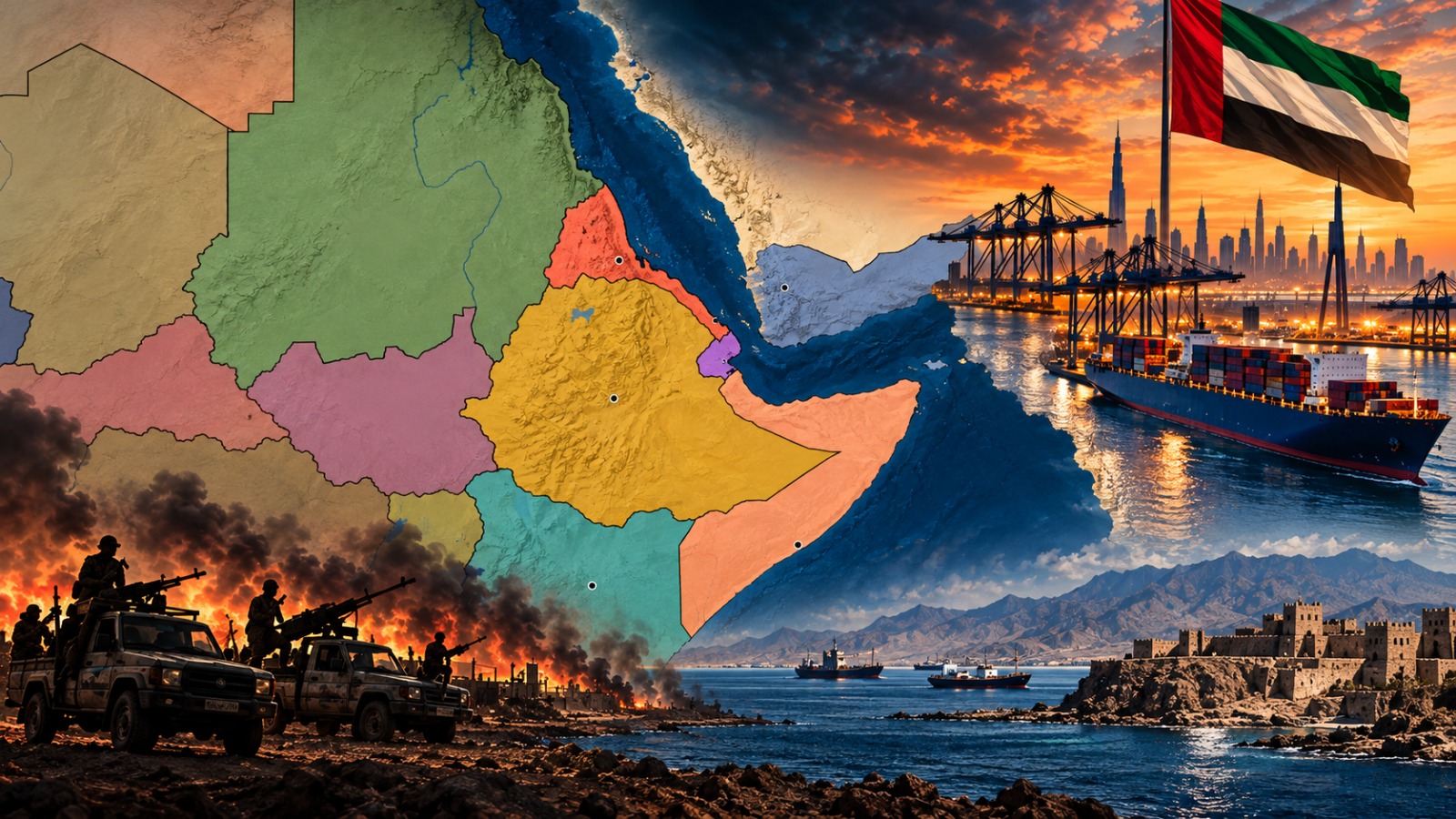

Ports, Proxy Wars, and the Sovereignty of the Horn of Africa
The Dangerous Intersection of Commerce, Ambition, and War
A port can be a gateway to prosperity or an instrument of geopolitical power. It can connect nations through trade, investment, and cooperation, or become a source of rivalry when commercial interests are entangled with military ambitions. Nowhere is this distinction more consequential than in the Red Sea and the Horn of Africa, where the pursuit of maritime influence is increasingly intersecting with territorial disputes, foreign military involvement, and devastating armed conflicts.
The Horn of Africa is approaching a dangerous crossroads. Sudan is being torn apart by a catastrophic civil war. Ethiopia remains engulfed in internal conflicts from six directions, while its increasing hallucination for sovereign access to the Red Sea have heightened tensions with Eritrea. Somalia faces its own challenges to territorial integrity, and competition among external powers threatens to deepen existing regional divisions. What once appeared to be separate crises are increasingly connected through overlapping alliances, military relationships, economic interests, and geopolitical rivalries.
At the center of this evolving landscape stands the United Arab Emirates (UAE), a country whose expanding network of ports and strategic partnerships has made it an influential actor across the Red Sea, the Gulf of Aden, and the wider Indian Ocean. Through state-backed companies, extensive investments, and security cooperation, the UAE has sought to establish itself as a leading power in international maritime commerce. There is nothing inherently objectionable about such ambitions. International investment in ports, transportation networks, and logistics infrastructure can generate enormous economic benefits. The problem arises when the pursuit of commercial influence becomes entangled with armed conflicts, support for competing military actors, and political ambitions that threaten the sovereignty of neighboring states.
The UAE’s close strategic relationship with Ethiopia, alongside serious allegations concerning its support for Sudan’s Rapid Support Forces (RSF), raises questions that can no longer be treated as isolated matters. To this add UAE’s support for Ethiopia’s aggression against Eritrea. What responsibilities do foreign governments bear when their military and financial assistance contributes to regional instability? Can a country credibly present itself as a champion of maritime security while facing allegations that its activities are prolonging conflicts along the very trade routes it seeks to protect? And what happens when the economic ambitions of powerful states begin to collide with the sovereignty of smaller coastal nations?
For Eritrea, these questions are particularly urgent. Ethiopia’s renewed emphasis on obtaining sovereign access to the Red Sea, especially through the Eritrean port of Assab, has transformed what could have been a legitimate discussion about commercial cooperation into a potentially dangerous confrontation over territory and sovereignty.
Understanding this crisis requires examining three interconnected developments: the UAE’s expanding maritime ambitions, its increasingly consequential involvement in the Horn’s security environment, and Ethiopia’s attempt to redefine its relationship with the Red Sea.
- The UAE’s Maritime Strategy: From Commercial Investment to Geopolitical Influence
The Red Sea as a Strategic Prize
The Red Sea is among the world’s most important maritime corridors. Together with the Bab el-Mandeb Strait and the Suez Canal, it connects the Indian Ocean with the Mediterranean, linking major markets in Asia, Europe, the Middle East, and Africa.
For the UAE, influence over this corridor offers opportunities extending far beyond ordinary port revenues. It provides access to international shipping networks, commercial intelligence, logistical infrastructure, and long-term relationships with governments controlling strategically located coastlines.
Through DP World and AD Ports Group, the Emirates has developed an extensive international network of terminals, industrial zones, transportation facilities, and logistics services. Its regional footprint includes Berbera in Somaliland, Bosaso in Puntland, and several Egyptian ports. In December 2023, AD Ports Group concluded a 30-year concession to develop and operate a terminal at Egypt’s Safaga Port, further expanding its presence along the Red Sea.
These investments are commercially significant, but their strategic implications are equally important. A country does not need to possess sovereignty over a coastline to exercise considerable influence over its commercial activities. Long-term concessions can provide control over critical terminals, access to shipping information, and enduring relationships with political and security institutions.
The UAE does not need to own the Red Sea to become an influential gatekeeper of its commerce. Control over strategically positioned ports and logistics networks can provide substantial economic and geopolitical leverage without formal territorial ownership.
That is the larger significance of its maritime expansion.
Why Ports Matter So Much to the UAE
The UAE’s strategy is partly driven by its own geographical vulnerabilities. Major facilities such as Dubai’s Jebel Ali Port depend heavily on shipping routes that pass through the Strait of Hormuz, a narrow maritime passage vulnerable to regional confrontation, political tension, and disruption. For a country whose prosperity is deeply connected to maritime commerce, reducing dependence on a single strategic chokepoint is therefore an important national consideration.
Developing alternative facilities outside the Persian Gulf, including Fujairah on the Gulf of Oman, reduces some of this exposure. Overseas port investments provide another layer of diversification, creating additional commercial opportunities while expanding the UAE’s logistical networks beyond its immediate neighborhood.
Economic transformation is another powerful motivation. The UAE has sought to reduce its long-term dependence on hydrocarbons by establishing itself as a global center for transportation, finance, technology, logistics, and international commerce. Ports are central to that strategy. They generate revenue not only through cargo handling but also through warehousing, customs services, industrial zones, transportation networks, and the broader commercial ecosystems that develop around major maritime hubs.
Food security adds another dimension. As a country heavily dependent on imported food and agricultural commodities, the UAE has a strong interest in maintaining reliable international supply chains and diversified transportation routes. Access to efficient ports and logistical corridors can therefore serve both commercial and national-security objectives.
Taken together, these considerations help explain why port development has become such an important component of the UAE’s national economic strategy. Yet the significance of these investments does not end with commerce. Their geopolitical consequences can extend considerably further.
A port concession lasting several decades can create enduring relationships with government ministries, customs authorities, security institutions, infrastructure agencies, and political elites. Commercial investments can consequently produce networks of influence that extend beyond the port itself. Under certain circumstances, commercial facilities may also support military logistics or other security operations, although such use requires appropriate political, legal, and operational arrangements and should not simply be presumed from commercial ownership.
That distinction is important. A port can remain fundamentally commercial while simultaneously possessing considerable strategic value. The same infrastructure that moves containers, fuel, food, and manufactured goods in peacetime can acquire very different significance during a regional confrontation.
Ports, therefore, occupy a unique position at the intersection of commerce and geopolitics. They are economic assets, but their location, infrastructure, and control can also make them instruments of diplomatic influence and, under certain conditions, military power projection. This dual character becomes particularly consequential when maritime investments are concentrated in politically fragile regions, where commercial competition, security interests, local political rivalries, and regional conflicts can become intertwined.
There is also a broader question that deserves separate examination: whether, in pursuing its own strategic interests, the UAE is at times coordinating with or advancing the interests of other regional middle powers. There are indications that such relationships warrant closer scrutiny, but establishing their nature, extent, and purpose requires evidence beyond the scope of this article. That subject deserves an article of its own.
For the present discussion, the crucial point is that the consequences of the UAE’s expanding maritime and political footprint cannot be understood solely through the language of ports, trade, and investment. Where commercial infrastructure intersects with fragile states and armed conflict, the stakes become considerably higher.
And nowhere is that intersection more consequential—or more devastating—than in Sudan.
- Sudan and Ethiopia: When Strategic Partnerships Become Regional Security Concerns
Sudan: The Cost of Entangling Ports With Armed Conflict
Sudan illustrates the tensions between the UAE’s maritime ambitions and the allegations surrounding its regional security policies.
In 2022, an investment arrangement involving Emirati interests envisaged the development of the Abu Amama port on Sudan’s Red Sea coast. The broader investment package, valued at approximately $6 billion, included associated economic and infrastructure projects.
Two years later, Sudan’s government announced that it was cancelling the agreement, explicitly citing allegations that the UAE was supporting the RSF, the paramilitary organization fighting Sudan’s national army.
The collapse of this prospective investment was significant. It demonstrated how allegations of military interference can undermine the political trust required for long-term economic cooperation.
Those allegations have become increasingly serious.
A January 2024 United Nations Panel of Experts report found credible allegations concerning weapons and ammunition transfers to the RSF through eastern Chad. The report described information gathered about shipments arriving at Am Djarrass airport and subsequently moving toward RSF-controlled territory.
Sudan has repeatedly accused Abu Dhabi of supporting the RSF through weapons supplies, logistical assistance, and other forms of military involvement. The UAE has denied these allegations and challenged the evidence presented against it.
The allegations require careful distinction from established findings of responsibility. Nevertheless, subsequent investigations and reporting have continued to raise questions about transnational military supply networks connected to Sudan’s war.
The consequences for Sudan have been catastrophic. Since fighting erupted in April 2023, millions have been displaced, communities have been devastated, and widespread food insecurity has compounded an already severe humanitarian emergency.
Against this background, an important question arises: Why would a country seeking commercial stability along the Red Sea become associated with allegations of military support that could prolong one of the region’s most destructive conflicts?
Several strategic considerations may be relevant. Sudan possesses important agricultural resources, mineral wealth, and a strategically located Red Sea coastline. Its internal political alignment also affects regional relationships and competition among Gulf states.
These factors may help explain why outside powers consider Sudan strategically important. They do not, however, establish that port control is the sole motivation behind alleged support for armed actors.
What they reveal is a broader danger: when commercial interests become entangled with military alliances, the pursuit of influence can undermine the stability upon which trade and investment depend.
Ethiopia: A Strategic Partnership Under Growing Scrutiny
Ethiopia represents another major component of the UAE’s regional strategy. With its large population, substantial domestic market, and dependence on external trade corridors, Ethiopia offers considerable commercial opportunities. For Emirati port operators, closer economic integration between Ethiopia and coastal facilities such as Berbera could create important transportation and logistics networks. The relationship extends well beyond commerce.
On January 6, 2026, the UAE and Ethiopia publicly reaffirmed their strategic partnership during high-level discussions. Their joint statement emphasized cooperation concerning peace, security, territorial integrity, and economic interests. Both governments also expressed support for regional stability and humanitarian assistance to Sudan. Such cooperation between sovereign states is legitimate. Governments have every right to establish economic, diplomatic, and security partnerships. The concern arises when those relationships become connected to armed conflicts affecting neighboring countries.
In February 2026, Reuters published an investigation reporting that Ethiopia was hosting a training camp for thousands of fighters associated with Sudan’s RSF. The investigation, based on multiple sources and supporting material, reported that the UAE had financed the facility and provided military trainers and logistical assistance. The camp was reportedly located in Ethiopia’s Benishangul-Gumuz region, near the Sudanese border. Reuters also examined the expansion of nearby aviation infrastructure and its possible relationship to military operations.
The UAE denied involvement in Sudan’s conflict. Reuters could not independently verify every allegation concerning the camp’s financing and purpose. Nevertheless, the investigation raised serious questions about whether Ethiopia was becoming a staging ground for a neighboring country’s civil war. The implications are profound.
If fighters are trained, equipped, or supplied from the territory of a neighboring state, the consequences extend beyond the country experiencing the original conflict. Such activities risk internationalizing the war, provoking retaliation, and drawing additional governments into confrontation.
In May 2026, Sudanese military authorities also accused Ethiopia and the UAE of involvement in a drone attack on Khartoum airport. These accusations require independent verification, but they illustrate the deterioration of regional trust and the growing danger of cross-border escalation.
The UAE–Ethiopia relationship must therefore be assessed not only according to the benefits it provides the two governments, but also according to its consequences for Sudan and the wider Horn of Africa.
Ethiopia’s Internal Conflicts and the Responsibility of Foreign Partners
The regional implications of foreign military assistance cannot be separated from Ethiopia’s internal security situation. The 2020–2022 war in Tigray caused immense human suffering, widespread displacement, destruction of infrastructure, and severe disruption of essential services. Although the Pretoria agreement of November 2022 formally ended that phase of the conflict, Ethiopia has continued to experience serious instability and armed violence in several regions.
Renewed fighting in northern Ethiopia in October 2026 has further heightened concerns about civilian protection and the possibility of a wider regional confrontation. Ethiopia’s government bears primary responsibility for protecting civilians and ensuring that its military operations comply with international humanitarian law. Armed opposition groups are likewise bound by applicable humanitarian obligations.
Foreign governments providing military assistance also have responsibilities. They should exercise appropriate oversight, assess the risk of misuse, and ensure that their support does not knowingly facilitate serious violations. This principle must apply consistently, regardless of the political alignment of the government receiving assistance.
The central question is whether military partnerships intended to advance national security are instead contributing to the spread of insecurity across the Horn.
For Eritrea, that question has acquired particular urgency because Ethiopia’s growing military tensions with its neighbors are unfolding alongside an increasingly assertive campaign for sovereign access to the Red Sea.
III. Assab and the Historical Contradictions Behind Ethiopia’s Maritime Claims
A Landlocked Country by Historical Agreement
The port of Assab occupies a strategically important position on Eritrea’s Red Sea coast. Before Eritrea regained its independence in 1993, Ethiopia relied heavily on Eritrean ports, particularly Assab and Massawa, for international trade. Eritrean independence once again left Ethiopia without a sovereign coastline.
Yet a crucial historical fact is frequently overlooked in contemporary Ethiopian political discourse: modern Ethiopia had already existed as a landlocked state for decades before its federation with Eritrea in 1952.
Its separation from the sea was not simply a condition imposed by European colonial powers. It also reflected territorial arrangements negotiated and accepted by Emperor Menelik II himself. During boundary negotiations with Italy in 1897, Menelik proposed that the frontier between Ethiopia and Italian Eritrea run approximately 60 kilometers inland from the Red Sea coast. This formula was subsequently incorporated into Article I of the Italo-Ethiopian Treaty of May 16, 1908, which provided:
“From the most easterly point of the frontier established between the Colony of Eritrea and the Tigre by the Treaty of the 10th July, 1900, the boundary continues south-east, parallel to and at a distance of 60 kilometers from the coast, until it joins the frontier of the French possessions of Somalia.”
The historical significance of this provision was confirmed by the Eritrea–Ethiopia Boundary Commission (EEBC) in its final and binding delimitation decision of April 13, 2002. In paragraph 6.9, the Commission recorded a point on which Eritrea and Ethiopia themselves agreed:
“The Parties agree that the origin of the ‘sixty kilometers from the coast’ formula was a recommendation by Emperor Menelik in 1897 to Major Nerazzini, the Italian negotiator.”
This acknowledgment is particularly important because it establishes that the formula’s origin was not merely an interpretation advanced by Eritrea. Both countries recognized Menelik’s role before the international tribunal responsible for delimiting their boundary.
The documentary sequence is clear: Menelik proposed the formula in 1897, it was incorporated into the 1908 treaty, and its origin was acknowledged by both parties before the Boundary Commission more than a century later. Nor was the Red Sea frontier the only instance in which Menelik participated in negotiations concerning Ethiopia’s distance from the coast.
A similar issue arose during negotiations with Italy over the frontier between Ethiopia and Italian Somaliland. Historical records from 1897 describe a proposed boundary approximately 180 miles inland from the Indian Ocean coast. The formula subsequently appeared in diplomatic correspondence and international proceedings, although its interpretation and application later became disputed.
Taken together, these records complicate the contemporary narrative that Ethiopia was arbitrarily deprived of a coastline without the participation of its own rulers.
They raise a question that advocates of sovereign maritime access must confront: If Emperor Menelik himself participated in negotiating boundaries that placed Ethiopia inland from both the Red Sea and the Indian Ocean, on what historical basis can Ethiopia’s present lack of a sovereign coastline be portrayed as an injustice that entitles it to territory belonging to its neighbors?
Ethiopia’s Own History Demonstrates That Trade Does Not Require Territorial Ownership
The historical record also challenges the assumption that Ethiopia must possess a sovereign port to participate effectively in international commerce. Menelik II, both as King of Shewa and later as Emperor of Ethiopia, relied on commercial routes through Tadjourah, in present-day Djibouti, and Zeila, in present-day Somaliland, rather than Assab. These trade corridors connected the Ethiopian interior to international markets long before the present dispute over Red Sea access.
Menelik’s infrastructure decisions reinforced this orientation. Rather than developing a railway from Addis Ababa to Assab, his government supported the Franco-Ethiopian Railway connecting the Ethiopian capital to Djibouti. Construction began in the 1890s, and the railway was completed in 1917. It became a major artery of Ethiopian commerce, demonstrating that maritime trade could be conducted through arrangements with neighboring coastal territories without acquiring sovereignty over their ports.
Djibouti continued to play an important role in Ethiopia’s foreign trade before the federation with Eritrea in 1952. Although Ethiopia subsequently relied extensively on Assab and Massawa, it also maintained commercial connections through Djibouti. Following the outbreak of the Eritrea–Ethiopia war in May 1998, Djibouti became Ethiopia’s principal maritime gateway and eventually handled the overwhelming majority of its international trade. This history demonstrates a fundamental distinction that is increasingly obscured in contemporary Ethiopian political rhetoric.
Abiy Ahmed’s Contradictory Maritime Rhetoric
This distinction is particularly relevant to the maritime ambitions repeatedly articulated by Prime Minister Abiy Ahmed. His public statements have created considerable uncertainty about Ethiopia’s intentions. At one moment, Abiy declares that Ethiopia has no intention of going to war with Eritrea over access to the Red Sea and insists that his government seeks a peaceful solution through dialogue. At another, his rhetoric becomes far more assertive, suggesting that Ethiopia will ultimately obtain sovereign maritime access regardless of opposition.
These conflicting messages, assurances of peaceful negotiation on the one hand and categorical declarations of sovereign access on the other, have raised serious concerns in Eritrea. The concern is particularly acute because the port of Assab has become a recurring focus of Ethiopian political discourse.
Assab as a modern port developed during the Italian colonial period. Yet contemporary political narratives increasingly portray it as a historical entitlement whose absence constitutes an injustice to Ethiopia. Such arguments overlook both the historical circumstances surrounding the port’s development and the internationally recognized boundaries separating Eritrea and Ethiopia.
For Eritrea, the Red Sea is not merely a route for international commerce. Its coastline is integral to its geography, sovereignty, economic potential, and national security.
For Ethiopia, maritime access is increasingly presented as indispensable to economic development. Yet Ethiopia’s experience during the decades when it controlled Eritrea and its ports complicates the argument that sovereign possession of a coastline is itself a solution to economic underdevelopment. Economic prosperity depends on effective institutions, infrastructure, investment, productive capacity, and regional cooperation. Territorial ownership alone guarantees none of these.
To assume that acquiring a coastline through military coercion would resolve Ethiopia’s economic challenges ignores both historical experience and the destructive consequences of war. More fundamentally, Ethiopia’s economic needs cannot override Eritrea’s sovereignty.
Assab lies within Eritrea’s internationally recognized territory. Any arrangement concerning the port must begin with respect for Eritrea’s independence, territorial integrity, and sovereign authority.
The prohibition against the threat or use of force against another state’s territorial integrity is a foundational principle of the United Nations Charter. Respect for borders and sovereignty is likewise central to the African Union’s legal framework. These principles are not obstacles to economic cooperation. They are the conditions that make peaceful cooperation possible.
- The UAE and Assab: Commercial Opportunity or Geopolitical Pressure?
The historical and legal status of Assab brings the discussion back to the UAE’s strategic interests. A central question is whether the UAE’s expanding maritime network and its close relationship with Ethiopia have any direct connection to Addis Ababa’s ambitions concerning the Eritrean port. There is a historical basis for examining this possibility.
In March 2025, Agence France-Presse reported that the UAE had previously proposed developing a pipeline connecting Ethiopia to Assab. The report also addressed misinformation circulating on social media that falsely suggested Ethiopia had regained control of the port. The proposed infrastructure project illustrates that Emirati interests have previously considered Assab’s potential role in regional economic connectivity. A commercial proposal involving an Eritrean port might not be evidence of a military plan to seize it and that distinction is essential.
The more consequential question is whether the UAE intends to use its economic and diplomatic influence to encourage mutually beneficial maritime cooperation or whether its security relationship with Ethiopia could contribute to an environment in which coercion becomes more likely. Abu Dhabi financing Ethiopia’s war budget, providing Ethiopia with military equipment however is directing Ethiopia toward war with Eritrea.
The convergence of three developments warrants scrutiny: the UAE’s extensive Red Sea port interests, its close strategic relationship with Ethiopia, and Ethiopia’s increasingly assertive maritime rhetoric. These developments become especially significant against the background of allegations concerning Emirati involvement in Sudan’s war and the reported use of Ethiopian territory for RSF training.
If military partnerships are contributing to instability in one part of the Horn, neighboring states have legitimate reasons to seek assurances that similar relationships will not facilitate further regional escalation. The UAE should therefore clarify its position concerning Eritrea’s territorial sovereignty and Ethiopia’s maritime ambitions.
Its January 2026 joint statement with Ethiopia explicitly emphasized respect for territorial integrity and regional stability. Those commitments should apply equally to Eritrea and every other sovereign state in the Horn. Any Ethiopian access to Assab must be based on Eritrea’s consent, negotiated agreements, and respect for international law.
The UAE’s economic and security partnership with Ethiopia should not be to support attempts to alter internationally recognized borders through coercion or military force. Clear assurances on these matters would help reduce regional uncertainty.
Cooperation Offers a Better Alternative
Nothing in this argument suggests that Ethiopia should be denied access to international maritime commerce. On the contrary, peacefully negotiated and mutually beneficial arrangements could serve the interests of Ethiopia and its coastal neighbors alike. Ethiopia could diversify its trade routes, reduce its dependence on any single maritime corridor, lower transportation costs, improve logistical efficiency, and expand its connections to international markets. Eritrea, Djibouti, Somalia, Kenya, and even Sudan could, in turn, benefit from increased port revenues, infrastructure investment, employment, transportation links, and greater regional trade. Ethiopia’s geography therefore need not be treated as a source of confrontation. It could instead become an incentive for deeper regional economic integration, with access provided through commercial agreements that fully respect the sovereignty, territorial integrity, and legal rights of the coastal states involved.
The region could also benefit from coordinated investment in roads, railways, energy infrastructure, industrial zones, and transportation networks. These opportunities demonstrate why the choice between commercial cooperation and military confrontation should not be difficult. Ports can serve the economic interests of several countries without ceasing to belong to the sovereign state in whose territory they are located. But such cooperation must be voluntary, transparent, and mutually beneficial.
It cannot be imposed through military threats, political intimidation, or claims that a larger country’s economic needs outweigh the territorial rights of a smaller neighbor. Ethiopia’s landlocked status presents an economic challenge, not a territorial entitlement. Commercial access can be negotiated. Sovereignty cannot be appropriated.
- The Red Sea Is Not the Property of Any Single Power
The issues surrounding Sudan, Ethiopia, Eritrea, and the UAE ultimately converge on a larger question: What kind of regional order should govern the Red Sea and the Horn of Africa?
One possibility is a system based on commercial cooperation, respect for sovereignty, peaceful dispute resolution, and shared economic development. The alternative is a region increasingly shaped by competing military alliances, external intervention, coercive diplomacy, and struggles for control over strategic infrastructure.
The UAE’s maritime strategy illustrates the tension between these two possibilities. Its economic success depends on predictable trade, secure shipping routes, functioning infrastructure, and stable relations among coastal states. Yet military involvement in regional conflicts, whether established or credibly alleged, can undermine precisely those conditions.
Sudan provides a particularly troubling example. A prospective multibillion-dollar port investment collapsed amid accusations of foreign military interference, while the country’s devastating war continued to destroy the infrastructure, institutions, and economic stability on which future investment would depend. The lesson extends beyond Sudan.
The Horn of Africa cannot become a prosperous international trading hub if its ports, transportation corridors, and coastal territories are surrounded by expanding conflicts. Nor can Red Sea security be achieved through arrangements that strengthen one country’s ambitions at the expense of another country’s sovereignty.
For Eritrea, Sudan, Somalia, Djibouti, Ethiopia, and the other states bordering or depending upon the Red Sea, the central issue is not whether foreign investment should be welcomed. Investment, technology, infrastructure development, and maritime expertise can contribute substantially to regional prosperity. The issue is whether such engagement respects national sovereignty and remains separate from coercive political and military objectives.
Long-term port concessions negotiated transparently between sovereign governments are legitimate commercial arrangements. Unlawful arms transfers, military intervention, and efforts to impose political outcomes through force are fundamentally different matters.
Confusing the two risks transforming the Red Sea from a corridor of international commerce into an arena of permanent geopolitical confrontation. The same principle applies to Ethiopia’s maritime aspirations. A country’s population, economic importance, or military strength does not give it greater territorial rights than its neighbors. International law does not recognize territorial entitlement based on population size, economic necessity, or geopolitical ambition.
The rules protecting sovereignty and territorial integrity must apply equally to all states.
Conclusion: The Red Sea Cannot Be Secured by Destabilizing Its Shores
The Horn of Africa does not suffer from a shortage of economic opportunities. It suffers from the repeated subordination of those opportunities to political rivalry, military confrontation, and competing ambitions for regional influence.
Its ports could connect markets. Its transportation corridors could link producers to consumers. Its coastlines could support international commerce, industrial development, and employment. Its strategic location could make the region one of the world’s most important centers of economic exchange.
Instead, the region faces the danger of becoming an interconnected theater of conflict, where internal wars spill across borders, foreign military partnerships deepen rivalries, and legitimate commercial interests are increasingly entangled with struggles over sovereignty.
The UAE’s maritime ambitions must be judged against this reality. There is nothing inherently illegitimate about seeking to become a leading global logistics power. Nor is there anything objectionable about investing in African ports, building transportation networks, or developing strategic economic partnerships. But the pursuit of commercial influence cannot be separated from responsibility for the consequences of foreign military and security policies.
Emirati support for Sudan’s RSF, the reported training of RSF fighters on Ethiopian territory, and the increasingly tense security environment surrounding Eritrea all demand independent scrutiny. The UAE has every right to pursue commercial investments and strategic partnerships. Those interests cannot justify conduct that violates international law or contributes to the destabilization of neighboring states.
The international community, particularly the African Union and the United Nations, should condemn any unlawful military assistance, and uphold the territorial integrity of every state in the region.
The fundamental contradiction at the heart of the present crisis is that the pursuit of maritime influence can destroy the very stability that makes maritime commerce valuable.
A port surrounded by war is not a gateway to prosperity. A trade corridor sustained by military coercion cannot provide lasting security. And an economic partnership built at the expense of a neighbor’s sovereignty cannot become the foundation of durable regional peace.
The Horn of Africa deserves a different future, one in which economic development is pursued through cooperation rather than conquest, security is built through mutual respect rather than intimidation, and international investment strengthens sovereign states instead of drawing them into destructive rivalries.
The Red Sea belongs to no single regional or external power. Its waters connect nations, but its coastlines remain subject to the sovereignty of the states that possess them. No foreign government should be permitted to turn the economic aspirations of one country into a justification for violating the territorial integrity of another. No strategic partnership should become a license for regional destabilization.
And no ambition for maritime dominance should be allowed to sacrifice the peace and security of millions.
The Red Sea should be a bridge between nations, not a battlefield for competing ambitions. Its future must be determined by cooperation, international law, and respect for sovereignty, not by the ambitions of those who believe economic power or military strength entitles them to control it.