

 Prof. Dr. Mehmet Özkan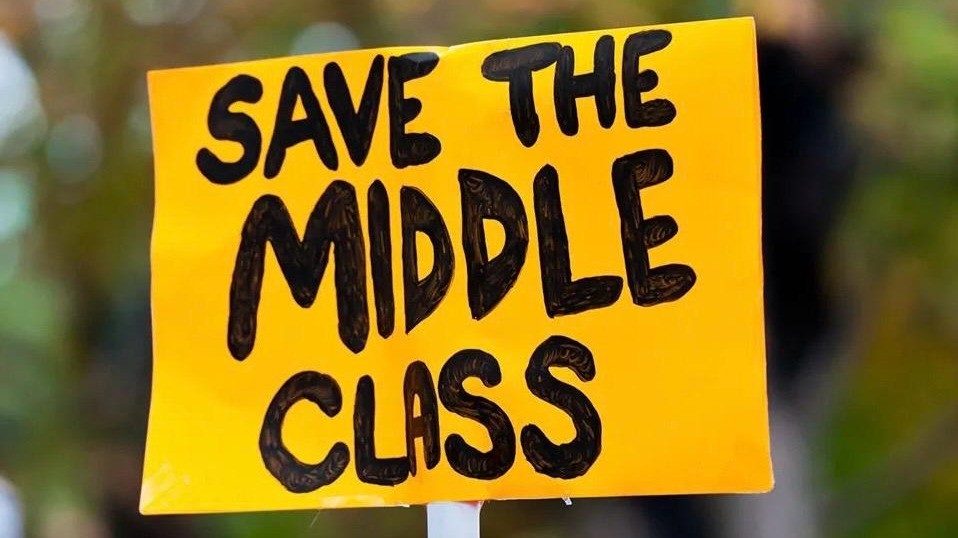

One of the most fundamental changes in world politics is happening quietly: the decline of the middle class. This is generally seen as an economic question – about salaries, housing, inflation or inequality. But it should be seen as a political and security issue.
And the argument is simple. In a world with a smaller, poorer or less secure middle class it is hard to preserve political stability. Protest movements are growing, anti-establishment politics are on the rise, and governments are increasingly turning to police, intelligence, surveillance and other security institutions to control social tensions.
But the worldwide picture is spatially diverse but overall it shows the decreasing of middle class everyplace.
The Asian middle class has been growing massively, helped by industrialization, urbanization, and economic expansion. In fact, much of the growth in the global middle class has been driven by China, India and other Asian economies.
But stats can be deceiving. Asia has around 60 percent of the world’s population. Big numbers of people still economically insecure can so coexist with hundreds of millions of new middle-class consumers. Furthermore, a large part of Asia’s emerging middle class is made up of relatively recent arrivals and in many cases their economic security is far weaker than that of the conventional Western middle class.
In Europe, the share of persons in middle-income families fell from 64 percent in the mid-1980s to 61 percent in the mid-2010s and the share of the middle class in total income shrank from 69 to 64 percent. Two-thirds of individuals who left the middle-income bracket went downhill, not ahead.
The picture in the Middle East is much more precarious. Poverty and economic fragility are structural long-term concerns in MENA as defined by the World Bank. Extreme poverty climbed from 4 per cent in 2010 to 8.6 per cent in 2021 and was expected to reach 9.4 per cent in 2025.
Africa has its own version of the same dilemma. The problem is not just the erosion of the middle class but the failure to develop a middle class large enough and economically secure enough. By the World Bank’s 2019 estimates, 85 percent of Sub-Saharan Africans lived below $5.50 per day, which means the genuinely secure middle class was a minuscule proportion by that yardstick.
In 2023, the middle class in Latin America actually reached 41.1 percent of the population, although 31.5 percent remained in an economically vulnerable category just below the middle class. The big concern here is the instability of middle class.

These regional variances hint to the same political challenge. The critical political fault line for the next decade may be between rising expectations and falling security.
The middle classes are politically significant because they offer a stable center to society. They possess property, they want working institutions, they invest in education, they hope to get forward in their careers, and they generally have something to lose from political turmoil. When that class feels insecure, the stabilizer breaks down.
That is why the next global protest cycle may not start primarily from the poorest. It is likely to come more and more from educated, metropolitan and digitally-connected populations whose expectations much outstrip their economic opportunities. And here is the most under-appreciated (and unexpected) consequence: the growing political influence of the security sector.
As societies polarize and protest becomes more frequent, populist regimes will encounter more and more political difficulties as public-order concerns. Political importance of police forces will increase. Intelligence agencies will turn their emphasis more to internal disruption. Governments will spend more on surveillance, facial recognition, artificial intelligence, cyber monitoring and predictive policing. Ministry of interior and national security councils will have greater say on matters that were previously handled primarily through social and economic policy.
The divide between social and security policies will slowly fade away. Bureaucracy and security sector and (partners surrounding it) is likely to determine not only high politics but also everyday activities, politics will be subordinate to this.Protest can be securitized. The urban disorder can be securitized. Online mobilization can be an issue of securitization. Economic strikes can be a security issue. Even frustration arising from the price of housing, unemployment or falling purchasing power might finally manifest as a security challenge to the state.
Is this the death of democracy? It is too soon to say, but the conclusion is that a new trend is emerging in world politics. This sets up a potentially hazardous political cycle.
Middle class decline leads to political frustration which leads to public protest and unhappiness. This leads to more security intervention and then falling institutional trust and inciting further protest again. This cul-de-sac only further legitimizes the growing involvement of security sector in governments.
So the security sector is not only an instrument of the state, but an increasingly crucial institution for the management of the social implications of economic transition. This does not need to be authoritarianism. It is a reasonable obligation of governments to provide for public order. But when economic difficulties continuously cause political instability, governments may view coercive and surveillance tools as speedier and easier to use than structural economic improvements.
Temptation will increase. The future of world politics will not be decided by the contest of major nations alone rather what occurs within societies when millions of people feel that the economic system no longer guaranties upward mobility.
If the middle class stops being the stable middle of society, the political space between citizens and the state will be more contested. If that space gets more disputed, the security industry will move more and more to the heart of politics.
