 Alberto M. Fernandez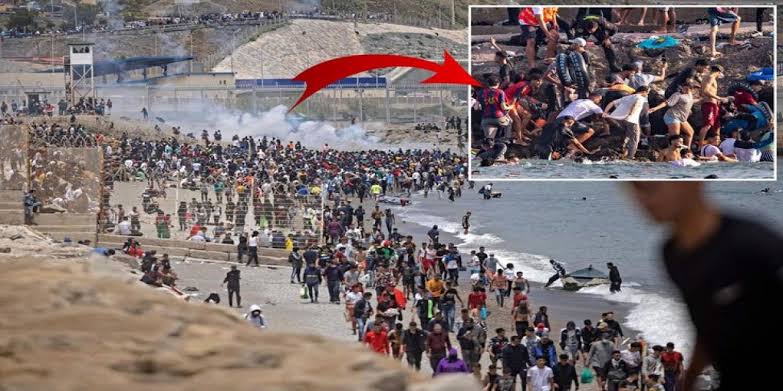

The images circled the globe and generated debate, memes and disinformation. Thousands, actually tens of thousands, of young men flooded the Spanish African city of Ceuta on the Moroccan coast. It was presented or contested as a story about uncontrolled migration, and the events in Ceuta are certainly part of that narrative, but there is much more to the story.
Ceuta, and the other Spanish city on the African coast, Melilla, are not “occupied territories” — not according to international law and the United Nations. They were never subject to debates on decolonization, and the Kingdom of Morocco has historically and legally — if very grudgingly — recognized them as Spanish territory.
Both cities are historical remnants of what was a political, religious and demographic reality that existed for centuries. There was a time when there was both a political and religious unity between the northern and southern shores of the Mediterranean Sea. That unity first came from the Roman Empire and then from the Catholic Church.
The Islamic conquests of the eighth century swept away that unity, but even well into the 20th century there were tens of thousands of Catholics of Latin (Spanish, Italian, French, Maltese) origin living in peace on the North African coast — in Oran, Algiers, Tunis, in parts of Libya and in Alexandria, Egypt. All these populations were swept away in the 20th century. They fled (Algeria) or were pushed out (in Tunisia, Libya and Egypt) by nationalist governments. Only Ceuta and Melilla, ruled by Spain, remain as Catholic cities.
Throughout North Africa you can see the physical remnants of this once rooted Catholic population, often in the shape of churches turned into mosques. But sometimes they were turned into schools or police stations or just allowed to decay.
In Tunisia, the mighty Cathedral of St. Louis of Carthage (consecrated in 1884) was turned into a concert hall. In Port Said, Egypt, the Latin cathedral was eventually handed over to the indigenous Coptic Orthodox. A few buildings remain in Catholic use.
In the former Italian Tunisian neighborhood of La Goulette — actress Claudia Cardinale grew up there — the whitewashed church of St. Augustine and St. Fidele dates from 1838 and offers the Mass in French, English and Spanish. Most of the small congregation are Sub-Saharan Africans temporarily living in Tunisia and trying to get to Europe.
The Spanish Catholic population of Ceuta and Melilla (both have populations of about 80,000 each and are still mostly Catholic, although the percentages are declining) is larger than the number of Catholics resident today in Morocco, Algeria, Tunisia and Libya combined. The flood of migrants into Ceuta in late July caused the cancellation of a week of August festivities dedicated to Our Lady of Africa, patroness of the city, whose 14th-century Gothic image was brought there by Portuguese Prince Henry the Navigator in 1421. Although the festivities were canceled, it is still expected that her image will be processed through the city on Aug. 5, her feast day.
The other hidden story about the Ceuta migrant crisis, not exactly hidden but shocking and disturbing, is the disinformation angle. There have been feverish online campaigns connected to the incident, and not in one direction but several.
First there was online coordination, on WhatsApp and Facebook, encouraging thousands of Moroccan youths to descend on the city. Whether it was the Moroccan government or trafficking gangs or Islamist opponents of the Moroccan government — or some combination thereof — is still not fully clear. Spain officially blamed trafficking gangs, others blamed Morocco, while still others pointed to the cynical pro-immigrant policies of Spain’s leftist government.
The other online campaign connected to the Ceuta events, pushed by the far left, some far-right nativists, and supporters of Iran and other Islamists, sought to blame Israel and the United States, along with Morocco. The conspiracy theory goes that the three countries are opposed to Spanish Prime Minister Pedro Sánchez’s “pro-Palestine” or “anti-imperialist” policies and sought to bring his government down by unleashing masses of migrants. Both Iran’s Foreign Minister Abbas Araghchi and far-left American influencer Hasan Piker pushed this line, guardedly in the case of the former and openly in the case of the latter. With the rise of global antisemitism, an antisemitic take on almost any issue has been seemingly routinized.
While it is true that some very online Israelis or Jews in the West have gloated at the Spanish predicament, the Israeli government largely has not. Israel did face the unedifying spectacle of its ambassador to Madrid having to correct the intemperate remarks of its ambassador to the United Nations. And, of course, thousands of migrants descending on Ceuta is nothing new; it happened in 2021 when more than 10,000 people crossed the border within 24 hours. Spain, under the Socialists, is not very enthusiastic about border protection in general, and the country has acquired the deserved reputation of being the “weak link” in European efforts to control migrant flows.
And the challenge of Spain’s porous borders isn’t limited to Morocco. More than 11,000 migrants have come in small boats from Algeria to Spain’s Balearic Islands over the past 18 months, while thousands more, mostly from Sub-Saharan states like Senegal and Mali, have landed on the Canary Islands. The Spanish government puts the arrivals up in tourist hotels and then transports them to the mainland.
Recent papal visits to Spain and Lampedusa have underscored the Church’s deep interest in the issue of migrants and their treatment. But Ceuta also highlights how migration flows can easily be, and are, weaponized not just by countries that facilitate them, but also by countries that receive them, by cynical politicians, and by nation-states and bad actors interested in chaos and bringing down their adversaries in any way possible.
*Alberto M. Fernandez is a former U.S. diplomat and a contributor at EWTN News.
Source: https://www.ncregister.com/commentaries/fernandez-ceuta-crisis