 J. Ricardo Martins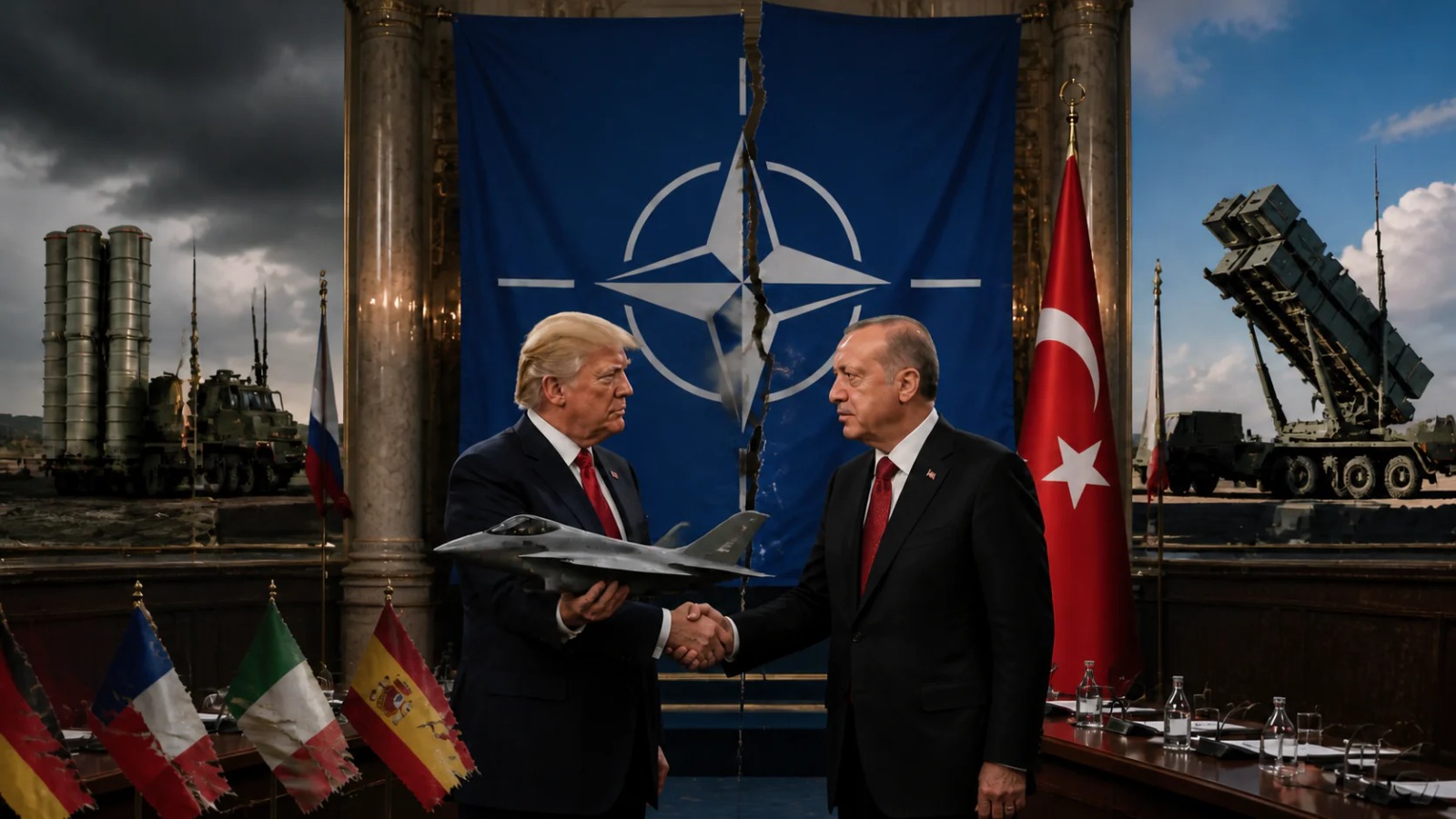

The NATO summit in Ankara was advertised as a moment of unity. Instead, it laid bare the alliance’s fractures and hollow rituals: a U.S. president openly antagonistic toward Europe, a gaping missile-defence deficit, and a Turkey that has become indispensable.
Long ago, in 1966, French General Charles de Gaulle argued that NATO was not primarily a mutual defence arrangement but a mechanism for American ordering and control of Europe. That is the reason why De Gaulle withdrew France from the military alliance and expelled American military personnel and NATO headquarters from French soil. Today, in Ankara, the Turkish capital, the NATO alliance revealed its limits, dominated by the United States.
A summit that showed the alliance is cracked
Ankara was set to stage NATO’s tired pageantry: polished group photos, hollow declarations, and the well-worn script of unity. Instead, despite Trump’s playful statement of “tremendous unity in that room,” the summit felt like a stress test the alliance was ill-prepared for. Donald Trump didn’t even pretend to be the guardian of the transatlantic order. Instead, he played the saboteur-in-chief, hurling threats, putting down allies, and reducing collective defence to a cheap bargaining chip. Spain was severely humiliated by Trump for refusing to join the 5% spending effort.
NATO did not collapse. But it is now standing on fractured ground. Trump’s lingering fury over Europe’s refusal to join the unlawful U.S. and Israel attack on Iran loomed over the meeting. His bizarre fixation on Greenland was less comic relief than a window into his worldview: allies are not partners, but assets to be squeezed and to get good deals. Even the summit’s indifferent final communiqué evidenced damage control rather than conviction.
Yet Trump’s threat was only the symptom; NATO’s real disease is the insecurity it tries desperately to hide. The alliance has become a club that spends more time reassuring itself than defending anything meaningful. While Trump scolded allies for not joining his illegal war in Iran, he tossed out half-promises to Ukraine about Patriot missile systems and, bizarrely, circled back to his obsession with Greenland, as if NATO were his personal real estate portfolio.
The European nightmare: missile defence, and the illusion of protection
If the summit had one strategic truth, it was this: Europe is dangerously underprepared for the kind of war it now fears most. Air and missile defence has moved from technical jargon to geopolitical nightmare. Russia’s war in Ukraine, the erosion of U.S. attention, and the depletion of Western stockpiles have all pushed the problem to the top of the European agenda.
The uncomfortable fact is that Europe still depends overwhelmingly on American systems, American production lines, and American political goodwill. Patriot batteries, THAAD interceptors, long-range defensive coverage: these are not luxuries; they are the shield. And Europe has too little of it.
Some European states have tried to close the gap, but mostly by buying more foreign equipment rather than building strategic autonomy. Germany’s Arrow 3 is impressive but limited. NASAMS and IRIS-T fill some holes but not the highest-end ballistic threat. The Franco-Italian SAMP/T exists as an alternative, yet its industrial base remains too thin to rival the U.S. in scale or speed.
That is the European nightmare in one sentence: the continent has learned it needs missile defence, but still cannot say with confidence who will provide it, in what quantity, and when. Worse, Washington may no longer be in a position to supply everyone. Europe could discover that, in a crisis, it is not first in line. It may be at the end of it.
Trump pleased only Erdoğan and criticised all others
If there was one leader who left the summit satisfied, it was Recep Tayyip Erdoğan. Trump’s visit handed him exactly what he wanted: recognition, leverage, and the appearance of rehabilitation. Washington signalled that it could lift CAATSA sanctions imposed over Turkey’s purchase of Russian S-400 systems and even consider selling F-35 fighters again. For Erdoğan, that is not just a military question. It is political vindication.
Everyone else had reason to be uneasy.
Trump’s message to allies was as crude as ever: pay up, fall in line, and stroke his ego. Europe and Canada endured the ritual cautioning. The summit devolved into theatre, devotedly prepared by NATO’s Secretary General, Mark Rutte, for Trump’s transactional style: a style that confuses bullying with diplomacy and loyalty with obedience. Effectively, only Turkey managed to extract tangible gains from the spectacle, exposing the hollowness of NATO’s supposed unity.
That is what makes Erdoğan so useful to Trump and so dangerous to his critics. He can be courted as a strongman who delivers. Behind the summit smiles sits a harsher truth: Turkey’s international value is now being used to mute concern at home. The opposition remains under pressure, and political trials continue.
How Turkey became vital to NATO
Turkey was once treated inside NATO as the awkward member: too independent, too transactional, too willing to irritate allies. That image is outdated. Today, Turkey is central to the alliance’s security calculations.
Part of the reason is geography. Turkey controls the Black Sea’s gateway and sits on NATO’s southern flank. Part of it is military weight: the alliance’s second-largest army, useful not only on paper but in a region where manpower still matters. And part of it is industry. Turkish defence production has become faster, cheaper, and more export-ready than many Western competitors.
But the deeper reason is political. The wars in Ukraine and the Middle East, combined with Trump’s return to the White House, have forced NATO to value Turkey. Ankara can mediate, obstruct, open doors, close them again, and talk to almost everyone – a fact that Europe cannot. In a broken security environment, it becomes valuable.
It also makes it dangerous. Turkey’s leverage comes from ambiguity. It can support Ukraine while preserving channels to Moscow. It can host NATO while resisting NATO’s instinct to push deeper into the Black Sea. Instead of NATO encircling Russia, as proposed by the Europeans, Turkey proposes a demilitarised belt. It can present itself as indispensable while refusing to behave like a reliable ally in the liberal sense of the word.
Brussels can’t ignore Turkey. But can’t embrace it either
The European Union is stuck in a trap of its own design. It cannot build a credible security architecture without Turkey, but Brussels can’t pretend Turkey actually shares the EU’s supposed values. The gap between what Europe claims to stand for and what it’s willing to accept could not be more obvious.
Officially, Brussels keeps Turkey at arm’s length. Turkey’s bid to join the EU is dead in the water. Cyprus is still an open wound, and the rule of law issues aren’t just isolated incidents—they’re the new normal. Yet, for all the moral posturing, Europe keeps the deals flowing with cooperation in migration, energy, trade, Black Sea security. The bare truth is that Europe needs Turkey far too much to actually walk away.
A note on European values and morals: after Gaza and its support for Israel, Europe’s moral authority is viewed as hollow and posturing by the Global South, including Turkey.
The result is strategic hypocrisy, plain and simple. While some European leaders still talk about values, others go for ‘pragmatism.’ Brussels, as usual, hides behind ambiguity and indecision, a posture fast becoming untenable. Turkey controls Black Sea access, influences energy routes, and its defence industry is only getting stronger. Europe can’t wish these facts away. In the end, the EU’s proud talk about values is held hostage by its own dependence on Ankara.
Europe’s real dilemma isn’t whether Turkey matters—of course it does. The question is how to handle a country that is a partner, problem, and pressure point all at once. For Brussels, it’s a game with no good moves. The situation becomes more critical because Europe no longer has high-level diplomacy.
In sum, this is the bare conclusion from Ankara: NATO is fractured, Europe is exposed, Trump is transactional to the point of recklessness, and Turkey has engineered its status as the indispensable country, though facing trust issues.
*Ricardo Martins – Doctor of Sociology, specialist in European and international politics as well as geopolitics
Source: https://journal-neo.su/2026/07/09/ankaras-summit-of-fractures/