

 Michael S. Weiss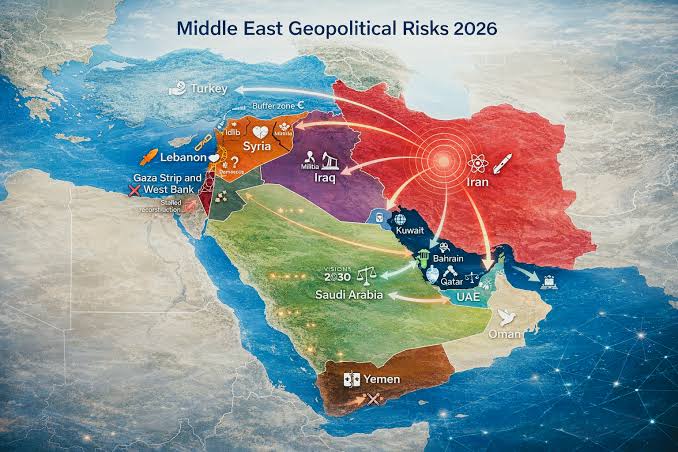

Shifting Tectonic Plates in the Middle East:
The dominant narrative shaping Middle Eastern politics for the past half-century has been the irreconcilable ideological and military conflict between the West (specifically the US) and Iran. Since the 1979 Islamic Revolution, Iran has been positioned as the greatest threat to Western interests in the region, while Israel has stood as the most loyal guardian of those interests and the regional status quo. Yet, the most immutable rule of history and geopolitics remains: there are no permanent friendships or enmities, only permanent interests.
Today, the unchecked spiral of violence escalated by Israel, its demographic confinement, and its severe loss of legitimacy in Western public opinion bring a structural question to the fore: If the West seeks a new anchor to secure long-term stability and energy corridors in the Middle East, could Iran—with its historical weight and institutional statecraft—assume this role?
Analyzing this radical hypothesis requires examining the historical background, geopolitical imperatives, and the deeply rooted dynamics of the region.
1. The Legacy of the Shah Era: Codes of “Regional Gendarmery”
The concept of Iran establishing a strategic partnership with the West and undertaking an order-building mission in the region is not a novelty in human history. Prior to 1979, under the Pahlavi Dynasty, Iran played the exact role of the “regional gendarme” and the guardian of Western interests that Israel holds today. As one of the twin pillars of the Nixon Doctrine during the Cold War, Iran single-handedly secured the Persian Gulf while preventing Soviet expansionism from pushing southward.
Historical Depth: The Iranian state apparatus possesses 2,500 years of imperial reflexes and a deeply ingrained strategic culture. While the “Axis of Resistance” rhetoric used by Tehran today serves as an ideological veil, it fundamentally represents Iran’s quest to project power and create geopolitical depth across its borders. Once this ideological shell is stripped away, what remains is a massive state structure characterized by institutional continuity, fully capable of negotiating with the West.
2. Israel’s Eroding Legitimacy and Its Cost to the West
Since its inception, Israel has functioned as a “regional fortress” for the West in the Middle East. However, recent developments indicate that this fortress is becoming a liability, carrying costs that may no longer be sustainable for the West:
Military and Economic Dependency: Israel relies heavily on uninterrupted military, financial, and diplomatic backing from the West (particularly the US) to maintain its security. Iran, conversely, has built its own domestic military-industrial complex and transformed itself into a regional and global actor despite decades of isolation and embargoes. For the West, Iran represents a self-sufficient powerhouse rather than a dependency requiring constant subsidies.
The Legitimacy Crisis: Israel’s unconstrained military escalations in Gaza and Lebanon have fundamentally shaken the narrative of a “rules-based international order” that Western powers claim to uphold globally. As the chasm between the Global South and the West widens, Western elites may eventually be forced to seek less politically costly and more sustainable partnerships to safeguard their strategic interests.
3. Energy Geopolitics and the “Belt and Road” Balance
The stability of the Persian Gulf and the Strait of Hormuz remains vital for the preservation of Western global hegemony. China’s growing economic footprint in the region, coupled with its efforts to pull Iran into its orbit (evidenced by their 25-year strategic agreement), forces the West toward a critical crossroads.
To completely ostracize Iran is to permanently drive it into the Sino-Russian axis. Conversely, a structural “Grand Bargain” with Iran would open the gates to a massive energy market for the West, while offering a unique opportunity to contain Russia and China across Central Asia and the Caucasus. Due to its geography, Iran sits at the crossroads of East-West and North-South trade routes, making it a geo-economic center of gravity that Israel simply cannot match.
Potential Scenarios and Structural Obstacles
Iran becoming a new “guardian of the status quo” (a new Israel mission) for the West is not a transformation that will occur overnight. This paradigm shift faces two major structural hurdles:
| Structural Obstacle | Geopolitical Reality & Likelihood of Overcoming It |
| Tehran’s Ideological Baggage | The internal legitimacy of the Iranian regime is built entirely upon “Anti-Zionism” and “Anti-Americanism.” However, Chinese-mediated normalization with Saudi Arabia and various nuclear negotiations prove that Tehran can flexibly pivot toward Realpolitik principles when under extreme pressure. |
| The Pro-Israel Lobby in the West | It remains highly difficult to swiftly alter the institutionalized perception of Iran held by the entrenched military-bureaucratic establishments, neoconservatives, and powerful lobbies in Washington and European capitals. |
Nevertheless, long-term geopolitical projections whisper that a scenario where “Iran is fully integrated into the global system and manages regional balances as a rational actor” would ultimately serve Western global vision far better than a fragmented, uncontrollable Middle East.
Conclusion
Should Iran ever assume a new Israel mission for the West, it will mark the triumph of geography and statecraft over ideology. As the security vacuum and instability generated by Israel deepen in the region, Western rationalism may eventually seek ways to sit back at the negotiating table with the Middle East’s oldest state tradition. The future of the Middle East may well be pregnant with a startling rupture—one where today’s enemies become tomorrow’s order-building partners, a shift entirely aligned with the true nature of geopolitics.
