 Peter Koenig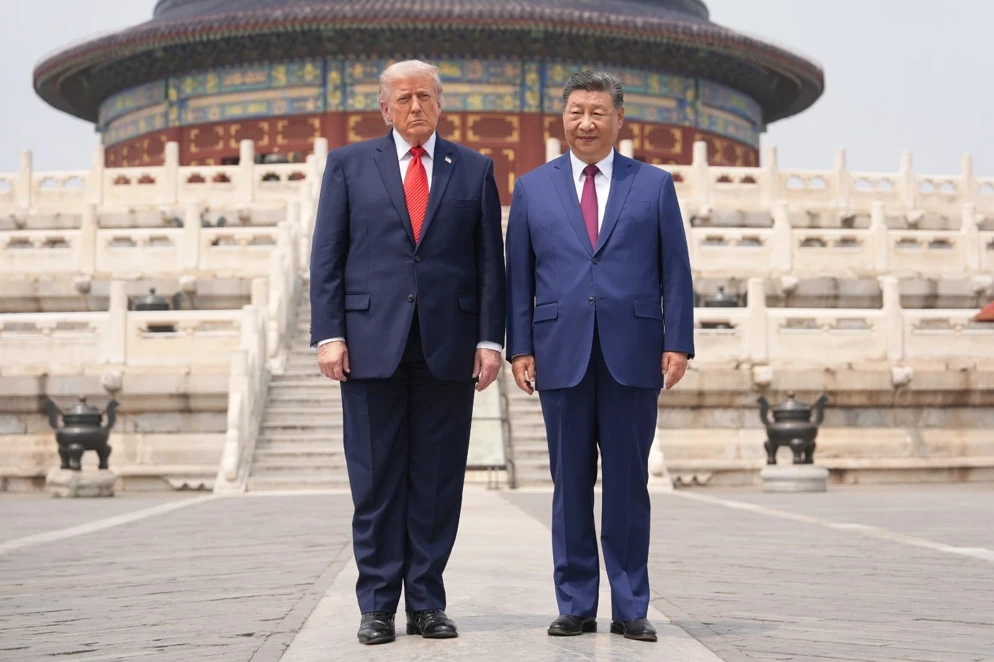

A Win-Win under China’s Upper Hand
President Trump arrived in China on Wednesday, 13 May, and received full red-carpet treatment from start to finish, in line with China’s customary hospitality toward visiting leaders—even when they are not especially aligned with China’s political and economic principles.
The Trump delegation first visited the Temple of Heaven in Beijing.
China’s culture is widely regarded as one of the world’s oldest civilizations, shaped by thousands of years of history and tradition. The United States, by contrast, has a comparatively younger cultural history.
At the outset and with President Trump’s endless involvement in wars, like the Israel-instigated Iran war, and US-executed war in the Middle East, with Trump’s worldwide infamous trade policies and his general posture as world emperor, it is clear that President Xi Jinping has the upper hand (see also this brief BBC clip).
The official White House statements say the leaders expect substantive economic and security discussions and possible large commercial purchases to be announced before the trip ends.
President Trump arrived in Beijing for a two‑day summit with President Xi Jinping amid expectations that the leaders will focus on Taiwan, tariffs and trade, Iran, and China’s control over rare‑earth supplies—issues where Beijing has tangible leverage and Washington has strong incentives to secure cooperation.
Taiwan
The matter about Taiwan revolves around the issue of core sovereignty. It is marked by high sensitivity. Beijing treats Taiwan as its top political priority and will press for limits on U.S. arms sales and diplomatic signals to Taipei. Washington will push for continued deterrence and “strategic ambiguity” to reassure alliance with Taiwan’s government.
Likely outcome: limited, non‑public understandings or face‑saving pledges (e.g., procedural steps to avoid provocative actions, hotline arrangements, or language about reducing escalation) rather than any formal U.S. policy reversal—because U.S. domestic politics and alliance commitments constrain major concessions.
Thus, President Xi’s position will remain firm; Trump’s wishy-washy concessions have no substance and only serve for temporary noisy mainstream headlines so as not to upset Trump’s potential Congress supporters and international allies, like Japan.
Since confirmed: Joint reference to establishing a military‑to‑military channel to reduce incident risk. Implication: lowers short‑term escalation risk; coordinate allied messaging.
Tariffs and Trade
Another matter is on tariffs and trade. Economic talks are expected to include tariff pauses, renewed Chinese purchases of U.S. agricultural goods, and announcements aimed at calming markets.
At the outset and with President Trump’s endless involvement in wars, like the Israel-instigated Iran war, and US-executed war in the Middle East, with Trump’s worldwide infamous trade policies and his general posture as world emperor, it is clear that President Xi Jinping has the upper hand (see also this brief BBC clip).
The official White House statements say the leaders expect substantive economic and security discussions and possible large commercial purchases to be announced before the trip ends.
President Trump arrived in Beijing for a two‑day summit with President Xi Jinping amid expectations that the leaders will focus on Taiwan, tariffs and trade, Iran, and China’s control over rare‑earth supplies—issues where Beijing has tangible leverage and Washington has strong incentives to secure cooperation.
Iran and Third‑party Leverage
The Iran war is a bargaining chip for Beijing. China’s ties to Tehran (energy and diplomacy) give Xi leverage to influence Iran’s willingness to de‑escalate or permit negotiations that Washington seeks.
Likely outcome: Beijing may agree to quietly nudge Tehran toward de‑escalatory steps or facilitate messaging channels, but will stop short of active pressure that damages China’s regional and energy interests—so any progress will be incremental and conditional, favoring China and Iran, which is also a member of the Shanghai Cooperation Organization (SCO), a highly economic and military strategic think-tank, as well as key member of the BRICS, therefore of the new Global South.
President Xi’s diplomacy will help de-escalate the war and let the energy flow for the world economy not to collapse – in ways that Trump can withdraw without losing face. And President Xi will have saved the world, the China way. And to add: the way of Dao:
A good General doesn’t like aggression
A good warrior doesn’t know hate
If you want to conquer your enemy, don’t confront him.
Put yourself below him
This is called the power of not-fighting
This is using the ability of mankind
This is called since ancient times, to be in harmony with heaven
And it is the greatest power there is.
Rare Earths and Critical Minerals
China’s dominant role in rare‑earth processing is a powerful lever—Beijing could use export controls to pressure Washington, as it has signaled in past rounds of tension.
Likely outcome: a temporary assurance from China to stabilize supplies (e.g., delay or soften new export controls) in exchange for tariff relief or commercial purchases, but not a permanent fix; the U.S. will still accelerate diversification and stockpiling plans.
Other Likely Agenda Items and Stakes
Technology (semiconductors, export controls), and commercial deals (aircraft, agricultural purchases) also figure prominently—each offering tradeoffs between economic gains and national security concerns.
Xi may seek concessions that improve China’s strategic position and in particular reduce U.S. coercive dollar-dominion-based leverage, not just with China, tacitly demonstrating the strength of the Belt and Road around the world; while Trump will seek headline deals and big ticket purchases that can be presented domestically as wins, but will soon be forgotten – so that Trump’s flaky commitments of this important encounter, may soon fade away again in the west, allowing the US to persist with their World’s Emperor roles. But China is prepared.
Concluding so far are short‑term implications and what to watch.
1) Announcements of large Chinese purchases of U.S. goods and a tariff pause or roll‑back are probable and would soothe markets in the short term.
2) Modest, confidential understandings on Taiwan and communications channels may reduce risk of escalation but will not resolve core disagreements.
3) Any rare‑earth assurances will likely be temporary or conditional, prompting continued U.S. efforts to diversify supply chains.
4) Progress on Iran may be incremental and contingent on Beijing’s ability to influence Tehran. Knowing Beijing’s diplomacy this will be done without alienating regional partners.
Source: https://www.globalresearch.ca/president-trump-china-visit-theatre-western-media/5926358