

 Ahmet Özcan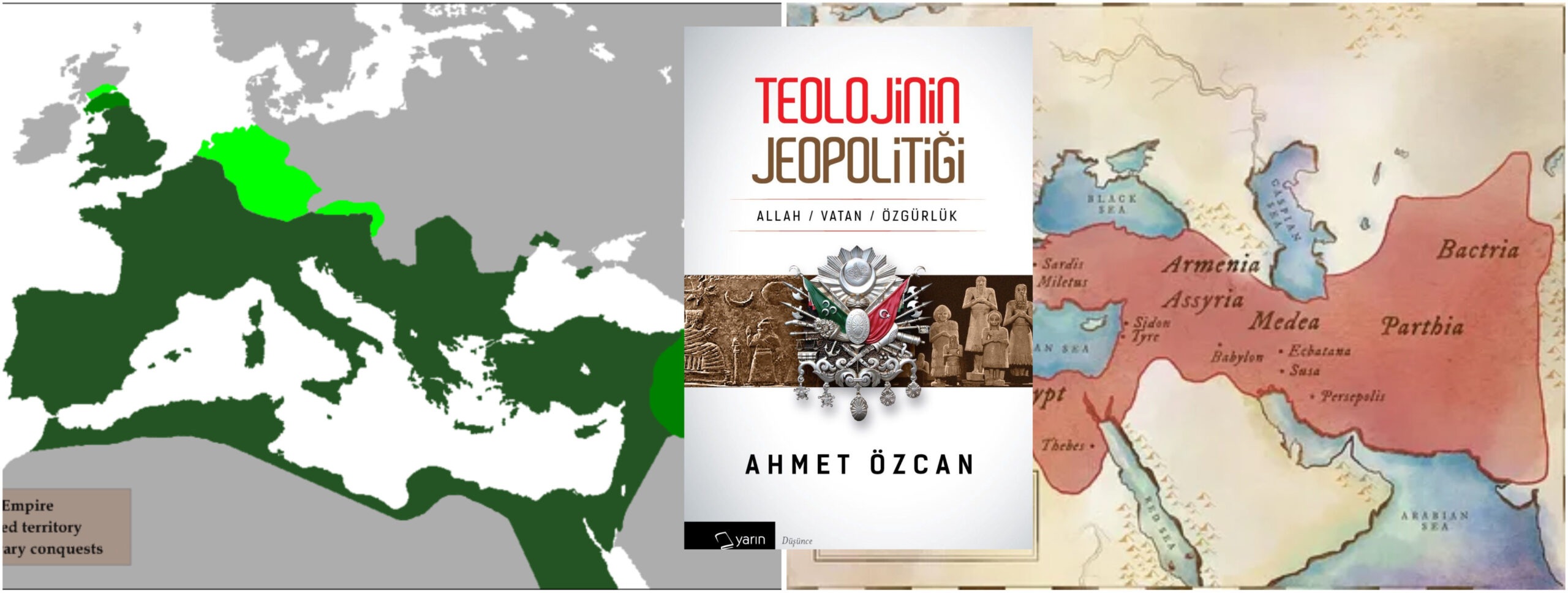

The Geopolitics of Theology*
In the agricultural age, the conflict between military-agrarian empires and the pagan religions they produced, and the monotheistic religion, reflects not only socio-economic contradictions but also inter-state struggles for hegemony. Theology, that is, the relationship between conceptions of God and religions and states and their policies, took shape in the age of agrarian empires and has become the dominant form of politics throughout history, including modern politics. For this reason, reading the history of theology through a political lens will also enable us to understand the present.
It must be remembered that the message of Tawhid (Monotheism) consists entirely of concrete socio-economic implications (rebellion against tyrannical authorities, exploitative clergy, and merchant classes) as well as a philosophical and ethical call to an alternative worldview. So, contrary to the fairytale-like stories told in classical religious interpretations, monotheism is neither the claim that there is only one God in heaven, nor were the authorities who were rebelled against so stubborn because of the multitude of gods they worshipped. Essentially, from God’s perspective, it makes no difference whether a person doesn’t know Him or commits shirk, polytheism/idolatry. For a person committing shirk to associate partners with God is to their own detriment. By submitting to tyrannical authorities, obeying usurers and merchants, and serving irrational sorcerers and charlatan religious figures, a person who diminishes themselves, distances themselves from the meaning and importance of their existence, and is humiliated by becoming enslaved to their sub-human side, can only become conscious through the conception of a single, supreme, merciful, omnipotent, eternal God. But only with this consciousness can he attain the awareness of their own existence and personality (the consciousness of being Adam). For this reason, all prophets reminded their societies of the mission and honor entrusted to Adam by God. And those who opposed the prophets first were always the ruling classes who understood the true implications of this message. In this sense, the struggle for tawhid (monotheism) is the political expression of the humanization process, articulated through the religious language dominant in ancient times.
The religious language of ancient times is pagan-animist-magical-miraculous. This language reflects the concrete lifestyle of the preceding hunter-gatherer period during the transition to the agricultural age, and, in the later stages of the agricultural age, the increasing sanctification and mythologization of the early periods of this era. (The examples of bull, water, earth, sun, moon, and star as gods, fetishes, or totems are actually the life sources of earlier eras.) To convey their messages, the prophets of monotheism spoke in this ‘religious’/theologic language, which had been sanctified to guide enslaved masses, that is, those whose understanding had been crippled and who had become ignorant. As can be seen from a careful reading of the Qur’an, the Qur’an uses this very language to expose and criticize it, calling people to reason, understanding, fairness, conscience, to the genuine human language (the language of Adam), which is the opposite of pagan theological discourse.
Likewise, shirk (associating partners with God, paganism, idolatry) is not simply believing in multiple gods; it means accepting the socio-economic order represented by the ruling classes symbolized by those many gods. It will be appreciated that if the belief in multiple gods were merely a personal conviction devoid of any concrete way of life, none of the historical developments that have sparked so much conflict, led to wars between states and prophets, and triggered large-scale changes would have occurred. In this context, it is important to remember that the ruling classes of pagan societies, while possessing all political and commercial agility, were not simply mindless people worshipping the sun, moon, stones, and earth; rather, they were able to control, employ, and incite wars among the masses through these forms of worship.
Throughout history and today, all ruling classes worship only power and seek to shape the beliefs of the people in ways that strengthen their rule. But when those beliefs encourage rebellion against them, they resist and impose every form of oppression. The reason why the ancient Egyptian, Babylonian, Sasanian, Roman, and Arab elites were so angry at the call for tawhid (monotheism) was not simply the spread of a type of belief, but the possibility that a new way of life, political and economic alternative might flourish alongside that belief. From this perspective, theology and mythology are essentially politics, sociology, and psychology.
On the other hand, interstate war and competition, that is, geopolitical contradictions, have also produced a politics of using religions, beliefs, and rebellions to their own advantage. When an independent, popular, and libertarian movement emerges, it inevitably attracts the attention of rival states, which then try to use it for their own political objectives. Without analyzing this reality that is, the geopolitics of theology, neither theology and its historical significance, nor the socio-economic struggles can be properly understood. For this reason, we will attempt to analyze the relationship between religions and states, beliefs and politics, civilization and tradition through a theo-political perspective.
The Political Birth of Religions
When we look at the available data, we see that during the periods when the prophets of tawhid (monotheism) emerged, interstate conflicts had reached their peak, peoples were exhausted, and a general era of crisis was unfolding.
Noah (pbuh) (estimated between 3200–2700 BCE) appears in the period when the agricultural order was being rebuilt after the Great Flood. Noah, referred to as Ziusudra in Sumerian texts and Utnapishtim in the Akkadian-Babylonian Epic of Gilgamesh, is, in a sense, a second Adam, a second ancestor for the re-emergence of the human species after the flood and the continuation of the process of humanization.
Prophet Abraham (pbuh) emerged when the Akkad-Babylon-Elam wars had exhausted the entire region (estimated around 1700–1500 BCE). In the Qur’an, the story of Abraham (pbuh) recounts his rejection of the sun, moon, and star deities. Thus, through these pagan religions, which symbolize the corruption of Sumer, Elam, Babylon, and Akkad, the old order is rejected, and a call is made to build a new world.
Prophet Abraham (pbuh) left the city of Ur in Babylon and traveled through Harran, Palestine, Egypt, and Arabia. The geopolitical balance of the period lies between the Elamite, Babylonian, and Akkadian powers that is, Mesopotamia and the Egyptian empires. Prophet Abraham (pbuh) represented monotheistic unity and peace against all internal and external conflicts. The monotheistic message of Abraham colored the order represented by the Laws of Hammurabi in the Neo-Babylonian period that emerged after the Elam-Akkad and Hittite-Egypt wars. However, he was unsuccessful in establishing regional order. The region was disrupted by the great migration of the Kassite peoples. Neo-Babylon came under the domination of the Kassite dynasty.
Moses (pbuh) appears on the scene (approximately 1300 BC) during the period when the Hyksos-who, according to one account, were foreign invaders from the north, from the Caucasus-ruled Egypt. Moses (pbuh) represents the revival of the Abrahamic message within one of the greatest states of that era. Ancient Egypt is the child of the Nile. It is a synthesis of Africa, the Mediterranean, and Mesopotamia. Animism from India and Africa, along with Mesopotamian paganism, are the sources of Egyptian theology. Egypt was also the source of Western Anatolia and Greece. Nearly all the philosophical and mythological heritage known as Greek civilization has Egyptian (and also Phoenician, Iranian, and Indian) origins. The Greek city-states were, at first (between 1300-400 BCE), essentially Egyptian colonies. After encountering the Abrahamic message, Egypt periodically came under the influence of monotheistic theology. Pharaoh Akhenaton – probably around 1500 BC, during the time of Joseph-replaced the sun-centered pantheon with a monotheistic religion called Aton-adonai. Moses represents the revival of this message from that period.
Egypt is a unique example of a state system based on a divine king and sacred priesthood. Egyptian priests were, in the literal sense of the word, scholars and technocrats. In this sense, Egypt resembled a technocratic state in the modern meaning. The technical expertise underlying its construction and irrigation systems formed the essence of Egyptian religion. Prophet Idris (pbuh), known as Hermes, is considered the founder of Egypt’s tradition of philosophical science. (Perhaps a thousand years from now, today’s dominant capitalist economic language will become the theology of the future, and economists will be the priests or sorcerers of that era. In ancient Egypt, priests were not religious figures in the modern sense but the technocrats of their time. However, by presenting technical knowledge to the public as esoteric and divine knowledge, they created charisma and sustained an institutional religious tradition. Just like in Iran and Babylon.)
The revolt of Moses (pbuh) corresponds to the period of decline of this powerful and advanced civilization. At a time when pharaohs had become tyrannical, priests were exploiting the people, and warriors had become their enforcers, Moses (pbuh) mobilized the Egyptian people and challenged the Pharaoh by emphasizing the liberating content of tawhid (monotheism). Yet the revolution of Moses failed, and Moses, along with part of the Egyptian population, was forced to migrate to Palestine. During the period in which Moses rebelled, Egypt and the Hittites were engaged in wars aimed at sharing control over the Syria-Palestine region. And when Moses migrated, the region was likely under Hittite control. Although concrete historical evidence is lacking, in addition to the order-shaking implications of the monotheistic message the Pharaoh’s harsh stance toward the movement of Moses may have stemmed from the suspicion that Moses was leading a Hittite-supported revolt.
Prophets David and Solomon (pbut) were the leaders of the community descended from the followers of Moses who had migrated to Palestine. The kingdom they established lay at the heart of the most critical trade route of the time, on the Jerusalem-Lebanon axis, representing peace between Mesopotamia and the Mediterranean (Egypt). (Between 1000-800 BC) Solomon and David (pbut) are two symbolic figures who best understood the message of Abraham and Moses and transformed it into state policy. The Kingdom of Solomon established a balance between Egypt, Babylon, and the Hittites in Jerusalem, a crucial point of conflict at the time, controlling trade routes and serving as a crossroads of the Mediterranean, Red Sea, and Euphrates basin. Solomon’s glory, his rule over everything from fish and birds to ants and jinn, essentially reflects the peaceful role he played among the alien and hostile states of his time. Fish and water represent sailors (Phoenicians), jinns represent Babylonians (astrologers-magicians), ants represent Yemenis, and birds represent the Hittites (symbol of the eagle) and the Egyptians (symbol of the hawk-horus).
After Solomon’s death, the kingdom collapsed. The northern region came under Hittite-Babylonian influence. The south would be the orbit of Egypt. When the Assyrians replaced the Hittites, they invaded the region. The Assyrian era (approximately 1000-600 BCE) was a period during which power dynamics were reshaped and the old order collapsed. The Assyrians were an unusual state combining fierce and bloody militarism with diplomacy and merchant character. They clashed with Babylon and conquered it. They took control of all major trade crossroads from the Persian Gulf to the Mediterranean and the Red Sea. They also invaded Palestine, which had been under Egyptian influence. After this first invasion in the 600s BCE, they exiled the merchants who controlled the region’s trade monopoly to Babylon. (At that time, there was no Jewish people yet. Those exiled by Assyria were likely mixed communities of Aramean-Canaanite origin who had managed Phoenicia’s trade monopoly. Some of these groups- Jewish sources say very few-returned to Palestine thanks to the Persians. These individuals later invented Jewish identity along with the writing of the Torah. The people called Jews were not then, nor are they now, a homogeneous ethnic group. Their upper classes were wealthy merchants of mixed origin settled in the Phoenician region, while their middle and lower classes were scattered tribes of Indian and Iranian origin who came with the Persians.)
A hundred years later (570 BCE), this exile was repeated. The famous Babylonian exile was actually a population transfer. Merchants who did not cooperate with Assyria were relocated and interned in Babylon. The so-called Babylonian exile was essentially a liquidation of the financial oligarchy carried out by the Assyrians. This financial oligarchy later invented a history for itself and adopted the name the Jewish people.
In the late 500s BCE, the Medes entered the stage. This warrior people coming from Iran, in cooperation with Babylon and Egypt, destroyed Assyria. After the Medes came the Persians. This century, precisely the period between 600 and 500 BC, was almost a century of chain-reaction theological and geopolitical revolutions in the civilized world of that time. In the East appeared Zoroaster, Buddha, Taoism, Confucius; in the West, Socrates, Plato, Aristotle, and many philosophical schools all emerged in this period.
The East, that is, the eastern part of the Mesopotamian-Mediterranean basin, produces its own theology and geopolitics for the first time. Taoism (the teaching of Laozi) and Confucianism symbolize China’s inward turn and its establishment of order against foreign invasions. China, as expressed in these teachings, entered a long historical slumber. Taoism and Confucianism transformed conservatism and cultural isolation into theology. China awoke only in the 20th century with Mao’s revolution. (21)
Buddha and Zoroaster represent the separation of East and West India from one India. Zoroastrianism separates its west, i.e., Iran, from the Indian subcontinent. (Ancient India refers to the region encompassing today’s northern Iran, Afghanistan, Pakistan, the Caspian shores, and as far as Western China.) Vedic religion, through its right-wing (Buddhist) and left-wing (Zoroastrian) interpretations, gave birth to two great religions. Hindu-Brahmanism represents Indian conservatism, the preservation of the eternal caste system.
The Zoroastrian Revolution and Dualism
Zoroaster (Zarathustra-Hurmuz), in the 600s BCE, as the heir to Abraham’s monotheistic message, spread the idea of a single god (Ahura Mazda- the King of Light) in Iran, representing rebellion both against Indian political influence and against the upper classes. Through Zoroastrianism, Iran challenged India and gained political independence. The Persians (Parsis) revolted against the Parthians, who were under Indian influence, and overthrew them, establishing an independent Persian identity. Over time, the monotheistic Zoroastrian religion shifted toward dualism once it became the official ideology of the Persian state. Dualism is a softened form of paganism (in Ali Shariati’s words, monotheism inside polytheism). The ancient Mithraic cult (the pagan celestial sun god) eventually overshadowed monotheism. In original Zoroastrianism, Ahura Mazda is the sole god. Spenta Manyu (the principle of goodness-Veda in India, Sophia in Greece, Hikmah/Wisdom in Islam) and Angra Manyu (the principle of evil-devil, shaytan) are the two opposing forces of the material world. The conflict between them will end with the victory of the principle of goodness through the coming of Saoshyant (Messiah) before the apocalypse, and thus the apocalypse, that is, the end of the material world, will come. (22)
Later, in state-sponsored Zoroastrianism, the principle of Spenta Manyu disappeared, and an immutable dualism emerged, based on the eternal conflict between Ahura Mazda and Ahriman (God and Satan), two separate deities of good and evil. Just as monotheistic Christianity developed a pagan-influenced trinitarian theology once it became Rome’s official religion, Zoroastrian monotheism deviated into dualism when it became Persia’s state religion. This dualistic Zoroastrian belief spread into all later Middle Eastern belief.
The Gnostic movements that arose under Persian rule (Manichaeism, Sabianism, Assyrian religion, Yezidism), the eastern interpretations of Christianity (Nestorianism, Ancient Syriac Christianity), Neoplatonism, and Shia Islam all carry this notion of dualistic conflict. Dualism also spread into Greece during the period of Persian domination (600-300 BCE), influencing Greek dialectical philosophy and forming the basis of distinctions such as matter-spirit, form-essence, noumenon-phenomenon, reason-sense, soul-body, religion-state. Persian influence is particularly evident in the philosophies of Socrates and Plato. These philosophers lived shortly after the Persian invasion periods. The Persian affinity of Socrates may even have contributed to his execution. In contrast, Aristotle, in the 4th century BC when anti-Persian sentiment was at its peak, represents an anti-Persian stance. Aristotle and his contemporaries, who contributed to Alexander the Great’s invasion of the East, were influenced not by Persia but by Egypt. Aristotelian logic represents in large measure the technical rationality of Egypt. In Plato, the search for truth predominates; in Aristotle, the search for correctness.
At the state level, the practical meaning of Persian dualism was the need to create an ‘other’ necessary for the formation of Iranian national identity. Despite suffering dozens of invasions throughout its long history, Iran preserved its national identity thanks to precisely this sharp dualistic dialectic. For Iran, Ahriman, the representatives of evil, were first India, then Alexander the Great, then Rome, then the Arabs, then the Mongols and the Ottomans… The uncompromising contradiction in Iranian dualist theology is the source of the Persian upper classes’ tradition of reconciling with invaders and gradually absorbing them (the famous Persian diplomacy). Because philosophical-level intransigence preserves core identity, there is extreme confidence in political-level pragmatism (taqiyyah). Despite all invasions, Iran remains today what it was 2,500 years ago. (The resemblance between the names of Persia’s founding Achaemenid dynasty and the founders of modern Iran’s regime, Khomeini and Khamenei, is not merely phonetic coincidence, but symbolic of Iranian continuity.) This notion does not exist in Egypt or Greece. These countries have changed their identities according to the culture of the population that arrived with each invasion or large-scale migration.
In the 520s BC, Iran entered the bustling Mesopotamian-Mediterranean region with great speed and ambition, transforming into the Persian Empire. It inherited the legacies of Elam, Media, Assyria, the Hittites, Babylon, and the Kingdom of Solomon. The rise of Persia is also the beginning of the rise of Judaism. By doing the opposite of Assyria’s geopolitical strategy, the Persians attracted to their side all the peoples filled with hatred toward Assyria. For this reason, Zoroastrianism spread rapidly. Ancient pagan beliefs weaken. New Zoroastrian sects emerge. One of them is Judaism.
The Production of Theology by Geopolitics: Judaism and Christianity
Judaism, in the full sense of the term, is the name of geopolitical religiosity. By analyzing Judaism, we can understand many things about history and humanity. Judaism is a very suitable example for grasping the geopolitics of theology.
The colony communities of Indian-Iranian-Iraqi origin that the Persians settled in the region after eliminating the Assyrians gradually synthesized Phoenician-Aramean paganism, the Mesopotamian heritage they learned in Babylon, and Zoroastrianism, and invented a new religion. The Persians settled this loyal community in Palestine, the heart of the Mediterranean-Red Sea trade route, both as a reward and as a requirement of their loyalty to the Persians. The critical commercial privileges of the region were handed over to members of this community. Thus began the emergence of the group called the Jews. In the 520s BCE, a Persian outpost was established under the name Israel/Judah. (There is no historical or archaeological evidence proving the existence of a northern Israel and southern Judah kingdom-or vice versa. Western historians rely on the Torah for this division. We use these terms with caution. It is possible that no such states existed, but only administrative satrapy established by the Persians.) The first act of the Jews who arrived in the region was to deport the local population. The remnants of the Solomonic Kingdom, the original people of the Moses (pbuh), were massacred. The Samaritans and the Sabians were among the most widespread. Jewish rabbis, who were bankers and merchants, were organized in imitation of the Iranian-Babylonian priestly tradition. They organized themselves into an effective class by synthesizing the Zoroastrian Mugh-Magus (mullah) style (23) with the Babylonian sorcerer (astrologer) and moneylender priest style. (Mogus later became the source of the name for Sasanian Zoroastrianism (fire worshipping), a heretical interpretation of Zoroastrianism that emerged around 500 AD. The word -Magi- has entered Western languages with the meaning of magic or sorcery.)
These priests began writing down the Torah (the mores). The Torah (i.e., the Jewish Torah… In our view, the Mosaic Torah essentially consists of the Seven Commandments, which are also found in Islam. So the original Torah is not a book like the Qur’an, but a code of laws based on seven commandments. In this sense, it preserves its original form in the person of the Qur’an), was written in parts, with additions and deletions, from around 600 BC to 100 BC. Its first five sections, the Old Testament, are Sumerian–Babylonian myths and legends. Later sections are, respectively, Persian, Phoenician, and Egyptian myths. The myths of heaven, hell, the apocalypse, the Messiah, and angels are borrowed from Sumerian-Babylonian and Zoroastrianism. In other words, the Torah is like a regional history filtered through the economic and political interests of the Jews. To establish themselves in Palestine, the Jews adopted the legacy of the Kingdom of Solomon. They claimed ownership of the Temple of Solomon. With Persian assistance, they rebuilt the temple. The Abrahamic tradition’s belief that those who believe in one God will be saved, that is, will become spiritually human and gain God’s favor, was transformed by Jewish rabbis into the belief of the chosen people. The belief in the Promised Land was a Persian promise given to the Jews in exchange for their role as a regional garrison. (This event was replicated in the 20th century by British and American forces, and the state of Israel was established again, almost exactly as before.)
The beliefs of Moses learned from the original people of the Moses (pbuh) of the region, and the Egyptian legends and stories of Moses, Jacob, Joseph, David, and Solomon (pbut), were recorded as if they were the Jews’ own history. In fact, this recording is initially like a narrative from the enemy community. In other words, the stories of the prophets in the Torah are actually full of expressions that openly insult, mock, and humiliate the prophets. For example, Abram (Abraham (pbuh)) tries to pass off his wife as his sister to the Pharaoh of Egypt, Lot (pbuh) sleeps with his daughters, Jacob (pbuh) cheats on his father-in-law, David (pbuh) wrestles with God, Solomon (pbuh) is an incorrigible womanizer, etc… This narrative resembles propaganda brochures written and distributed to mock the beliefs of the local people, namely the people of the Moses (pbuh).
Jewish merchants, like today’s capitalist elites, believed in nothing but money and power, and looked down on the beliefs of the peoples. However, as time went on and commercial gains became politically indispensable in the region, these texts were constantly revised and codified, eventually appearing as if they were the history of the Jews. Now, Jews have become the central figures and owners of almost all of human history, all of the history of civilization, all of the accumulated knowledge of the Mesopotamian-Mediterranean basin, and even the monotheism that became fashionable after Zoroastrianism! Yet the Jewish god had nothing to do with the God of Moses. Until around 100 BC, some Jews worshipped Mammon, a god of gold and power, while lower classes worshipped Yahweh, a volcanic demon, and others worshipped Aramaic gods such as Elohime or Baal-Marduk. Nor did they have any authentic connection to religion of Moses (pbuh) or Jacob (Israel) (pbuh)… The meaning of Israel is obscure. Jewish historians have interpreted it as meaning ‘one who walks or wrestles with Allah/God (El means deity).’ In our view, the term ‘Israel’ as used by the Jews may be related to Ezra (Ezra-il), the leader who brought the Jews onto the stage of history through an alliance with Persia… The Torah’s passages about Ezra clearly describe his role in connection with Persia. The terms Israel and Children of Israel in the Qur’an, however, refer to all Middle Eastern peoples who spread across the region after the breakup of Akkad-Babylon and whose ties to Abrahamic tradition weakened, mixing it with other beliefs. The reason this epithet was later attributed solely to Jews is that, starting in the 4th century BC, after the Jews in the region adopted religion of the Moses (pbuh) and eliminated the original people of the Moses (pbuh), they identified themselves with Jacob and his followers, thus causing the remaining local people to also attribute this epithet to them. Because this community possessed almost the only written source, the Torah, and because they held a sacred reference that held supremacy among the original inhabitants of the region who later lost their memory and identity, the Jews became the sole source for the Abrahamic tradition’s narratives. This monopolization is also the source of this group’s psychology of asserting themselves in many other areas, making themselves indispensable, superior, privileged, and special.
The Jews built a religion and a nation within 400 years thanks to the opportunities offered by the Persians. (24) For example, Hebrew is essentially a mixture of Aramaic and Akkadian, which were the dominant languages in the region. Hebrew is Aramaic with an Akkadian dialect. And only the rabbis, that is, those who came from Babylon, spoke it; the ordinary people spoke Aramaic. Akkadian was also a widely spoken language in Iran at the time.
The Jewish affection to Jerusalem stems entirely from the commercial and strategic position of ancient Jerusalem. This affection, however, was not directed toward the physical city of Jerusalem among Jewish communities until the Zionist movement of the late 19th century; rather, it referred to an ideal Jewish homeland. (In the Middle Ages, the most common Jewish prayer began with: ‘Next year in Jerusalem.’) Supported by German and British imperialists who sought to establish a plantation in the region after the discovery of 20th-century oil fields, the Zionist movement began using this symbolic name to refer specifically to the city of Jerusalem. Yet at the beginning of the 20th century, only about 30,000 Jews lived in Palestine. And Jerusalem held no such special significance for world Jewry.
The Israel/Judah Kingdom, a Persian colony, remained dominant until Alexander’s invasion in the 300s BCE. With Alexander’s conquest, the Jews split into two groups: Easternized and Westernized. Easternized Jews continue the Persian tradition. Westernized Jews collaborate with this new Hellenic power that dominates the region. They recognized the authority of Ptolemy, one of Alexander’s generals. In the 270s BCE, the Torah was translated into Greek. A new, Egypt-centered Jewish interpretation emerged. This schism is the source of later interpretations of the Torah such as the Torah, the Mishnah, and the Kabbalah. Hellenistic influence eventually drove some Jews to collaborate with Rome. The Maccabean Revolt of the 140s BCE was a joint uprising of the people of the Moses (pbuh) of the region not only against Rome but also against these collaborating Jewish groups. This revolt triggered many bloody conflicts between people of the Moses (pbuh) and Jews until the emergence of Jesus (pbuh).
The name Pharisees seems to derive from the first Persian-backed leader Ezra. Pharisee-Persian. True to their habit of aligning themselves with rising powers, they were the first group to cooperate with Rome. They acted as guides and collaborators when Roman armies destroyed Jerusalem, which had been under Iranian influence. In the 40s BCE, these Pharisees were settled in Jerusalem and granted administrative privileges under Roman rule. Jesus (pbuh) appears as the successor to the true people of the Moses (pbuh), specifically those communities identified as the Samaritan, Sabian, Essene, Nasiri, and John the Baptist sects. The Jews spread rumors and fear that Jesus was preparing a new Persian-backed Mosaic uprising and incited the Roman governor. Thus they ensured Jesus’ execution. However, later, Paul, from the pro-Roman Jewish school of thought, began to adapt Jesus’ message to suit the Romans. Rome, for a long time, treated Mosaic monotheistic movements harshly because it saw them as aligned with the Persian sphere of influence. Many uprisings in Anatolia, Palestine, and Iraq were indeed supported by the Sassanids, who had seized power in Iran. The Iran-Rome contradiction gradually develops in the region, and the two geopolitical poles, as heirs to the region’s entire ancient tradition of conflict, fight until the Islamic conquests.
The acceptance of Christianity in Rome (313 CE) coincided with a time when the Roman–Persian Wars began turning in Rome’s favor, and when northern barbarian invasions and migrations threatened to overrun Rome. Rome seized this ideological weapon from Persia, making Christianity its official religion, thereby binding the region’s peoples to itself and gaining an ideological shield against the invading Germanic tribes. Once Christianized, Rome grew even stronger, while Iran lost influence and withdrew to its present borders. Spartan Platonism is a result of the Persian invasion. Aristotelian philosophy, which developed during Alexander’s time, is the Egyptian-Greek response to this. Christianity, through its synthesis of Aristotelian thought and Pauline interpretation, broke Iran’s theological influence over the region.
From a geopolitical perspective, the emergence of the community known as the Jews is the result of Persian deep politics. Theologically, Judaism is a synthesis of Zoroastrianism and Religion of Moses (pbuh). Babylonian and Phoenician beliefs were also incorporated. But the dominant element in this synthesis was the mission assigned to this community by Persian geopolitics. In other words, the narcissism of being the chosen people, the promise of the Promised Land, and minority privilege… Even today, what sustains Judaism is not monotheism or the Sharia that poor Jews persistently try to uphold (that is, the synthesis of the Babylonian Hammurabi Code, Zoroastrian and Mosaic moral traditions), but this geopolitically-rooted Jewish group solidarity. All the diasporas, exiles, and massacres experienced by this community throughout history stem essentially from this geopolitical utility. Both the Jewish exiles carried out by Assyria and Rome in antiquity, and the oppression and massacres committed by the Catholic world in the Middle Ages and the 20th century, stem essentially not from a conflict of faith, but from the Jewish community falling into the position of an easier enemy for those who are hostile to the ally they have chosen. Rome, Catholic Church, and Hitler all wanted to conduct a kind of ground clearing before striking their rivals, and they launched the war by eliminating these communities to whom their rivals had entrusted critical missions (i.e., those responsible for trade and finance). In medieval Europe, the destruction of Andalusia (the main enemy of the Catholic Church) necessitated the elimination of the Jewish merchants of Andalusia. In the 20th century, Hitler carried out a similar purge before engaging in war with his true enemies, Britain and Russia. Today, Jews are again largely aligned with Anglo-Saxon power. And it is likely that when this power declines, that is, when the Anglo-Saxons are defeated, the first community that the victorious power will target will again be the Jews. At least, history shows it to be so.
The Geopolitical Meaning of Christianity?
As with Judaism, the relationship between Christianity and Rome is also a geopolitical phenomenon. In essence, the Christianity codified by Saint Paul is not the same as the Abrahamic-monotheistic message of Jesus (pbuh). Paul was a member of the Jewish community’s faction that cooperated with Rome. Similar to the historical Jewish awakening of the Ezekiel–Ezra period, which began when the Persian King Cyrus II settled the Jews in Palestine around 520 BCE, Paul seems to have intended to become a second Ezekiel or Ezra by bringing the Jesus movement to Rome in cooperation with the newly rising Roman power. Thus, the same geopolitical motive, but this time the effort to remain on the historical stage by cooperating with the rising Romans instead of the declining Persians, is revealed in Paul. However, Rome at that time was struggling with internal turmoil, as well as with Carthage in the south and Germanic barbarian incursions in the north, and it would take two centuries for Rome to grasp his message.
For these two hundred years, the followers of Jesus had Sasanian support in their struggle against Rome. However, considering that Rome constantly maintained a military presence in Anatolia and Palestine under the pretext of combating Christianity, and developed its mobility in the region as far as the Iranian border, it can be argued that Christian resistance benefited the Romans more than the Sasanids. At the end of this process, with the people of the region suffering under Roman military oppression and increasingly converting to Christianity as a reaction, the Roman aristocracy under Emperor Constantine made a critical, though unwilling, decision; abandoning the ancient pagan tradition and adopting Christianity. This move, in the name of the deep will of Rome, breathed new life into the waning empire, and this spirit, symbolized by the Church, played a role in uniting, sustaining, and strengthening Rome even after its division. The Church was no longer a refuge of solidarity and resistance for the poor, but an auxiliary institution of deep Rome.
The belief system codified under the name Christianity at the Councils of Nicaea (313 CE) and Chalcedon (383 CE) is essentially a reformed version of Roman paganism of Egyptian-Greek origin, framed within monotheism. Just as Judaism took shape within the religion of the Moses (pbuh), Christianity took shape within the Jesus (pbuh) tradition. Judaism is a theological product of Persian geopolitics, while Christianity, both as a response and an imitation, represents Rome’s way of producing and managing theology. Monotheism, or the monotheistic Jesus (pbuh) tradition, after these geopolitical upheavals, retreated to mountains and deserts, existing as closed communities until the rise of Islam, such as the Essenes-Nasserites in Palestine, the original Christians in Anatolia, the Hanifs in Arabia, and the Manicheans in Iran.
Meanwhile, Manichaeism, which emerged in the 2nd century CE, attempted to synthesize Zoroastrianism and the Jesus movement under its founder Mani, son of an Iranian aristocrat. Although it briefly spread widely, it was violently suppressed by both Rome (and the Church’s harsh measures) and the Sasanian Empire under an inept new king. Its elimination by these two geopolitical forces resembles how proxy wars during the Cold War enabled the U.S. and Russia to maintain their global division; Mani’s challenge seems to have been perceived as upsetting the balance between Iran and Rome. Manicheans were exiled from Iran to India, Afghanistan, and Central Asia, and for a period became the official religion of the Uyghur Turkic State. From Rome, they dispersed to Bulgaria and then to Bosnia-Herzegovina and southern France, surviving as the Cathar-Bogomil sect. It is also argued that the 8th-century Armenian Paulician sect was a remnant of Manichaeism in Anatolia. The Paulicians rebelled against Byzantium for a long time and psychologically paved the way for Arab and Turkic incursions that eventually detached Anatolia from Byzantine control. When Islamic armies arrived, this Armenian group sided with Muslims rather than Byzantium, and many later converted voluntarily to Islam.
The Cathars became the first victims of the Catholic Inquisition. Mass burnings and brutal torture wiped them out, severing them completely from Christianity. The remnants in Bosnia-Herzegovina converted to Islam with the arrival of the Ottomans. Thus, the contemporary hostility Bosnian Muslims face from some Christian groups has historical causes beyond simply their being Muslim.
The use of theology along the axis of Iran-Rome contradiction is also the origin of the modern use of ideologies between East and West. The Cold War of the 20th century was the peak of this mutual instrumentalization. Socialism, nationalism, and Islamism, like monotheistic religions, originated with different aims and contents, but over time they transformed into political tools of states. In other words, the ancient geopolitical contradiction, the imperial structures reflected in the Iran-Rome conflict, continues in modern times. Following the collapse of Russia, it is likely that a new world order, based on the conflict between a new Eastern power, possibly led by China, and the powers in the West, will reshape itself. The Mesopotamian-Mediterranean basin is the first nucleus of this brutal geopolitical tradition, the laboratory of historical geopolitics. The history of this place is still the history of humanity. And the dialectic of civilization born here continues to be the engine of history. The dialectic of the Mesopotamia-Mediterranean basin, almost bearing the character of a ‘prime mover’, continues as a history that encompassing all humanity by expanding and growing in time and space, like the ever-widening rings created by a stone thrown into water.
The birth of Islam is the final example of this historical call, and perhaps for the first time, monotheistic theology destroyed animist and pagan theology and produced its own geopolitics. Yet shortly afterward, the ancient geopolitical contradiction would reappear as an internal contradiction within Islam.
Middle Eastern Geopolitics: The Iran-Rome Dialectic
In the 6th century BCE, the Persians defeated the Assyrians and came to dominate the region. They later conquered Egypt and the Anatolian and Greek cities that were Egyptian colonies. Until the 300s BCE, that is, until the campaign of Alexander the Great organized by Egypt as a response to this invasion, the Persians were the sole dominant power in the region and by coming into contact with Babylon and Egypt, they invented Zoroastrianism. Zoroaster (Zarathustra/Ormuzd) was likely a Babylonian priest who held an Abrahamic belief. By carrying this belief to Iran, he contributed to the revival of the Iranian peoples, who were vulnerable against the northern invaders. Zoroastrianism desires that the war between Ahura Mazda, the absolute god of the universe, an archangel representing goodness (in Babylonian mythology, a creator angel-Demiorg-created by God and tasked with creating the world), and Ahriman (Satan), the god of evil and darkness, should end in favor of ‘goodness’. The world is the arena of this war. People will choose sides and fight until the time of the coming Saoshyant (Messiah) before the apocalypse. After Judgment Day, the righteous will cross the Chinvat (Sirat) Bridge into paradise, while the wicked will go to hell, the eternal realm of darkness, thus ending cosmic chaos.
When Zoroastrianism became the official religion of the Persian aristocracy, it was codified, as happens with every religion, to suit the socio-economic and political conditions of the time, and especially took the form of a rejection of the dominance of the upper caste class of Turan (meaning the land beyond the mountains), that is, India, over Iran, which was Iran’s main enemy.
The Hindu religion, Vedism (Veda means wisdom, divine knowledge), is based on the principle of the unity of existence and multiplicity within unity. The upper Indian castes turned this multiplicity into a hierarchical order and theologized it to maintain control over the lower castes. Early Vedic religion carried traces of Babylonian-Abrahamic monotheism. In the Hindu caste system, at the top are the Brahmins (priests) and Rajas (nobles), then the Kshatriyas (warriors-rulers), followed by farmers, then artisans and merchants. At the very bottom are the common people-slaves (dravidians-pariahs)-who have no value whatsoever. The chief deity, Varunamithra, is a combination of Mithra, the god of the Brahmans and Rajas at the very top, and his assistant Varuna. Its source is Ageni-fire. The god of the Dravidians was Ahura. Evil meant degradation.
Zoroastrianism is Iran’s way of challenging India, a religion formed by slaves fleeing oppression from the upper castes of India. Ahura was elevated to the supreme deity and all other gods were rejected. The Mithra cult was targeted. Its temples were destroyed. Only Ahriman (Spanta Manyu) is made the god of evil, the chief antagonist, representing all of India. Through Zoroastrianism, Iranians acquire a national identity and adopt a settled lifestyle by engaging in farming and animal husbandry, which are the most important social commandments of Zoroastrianism. As Zoroastrianism became a state religion, it gained a purely political character. The hatred felt for Hind produces a dualism, a dualism of two realities: the eternal battle between absolute good and evil. The belief in a single, absolute God gradually disappears, transforming into a dualistic system consisting of Ahura Mazda and Ahriman. Iran became the army of Ahura Mazda, and Iran’s enemies the army of Ahriman. Each deity had six assistants, angels. Thus, the seven-planetary system of Babylonian cosmology in the ancient world transformed into the seven-part theological system of Zoroastrianism. (The seven-branched candelabra of Judaism originates from here.) According to available data, around the same time (7th-6th centuries BC), Buddha emerged in eastern India, and Lao Tse appeared further east. It is as if the great Indian civil war gave birth to new religions and political entities in both the east and the west.
It should be stated immediately that claims viewing India as the center of civilization should be approached with skepticism. India has been a kind of population reservoir since the earliest periods of history. It has produced countless varieties of living things as well as human communities. This population was continually exported outward. Ancient India (Hind) meant the greater Asia extending from western China to Iran, Afghanistan, Central Asia, and parts of the Caucasus. India’s internal conflicts were the source of these outward migrations.
The Indian subcontinent has African origins. Through these populations, Abrahamic beliefs entered India and gradually transformed into Vedic religion, the faith of the upper Indian castes. Just as the religion of Jesus, which was the religion of the Roman lower classes, became Christianity by transforming into the official Roman religion, and just as Islam, the religion of the poor Arabs, was later transformed into the official ideology of the Arab elite-the Umayyads-the same rule applies to Vedism and Zoroastrianism. Zoroastrianism began as the religion of Indian pariahs and became the official religion of the Iranian aristocracy. Like any religion that becomes an official religion, Zoroastrianism has become intertwined with previous beliefs, and Mithraic customs, such as the fire cult, have become hallmarks of Zoroastrianism.
The distorted form of Zoroastrianism that spread into the Middle East as Persia’s official religion left deep traces. Like every religion that expands under political power, Zoroastrianism endured for centuries in Egypt, Anatolia, Greece, Iraq, Palestine, Yemen, the Caucasus, and partly India, expressed in various local forms.
The essential characteristic of Zoroastrianism is dualism; the eternal struggle between good and evil… Within this context of war, it is believed that there is chaos in the world, that these opposing poles will fight until Saoshyant-Messiah comes, and that through the triumph of good, Satan will be destroyed and the chaos he caused will be transformed into cosmos-order.
The source of these fundamental beliefs of Jewish theology that the Jews as God’s chosen people, the distinction between Jews and Gentiles, the idea that Gentiles must either serve or be destroyed by Jews, and the special mission of the Jews, is precisely this dualistic Zoroastrianism. This dualism, dialectic, the concepts of chaos-cosmos, and elitism also formed the basis of Platonic thought in Anatolia and Greece during the Persian invasions. It is no coincidence that medieval Judaism, when reinterpreted, relied heavily on Neo-Platonism. In the modern era, the ideological roots of Fascism and today’s Neo-Cons that is, Christian Zionists, are also lie in this antagonistic conflict, dualism, and elitism grounded in Zoroastrian Aryanism.
To prevent readers from associating the terms Aryan, Persian, and Zoroastrian with present-day Iran, let us state immediately that today’s Iran is one of the countries furthest removed from this Zoroastrian Aryanism. Although some extreme Shia sects and a faction of the Persian aristocracy may share similarities with this worldview, the culture created by the Iranian Islamic Revolution can be interpreted as an attempt to break free from the Zoroastrian framework. Just as this way of thinking has emerged as an ideological force in geographies unrelated to Iran and Iranian history, such as modern Germany and America, it is now equally ineffective within Iran itself. Therefore, Zoroastrianism and Arianism should be understood as concepts independent of Iran. Unless, of course, Iran one day returns to its Zoroastrian roots, which are one of the many factors in its ancient history.
The opposite of Zoroastrian Arianism, or dualism, is the Egyptian-Roman theory of order. Egypt is the product of the mathematics required to control and utilize the Nile. This mathematics, originating from Babylonian astronomy, gave rise to the engineering sciences that built Egypt’s massive dams, pyramids, and palaces. Egyptian theology was rooted in this mathematical approach to creating and sustaining order. The idea of absolute order, symbolized by the pharaohs, was carried from Egypt through Phoenician merchants to the Ionian cities on both sides of the Aegean, such as Crete, Mycenae, Ephesus, Pergamon, Athens, and Sparta, which were Mediterranean colonies. This is the source of what is described as the Greek miracle. All Greek philosophers were educated in or received instruction from teachers who were educated in Persia-Babylon or Egypt. The Greek city-state experience developed during the era of the Persian satrapies.
The expedition of Alexander the Great is an anti-Persian campaign organized by the political will of Egypt and initiated by the mobilization of all Egyptian-Greek-Ionian colonies, under the guidance of a philosopher of order, Aristotle, a student of Plato who was under Persian influence and who criticized Plato on behalf of Egyptian thought. It pushed Iran back around the 300s BCE and gave birth to Rome. These two major reciprocal expeditions-each having an impact lasting approximately 300 years-became the main driving force behind the next 2,300 years of history.
Rome represents order against chaos, unity in diversity against dualism, absolute authority against antagonism, and hierarchy against contradiction. Rome is, in a way, India’s revenge on Iran, reborn in the Mediterranean. And by conquering Iran, that is, Zoroastrian Aryanism, in thought, it reduced dualism and the idea of chaos to the level of a refuge for heretical movements in history. This idea, for the first time after 2,000 years, has gained a chance for political sovereignty, not merely as an ideological current, first with fascism in the 20th century, and now with Neo-Con globalism.
In conclusion, the Mesopotamia–Mediterranean basin produced the contradiction between the two different great mentalities and political wills we call Iran and Rome. Iran is both the opposite and the repetition of India; Rome is the continuation of Greece and the repetition of Egypt. Zoroastrian Aryanism represents dualism, while Rome represents paganism. This diagram is an effort to simplify, schematize, amplify, and formulate what is necessary for our understanding of thousands of years of history.
The Geopolitics Created by Liberating Theology: Islam
The emergence of Islam, like the arrival of previous prophets, carries the message of ending these conflicts. And within 30 years, Persia, Anatolia, and Egypt were conquered, achieving true regional peace, unity, and well-being. As the last representative of the Abrahamic tradition, Prophet Muhammad (pbuh) carried out in practice the theological revolution that earlier prophets had accomplished in belief. By destroying divine kingdoms, ruling-class systems, and master-slave structures, he opened a new page in human history. Only Rome remained, and it was later brought down by the Ottomans.
The emergence of Islam, much like the Akkadian-Assyrian Wars of 2000 BC and the rise of Abraham, was an era when the Persian-Roman wars had devastated the entire region, leaving masses helpless and without a protector, local authorities and tribes disrupted order with civil wars, and only the strongest survived. For this reason, Islam was able to take root quickly, establish a new world, and produce a completely new geopolitics independent of regional geopolitical traditions. Islam could not be utilized by the state policies of either Persia or Rome; on the contrary, both great empires found the dynamics of Islam right on their doorstep without fully grasping its historical meaning and mission.
The rise of Islam as a political force, for the first time in history, in a way that also united the asabiyyah (solidarity) of Arab societies, buried both great powers in history in such a way that they could never rise again in their original form. The new geopolitical order brought by Islam ended 3,500 years of wars and conflicts and unified Iran, Rome, Egypt, Mesopotamia, India, and Central Asia under a single geopolitical framework. After the advent of Islam, all socio-economic contradictions and conflicts, the dialectic of history and civilization were transformed into an internal conflict within Islam. In other words, instead of the geopolitics of pagan and animist theology, a monotheistic-Abrahamic geopolitical order became the dominant language of history and societies.
All the internal and external contradictions of agricultural civilization resurfaced as internal Islamic struggles with the birth of Islam.
This resurgence begins with Muawiya, the governor of Damascus (the Byzantine basin), seizing power in a coup by eliminating Ali (r.a), thus derailing this new theological and geopolitical revolution. Shiism emerged as a reaction to this event. In a sense, Persian dualism reappeared within Shiism in a new form. Ahura Mazda vs. Ahriman became Ali vs. Muawiya or Husayn vs. Yazid. The Abbasid and later the Fatimid states are products of this culture. The Umayyad expansion spread from North Africa to Spain. The Andalusian state was Mesopotamia’s offensive against Rome. But it could not cross Spain and was later violently eliminated. In the East, after the Mongol conquest, the Iranian region became the base of Mongol Dynamics. And soon Safavidism emerged. Safavidism, like Zoroastrianism’s reaction against India, first developed as a reaction to Mongol remnants. Later, the ancient geopolitical Iran–Rome dialectic reemerged, leading to the Ottoman-Iran wars. Safavid Shiism fully defined itself as Iran’s war against Rome. These wars, lasting until the mid-18th century, ended with the victory of the Ottomans (the Muslim Rome).
*Source: Teolojinin Jeopolitiği-Allah Vatan Özgürlük, Ahmet Özcan, Yarın Yayınları, 2012