 Fariba Parsa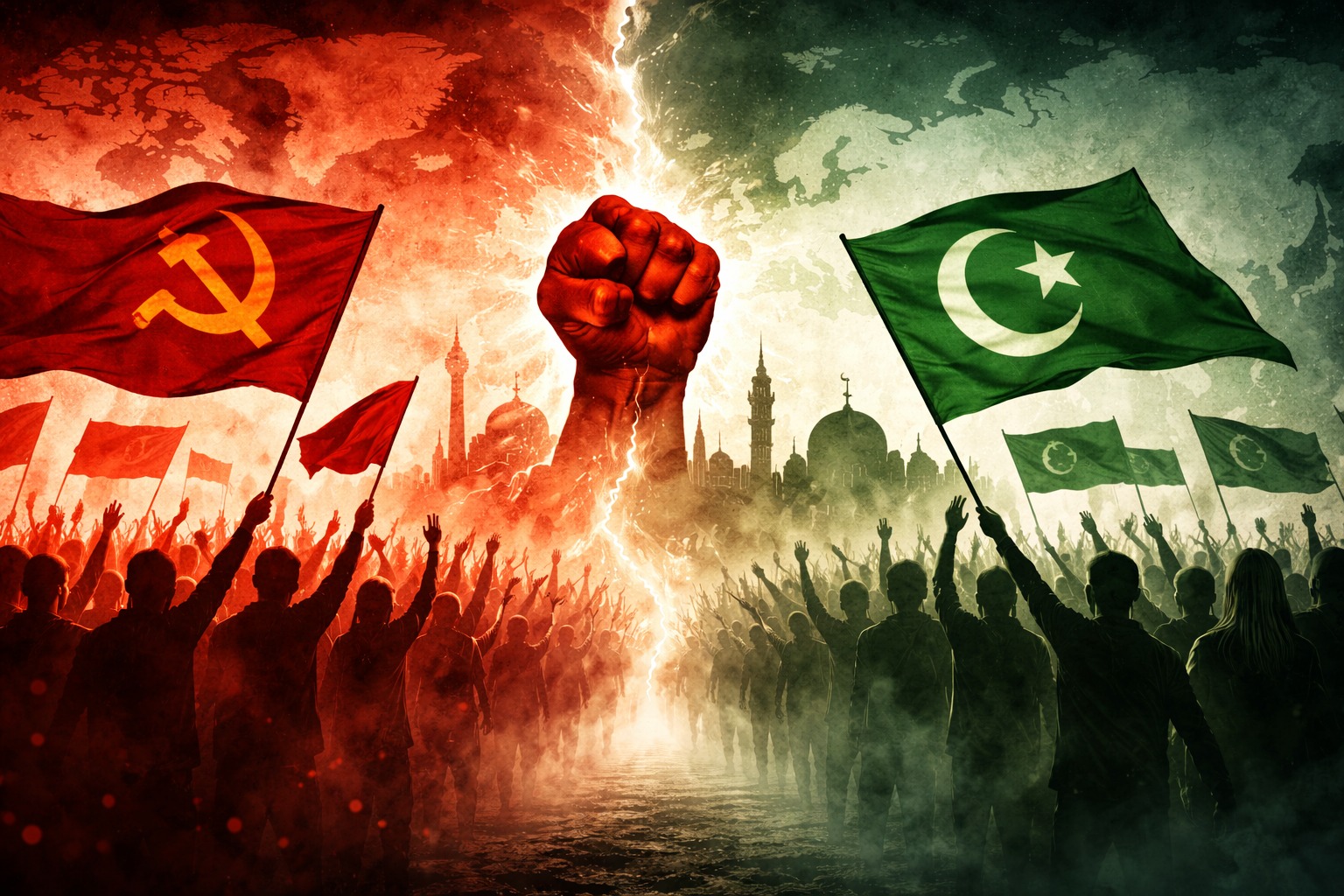

A recurring paradox in modern politics is the alliance between two ideologies that, at first glance, appear fundamentally incompatible: radical leftist movements and Islamist political movements. One emerges from secular revolutionary theories associated with figures such as Karl Marx and Vladimir Lenin; the other from religious-political doctrines developed by thinkers like Ruhollah Khomeini. Yet history shows that these movements have repeatedly converged around shared political narratives.
This “marriage” first became visible during the Iranian Revolution in 1979. In the uprising against the monarchy of Mohammad Reza Pahlavi, Marxist organizations, secular nationalists, and Islamist groups joined forces under a shared revolutionary banner. Their alliance was built less on ideological compatibility than on a common opposition to Western influence and the existing political order. Once the revolution succeeded, however, the Islamist leadership consolidated power, sidelining and repressing many of the same leftist groups that had helped overthrow the monarchy.
Despite that history, similar patterns reemerged decades later. Following the October 7, 2023 attack by Hamas against Israel, protests erupted across Western cities. In many demonstrations, Islamist activists and radical leftist groups marched side by side, united by anti-Israel and anti-Western rhetoric. The alliance appeared again even as the war expanded across the region, affecting countries including Lebanon, Syria, and Yemen.
Yet the partnership revealed its contradictions when protests and repression escalated inside Iran. As security forces of the Islamic Republic responded violently to anti-government demonstrations, thousands of civilians were reportedly killed in the streets by forces connected to the Islamic Revolutionary Guard Corps. Many of the international activist movements that had mobilized loudly on other issues remained largely silent about the regime’s actions against its own citizens.
The recurring convergence between radical leftists and Islamists is not accidental. Despite their different philosophical foundations, the two ideologies share several structural similarities in how they frame politics and power.
First, both often adopt a revolutionary worldview that frames politics as a struggle between oppressed and oppressors. In Marxist theory, the conflict is between the proletariat and the bourgeoisie. In Islamist revolutionary ideology, the struggle is frequently framed between true believers and corrupt or imperialist systems.
Second, both promote comprehensive ideological systems that seek to reshape society beyond normal governance. Leninist systems attempted to reorganize economic, cultural, and political life under the leadership of a revolutionary party. Similarly, the Islamic Republic institutionalized clerical authority through the doctrine of Velayat-e Faqih, placing ultimate power in the hands of religious leadership.
Third, both emphasize vanguard leadership. In Leninist theory, the revolutionary party acts as the guiding force of society. In Iran’s system, the Supreme Leader and clerical establishment claim ideological authority to guide the state.
Fourth, both traditions historically express deep skepticism toward liberal democracy. Liberal pluralism, individualism, and market capitalism are often criticized as Western constructs that undermine ideological unity.
Finally, both rely heavily on ideological mobilization—through political education, revolutionary symbolism, and narratives of resistance—to sustain legitimacy and maintain control.
These similarities help explain why alliances between radical leftist activists and Islamist movements can emerge despite their philosophical differences. Both often frame their struggle through anti-imperialist narratives that portray Western influence as the central global conflict.
Yet the partnership is inherently unstable. Their ultimate goals diverge sharply: Marxist ideology seeks a classless secular society, while Islamist movements aim to establish governance based on religious authority. When such alliances succeed in seizing power—as Iran’s experience after 1979 illustrates—the result can be centralized authority and limited tolerance for dissent.
For observers of global politics, the lesson is clear. Ideological alliances built primarily on shared opposition—to the West, capitalism, or Israel—can obscure deeper contradictions. And in the end, it is often ordinary citizens, not ideological movements, who pay the price.
Dr. Fariba Parsa holds a Ph.D. in social science, specializing in Iranian politics with a focus on political Islam, democracy, and human rights. She is the author of Fighting for Change in Iran: The Women, Life, Freedom Philosophy against Political Islam. Dr. Parsa is also the founder and president of Women’s E-Learning in Leadership (WELL), a nonprofit organization dedicated to empowering women in Iran and Afghanistan through online leadership education and training.