
 Reuben Johnson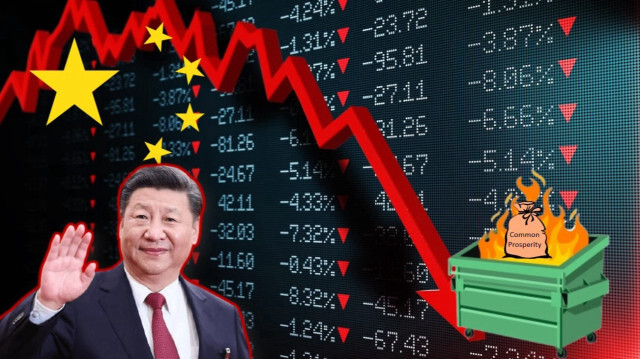

Analysts tracking China’s structural macro risks warn that 2026 could bring a rare convergence of seven destabilizing pressures. The warning set spans widening pension contribution and payout gaps, collapsing local fiscal self-sufficiency as land-sale revenues shrink, and a property market stuck with weak new-home sales, swelling second-hand listings, and slow inventory digestion.
China Could Face 7 Crises at Once in 2026: Deflation, Property, Debt, and Banks
Beginning in January 2026, analysts familiar with the current developmental and political tensions in the People’s Republic of China (PRC) predict the country will face a convergence of deepening economic and structural crises. The primary bellwethers will be a worsening deflationary spiral, a prolonged property market slump, and mounting financial risks.
The conclusions of these Chinese analysts, along with a brief discussion of the fallout, were published in an article at the end of December 2025 on the Canada website 51.ca.
The site 51.ca is a major Chinese-language online news and networking portal in Canada. It specifically targets the Chinese-Canadian community and is one of the most prominent Chinese-language, user-networking, and information sites in the country.
The assessments presented were considered so significant—even for a non-mainstream news site or an academic publication—that their findings were translated and published on the US PRC-watchers site China Scope.
Domestic Sectoral Indicators Look Bad for China
The analysts, who met in late December 2025 to assess the data they had gathered, were a group of economists and data analysts specializing in PRC structural macroeconomic risks. Their approach was to devise a “cross-sectoral quantitative indicator framework,” as it is described in the Chinese-language version.
They concluded that 2026 may become a critical window. During this time, developments across numerous sectors will amplify each other. The final result could facilitate the emergence of seven major crises occurring simultaneously.
Their analysis identifies the warning signs across seven key indicator clusters. They are expected to have spillover effects that could exacerbate or accelerate their collapse:
One is a worsening pension contribution and payout gaps. The PRC pension system is suffering significant gaps due to rapid aging, low birth rates straining the pay-as-you-go structure, and vast inequality between urban/rural and formal/informal workers. This led to low participation, “empty accounts,” and young people doubting future payouts. These are coupled with reforms like delayed retirement and private pensions, which are struggling to keep pace with demographic shifts and structural issues.
A second is local government fiscal self-sufficiency collapsing alongside shrinking land-sale revenues and mounting hidden-debt pressures. This is creating a “fiscal winter” caused by a perfect storm of collapsing land revenue, massive debt, and a deep property crisis. The traditional model where local authorities fund themselves through land sales has failed, creating a “slow-motion crash” that threatens to derail economic growth and social stability.
Thirdly, the PRC is experiencing synchronized reversals in new-home sales, second-hand listings, and inventory digestion in significant cities. The home sales inventory is massive and is taking years to digest, with authorities implementing policies like government buying unsold homes and controlling new land supply to reduce the glut. This then prompts cuts in developer investment, falling prices (especially on the secondary market), and a structural shift towards “good cities and good houses.”
In a fourth set of developments, there is increasing stress in small and mid-sized banks reflected in non-performing loans, interbank funding strain, and delayed wealth-management redemptions. A deepening property slump causes this, weak domestic demand, deflationary pressures, and rising local government debt, leading to shrinking profit margins, lower returns, and a rise in loan defaults.
Industrial Slowdowns and Population Trends
Number five is a prolonged contraction in industrial profits, output growth, and employment indicators. This contributes to the already slowing growth in job opportunities.
Six is a combination of a long-term drop in birth rates caused by the one-child policy, creating a demographic decline, a shrinking working-age population, and slowing preschool enrolment.
Lastly, there is a broad downturn in external demand, signaled by weakening export orders, slowing shipments to major markets, reduced coastal electricity consumption, and declining container throughput on the central eastern seaboard. Exports are critical to the engine of the PRC’s economy. If it begins to fall off precipitously, it triggers a “house of cards”-type collapse.
Historically, these seven core indicator groups have rarely deteriorated in parallel within a 12–18 month period. By the second half of 2025, however, most of them had already crossed over critical warning thresholds and were worsening in tandem.
In the aggregate, they are all raising the risk of an unusually dangerous system-wide “resonance of disappointment” across China’s fiscal, financial, demographic, and economic foundations. If these conditions turn out to be prolonged, an increase in internal stability in the PRC could be the next shoe to drop.
* Reuben F. Johnson has thirty-six years of experience analyzing and reporting on foreign weapons systems, defense technologies, and international arms export policy. Johnson is the Director of Research at the Casimir Pulaski Foundation. He is also a survivor of the Russian invasion of Ukraine in February 2022. He worked for years in the American defense industry as a foreign technology analyst and later as a consultant for the U.S. Department of Defense, the Departments of the Navy and Air Force, and the governments of the United Kingdom and Australia. In 2022-2023, he won two awards in a row for his defense reporting. He holds a bachelor’s degree from DePauw University and a master’s degree from Miami University in Ohio, specializing in Soviet and Russian studies. He lives in Warsaw.
Source: https://www.19fortyfive.com/2026/01/chinas-7-simultaneous-crises-of-2026/