 Doç. Dr. Mehmet Rakipoğlu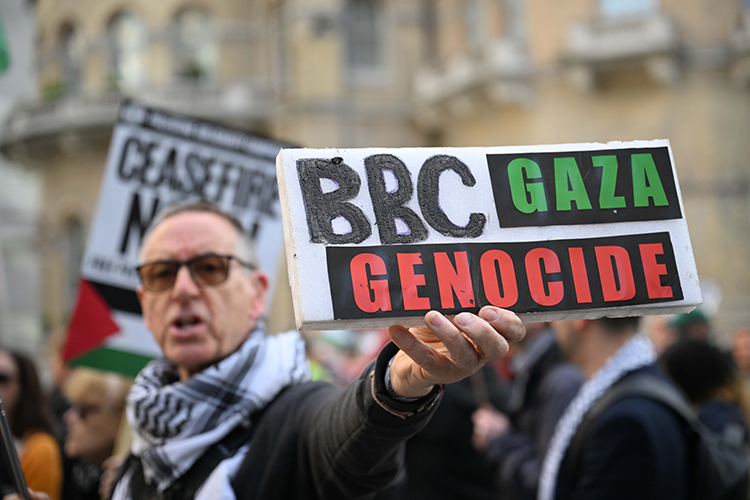

Founded in 1922, the British Broadcasting Corporation (BBC) is the United Kingdom’s most established and influential public broadcaster. Operating under a Royal Charter, the BBC declares its commitment to principles such as impartiality, independence, and accuracy in line with public service broadcasting principles. However, its direct funding from public funds, the appointment of its executives by the government, and its symbolic relationship with the monarchy have at times positioned the BBC in alignment with state policies. This contradictory structure has led to debates particularly in the areas of foreign policy and war reporting, regarding the BBC’s institutional interests and its role in shaping public opinion. Furthermore, the Israeli genocide in Gaza has clearly revealed the true face of the BBC. Indeed, the language used by the BBC in depicting the genocide in Gaza contradicts the institution’s long-standing claim of impartiality.
It has been observed that the BBC uses different words for similar events in its Israel–Gaza reporting, emphasizing the human aspects of the victims differently. A report by the Centre for Media Monitoring (CfMM) found that while the BBC used the verb “killed” almost equally for Israeli and Palestinian deaths, it mostly resorted to the more neutral word “died” when referring to Gaza. For example, on the BBC’s news page dated October 9, 2023, the phrase “more than 700 people were killed in Israel” was used, whereas for Gaza the wording was “more than 500 people died.” CfMM also emphasized that more emotionally charged terms such as “massacre” appeared only in headlines about Israeli victims, while such words were absent from headlines related to Gaza. The same report noted that adjectives such as “atrocities,” “slaughter,” “barbaric,” and “brutal” were used approximately four times more often for Israeli victims than for those in Gaza, and that while the verb “murder(ed)” appeared 220 times in reference to Israelis, it appeared only once in reference to Palestinians. For example, the word “butchered” was used exclusively in the context of Israeli victims, while no similar word was chosen for Palestinians.
The BBC’s choice of terms has also drawn similar criticism. The organization’s editorial guidelines recommend avoiding the word “terrorist” on the grounds that it is emotionally charged and could create a one-sided judgment; instead, more neutral alternatives such as “militant,” “attacker,” or “bomber” are suggested. Accordingly, in BBC reporting, Hamas activists are referred to as “militants” (indirect phrases like “proscribed terrorist organisation” are rarely used), and similar phrasing such as “Hamas militants” is also seen in the Western press. Critics argue that this policy exempts Palestinian groups from an asymmetric definition of terrorism while avoiding labeling Israeli leaders who commit similar violations as “terrorists.” On the other hand, there are those who seek to legitimize the BBC’s approach by arguing that “our job is not to take sides on who is good or bad.” However, the criticism maintains that this discourse of impartiality in practice renders the humanity of Palestinians invisible.
In summary, a systematic double standard can be observed in the language used by the BBC. While passive words such as “died” are preferred for Palestinians, more dramatic terms like “killed” are used for Israelis; the term “massacre” is reserved only for incidents involving the deaths of Jews; and labels such as “Hamas-run Gaza Health Ministry” are frequently repeated. These choices are interpreted as representing a differentiated humanization of victims in favor of one side. The pro-Israel language preferred by the BBC appears far too systematic to be explained by coincidence or journalistic technique. Indeed, Palestinians are portrayed as “dehumanized” in BBC reporting.
Increasing Criticism
The so-called crisis of impartiality at the BBC has also been exposed by strong internal criticism from within the organization itself. In 2025, hundreds of people protested in front of the BBC building, claiming that the institution’s reporting on Gaza served as Israeli propaganda. Among them were more than a hundred BBC employees who sent videos to newspapers and television outlets. In letters addressed to the Director-General and the Board of Governors, the employees stated that BBC executives were censoring content due to political concerns; as an example, they pointed out that even the documentary “Gaza: Doctors Under Attack”, produced by independent researchers, had been delayed and ultimately canceled due to “impartiality” concerns. The letter emphasized that the BBC was afraid to criticize the Israeli government and therefore could not honestly share the truth with the public; employees stated that the organization was acting “not as independent journalism, but under the influence of lobbies and PR campaigns.” The letter further stated that the BBC’s obsession with protecting its image (perception of partiality) was in fact the institution’s core problem, including expressions indicating that the organization’s “fear undermines its work as much as the broadcasts it airs to its audience.” The text also included criticism that the BBC had scarcely addressed the conflict in Gaza in the context of the United Kingdom’s arms sales or the legal dimensions of the war—subjects that rival organizations had managed to bring to light.
Academic and civil society organizations have similarly criticized the BBC. The CfMM’s 2025 report showed that BBC reporting portrayed Palestinian deaths as innocent and passive, while Israeli deaths were framed with active phrases such as “Hamas attack.” According to the report, the BBC often used the word “died” for those killed in Gaza, thereby concealing responsibility, while opting for the verb “killed” when referring to Israelis, clearly identifying the perpetrator. In addition to the linguistic contrast highlighted in death reports, the report found that Israeli deaths received 33 percent more coverage (33 times more visibility per death). Prisoners and detainees in Gaza were similarly portrayed with such disparity: Israelis were referred to as “prisoners,” while Palestinians imprisoned in Gaza were merely considered “detainees”; this has been interpreted as part of Israeli propaganda. Letters and reports also noted that BBC reporters interrupted guests who questioned “whether it was a real genocide,” with the word “genocide” being silenced over 100 times; in contrast, similar accusations against Israel were rarely taken seriously. Concepts such as war crimes were also neglected in BBC texts: the number of articles referring to Israeli attacks on Palestinians as “war crimes” totaled only 121, accounting for just 3 percent.
Studies on general trends in Western media present similar findings. For instance, an analysis published in The Intercept revealed that newspapers such as The New York Times, The Washington Post, and The Los Angeles Times described Israeli deaths using words like “slaughter” and “massacre” in over 1,000 articles, while such loaded terms were almost never used for deaths in Gaza. The killing of Palestinians was generally conveyed using the passive voice with verbs like “killed” or “died”, whereas expressions like “massacre” were actively used in reference to Israeli victims. All of these criticisms support the observation that the BBC and other Western media outlets adopt a broadcasting approach that aligns with Western-centric frameworks and, at times, with secular traditions.
Gaza Documentaries
The Gaza documentaries recently published—or rejected—by the BBC also exemplify these criticisms in terms of their themes. The documentary titled “Gaza: Doctors Under Attack” presents evidence showing that healthcare workers in Gaza were targeted by Israel. The film includes footage and testimonies indicating that hospital staff in Gaza were not protected even under international law; furthermore, it features claims that they were deliberately shot by the Israeli military, detained, and tortured. This film was produced by the BBC’s Panorama team, but BBC management pulled it from broadcast in February 2025 on the grounds that it would “undermine impartiality.” Channel 4 opposed this decision and aired the documentary on July 2, 2025, emphasizing that the film “meticulously examines evidence of serious violations of international law.” Channel 4 News Director Louisa Compton described the documentary as an example of “courageous journalism in the public interest,” noting that it carefully addressed serious allegations against Israel’s healthcare practices in Gaza. In contrast, the BBC returned the rights to the production company, Basement Films, despite having scheduled the film for broadcast six times, and canceled it on the grounds that it did not meet the corporation’s standards of impartiality. The production company described this decision as “silencing the voices of Gaza” and accused the BBC of obstructing journalism.
A documentary produced by the BBC from a child’s perspective was also restricted. The film, titled “Gaza: How Do You Survive in a War Zone”, tells the story of a 13-year-old child growing up amid conflict in Gaza. However, following its broadcast, it was revealed that the child’s father was a deputy minister in the Hamas government. The BBC subsequently removed the film from iPlayer and issued an apology, stating that it violated the corporation’s editorial guidelines. British broadcasters deemed this a serious breach of accuracy, and Ofcom launched an investigation into the matter.
The content analysis of these documentaries reveals an approach that contradicts the BBC’s general broadcasting policy. Productions like the Doctors documentary highlight the human tragedy experienced by Palestinians, aiming to evoke empathy in viewers by telling the stories of individuals such as doctors and nurses. Contrary to the norm in British media, these works have been criticized for adopting a narrative that directly condemns Israel’s aggressive stance; this perspective has clashed with the BBC’s so-called understanding of impartiality. On the other hand, the narrative presented in the children’s film also glorifies the resistance of civilians in Gaza, but the editorial error in this production (the narrator’s connection) has undermined the BBC’s credibility. Critics have pointed out that the BBC’s discourse of “impartiality” is shaped in practice by fear and politics, and that blocking productions like this film reflects “a tendency toward PR rather than journalism.” The BBC’s conception of impartiality often focuses on managing how it looks rather than reflecting the truth. The aim here is to appear balanced without provoking powerful circles. However, this approach overshadows journalism’s essential commitment to truth and exacerbates the problem of unjust representation, particularly in crises such as Gaza.
This observation can be interpreted through the lens of media representation theories and orientalism analysis. Critical media theorists point out that Western media tends to render trauma invisible in reports concerning the Palestinian side by employing “Other” discourse. For example, the West still perceives Palestinians through the lens of “colonialism, white supremacy, and Islamophobia”; therefore, it has become commonplace to say that “in some media narratives, Palestinians are presented as having ‘died’, while Israelis are ‘killed.’” This dichotomy in documents and reporting frames Gaza not as a place that carries human stories with its subjects, but rather as a “zone of violence.” However, as Edward Said emphasized in his critique of orientalism, such framing ignores the humanity of the Palestinian people and serves to obscure the question of legitimacy. According to these constructed narratives, Israel’s self-legitimization within its doctrine of “defense” is generally not questioned by the media, while Palestinian resistance is automatically associated with terrorism.
In conclusion, the underlying reasons behind these widespread tendencies observed in the BBC and similar Western institutions are being questioned. As seen in the case of the BBC, internal editorial biases and political interventions reveal that media institutions’ discourse of “impartiality” is effectively distorted in practice. Pro-Israel broadcasting policies are not unique to the BBC but are systematically implemented across many Western media outlets, resulting in a departure from journalistic principles in service of Zionism and leading to significant losses of trust among viewers and readers.