Armageddon Now! Israel’s Nuclear Weapons Program
Ever since Israel came into being in 1948 – by a vote of 33 in favour (with 13 countries voting against it and with 11 abstentions) by United Nations resolution 181, which also included a fully autonomous Palestinian state – Israel has sought a nuclear deterrence. Indeed, it was stated by the first prime minister, David Ben-Gurion, that: “Science could compensate us for what Nature has denied us.” He believed it would show his commitment to Zionism, the political ideology that underpins the state of Israel.
It was considerably aided by the fact that many of the leading scientists that worked on the Manhattan Project were Jewish and some were enticed into relocating to and supporting the new state. France also wanted access to these scientists and so entered into a pact with Israel to jointly produce nuclear weapons. To this end Israeli scientists were given full and unhindered access to the French nuclear research centre at Marcoule, where they also helped to build the G1 plutonium production reactor and the UP1 reprocessing plant. In return they were allowed to observe the development of France’s nuclear deterrent and were provided full access to the data obtained from France’s nuclear weapons tests. This was confirmed years later by the ‘father’ of France’s nuclear weapons, Francis Perrin.
In 1956, France (under the extremely pro-Zionist and Anglophile prime minister, Guy Mollet) agreed to build a 24 megawatt EL-102 heavy water nuclear reactor at Dimona, capable of producing plutonium, in the Negev desert area of Israel, in return for Israel’s assistance during the Suez crisis. The French also provided the designs for the separation technology for spent nuclear fuel. Ben-Gurion described the reactor as being for entirely peaceful purposes as it was going to be used to power desalination plants so the Negev could be used to grow crops. French technicians were brought in, although their presence there was officially denied – even going so far as to send their personal mail via South America to disguise their actual location. Thousands of Sephardic Jews were forcibly transported from Morocco, via Marseilles, in order to provide the manual laborers under Operation Yachin. When questioned by the US, after the construction was observed by US spy planes, Ben-Gurion stated that they were building a furniture factory. At least half of the money ($80 million – around $1 billion in today’s dollars) for the construction came, according to Ben-Gurion, from wealthy Jewish donors based overseas, with the majority originating from the US.
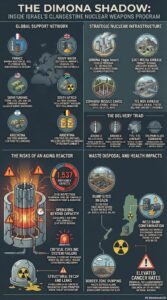
France was not alone in providing nuclear materials and technology. In particular, in order for a reactor to run on natural uranium (like the CANDU reactor in Canada) it needs heavy water. For years it was assumed that Norway supplied the heavy water to Israel as a Norwegian company, Noratom, had supplied at least 20 tons of it to Israel. It later leaked out that it was, in fact, Great Britain that had supplied it, using Noratom as a front company (for which they got a 2% commission). A 2006 Newsnight (BBC political affairs) program revealed that not only did Britain (who had their own nuclear weapons arsenal) supply the material but it also supplied equipment, designs, chemicals used for separation, technology and research data. Moreover, in the mid-1960s, when France, under De Gaulle, decided not to supply any more uranium to Israel, they started buying their natural Uranium from Britain. Britain also supplied Uranium 235 and plutonium so they could be used directly in nuclear weapons. British officials stated that they had obtained assurances from Israel that it was purely for peaceful purposes despite the fact that the intelligence agencies warned about the real intentions. Argentina also supplied 100 tons of yellowcake, uranium oxide, which was also used to fuel the reactor.
One of the most significant collaborators was South Africa. For example, in 1965, South Africa supplied a further 10 tons of yellowcake supposedly under the International Atomic Energy Agency (IAEA) Safeguards Agreements as Israel was a signatory of the Atoms for Peace initiative started by Eisenhower. This nuclear relationship between the two countries was allegedly initiated by the, then South Africa based, Zionist Lubner family. This family founded Belron, which is now based in the UK, which owns automobile glass companies around the world, such as Safelite in the US and Autoglass in the UK. The current scion, Gary Lubner, is one of the main donors to the UK Labour party (along with Trevor Chinn, who was also the prime mover of the removal of Jeremy Corbyn and the installation of Keir Starmer) and donated over £70,000 to David Lammy, the deputy prime minister, ‘for his office’.
The nuclear collaboration deal between South Africa and Israel was subject to yearly inspections by the South African Atomic Energy Board. But the inspections only lasted until 1976, when South Africa agreed to remove the safeguards. Soon afterwards, Israel obtained 500 tons of uranium specifically for plutonium production in Dimona’s reactor in exchange for 30 grams of tritiumfor South Africa’s nuclear weapons program.
Israel also conducted a nuclear test off the coast of South Africa (Vela Incident), which the US tried to cover up saying it was a typhoon or the satellite wasn’t on station at that time,. However, President Jimmy Carter wrote in his diary, “We have a growing belief among our scientists that the Israelis did indeed conduct a nuclear test explosion in the ocean near the southern end of Africa.” That broke the strategic ambiguity agreement that had been in force since Nixon (more on that below).
Belgium also supplied yellowcake to Israel, albeit unknowingly, for the reactor. In 1968, Israel, acting through MOSSAD, purchased 200 tons of yellowcake from the Belgian company Union Minière, who obtained it from their mines in the Congo. The basis of this operation, known as Operation Plumbat, was for the Belgian company to ship the uranium from Antwerp to its legal destination of Genoa in Italy, but the shipment was intercepted at sea and the uranium was transferred to another vessel and sent to Israel.
During the late 50s and early 60s some US officials were concerned about the construction of the reactor; indeed, the CIA produced a report highlighting the dangers but the Eisenhower administration suppressed it. President Kennedy, on the other hand, was very alarmed about Israel acquiring nuclear weapons and demanded thorough inspections of what was taking place on the site. He was in the final process of setting up the inspection regime and possibly shutting down the production of nuclear weapons in Israel when he was assassinated.
After Kennedy’s assassination, the Johnson administration cancelled the thorough inspection program but did, under pressure, allowed limited inspections of certain parts of the site. The inspectors were barred from inspecting the sensitive areas, where the plutonium was produced, for ‘safety reasons’ and they were required to provide substantial warning before an inspection was due to take place and the Israelis could cancel the inspections with no notice. This was, according to US security analysts at the time, to allow plutonium production to take place between visits.
Prior to Kennedy’s assassination, Ben-Gurion’s’ successor, Levi Eshkol, told Kennedy: “If you want it, there will be no nuclear weapons. But give us something else which will deter the Arabs.” Kennedy was extremely reluctant to provide Israel with what would effectively be a carte blanche for Israel to do what it wanted in the Middle East with full American backing. Kennedy concerns were that it would undermine his balanced policy between the Arabs and Israelis as it would seem to the Arabs that the US was taking Israel’s side in every conflict they undertook. The State Department even issued a statement on the matter saying: “Each matter arising in our relationship with Israel, is carefully weighed in terms of its effect on our policy of impartiality as between Israel and the Arabs and of its effect on Israel’s security. If the United States were to align itself more closely with Israel it would constitute a direct challenge to the Arabs by the US and would destroy growing Arab confidence in our impartiality.” Fortunately for Israel, Kennedy’s removal also removed US impartiality from then on, something that the Gulf Arab states have had demonstrated to them in the last few days.
It was during Johnson’s tenure at the White House, that the NUMEC affair took place. This involved the alleged theft of 200–600 pounds (91–272 kg) of highly enriched Uranium from a nuclear reprocessing plant in the Pittsburgh suburbs of Apollo and Parks Township, Pennsylvania, called NUMEC, which was owned by a staunch Zionist called Zalman Shapiro. This uranium was thought to have found its way into Israel’s nuclear program. Subsequent investigations under the auspices of the FBI, the CIA and the Department of Energy were stonewalled and eventually petered out after pressure from the White House. No arrests were ever made nor findings published. A General Accounting Office study of the investigations was declassified in May 2010, which stated “We believe a timely, concerted effort on the part of these three agencies would have greatly aided and possibly solved the NUMEC diversion questions, if they desired to do so.”
Reactions by other US presidents have been weak, concerned by the intelligence from Israel that the USSR would supply nuclear weapons to the Gulf Arab states, or at least help them to build their own, if they got wind of Israel’s nuclear ambitions. For example, Nixon had qualms about the nuclear program and he asked Henry Kissinger about how he should approach the problem. Kissinger then came up with the strategy of ‘strategic ambiguity’, where the US would neither confirm or deny the existence of Israel’s nuclear weapons. This policy led to a meeting between Nixon and Golda Meir, the then Israeli prime minister, in September 1969, where it was agreed that Israel could pursue its nuclear ambitions without any interference by the U.S. with the only conditions being that Israel would refrain from testing its nuclear devices and going public about their possession. In exchange, the U.S. would not press Israel to sign the Nuclear Non-Proliferation Treaty (NPT). The documents giving the details of this meeting were kept secret until they were declassified, in 2014, by the Obama administration. Note, it was during that meeting that the US agreed to Israel having ballistic missiles as long as they were not nuclear tipped.
The weapons program progressed rapidly after that; so, that by the time the Yom Kippur war started, Israel had enough warheads mounted on French supplied missiles that discussions were held in Israel as to whether nuclear strikes should be undertaken against Syria and Egypt. In the end Golda Meir decided that Israel wasn’t in existential danger and so the strikes didn’t go ahead.
Little was known about the actual number of warheads Israel had produced until Israeli whistleblower, Mordechai Vanunu, revealed to the British Press (Sunday Times – followed by a BBC documentary) that Israel had produced dozens of kilograms of plutonium in Dimona each year between 1980 and 1986 and that Israel possessed between 100-200 nuclear weapons at that time. They were also producing materials like exotic isotopes of Lithium (such as Lithium-6) and Tritium for boosted fission or fusion weapons He also took a series of photographs inside Dimona.
It is currently estimated that Israel has up to 400 warheads and have produced over 900kg of plutonium in the facility.
Safety Issues
Judging by the amount of fuel being consumed by the reactor it is being run at two to four times its rated capacity, which is obviously creating a huge amount of nuclear waste. So, what does it do with this waste given that it is not a signatory to the NPT and can’t, legally (if that still means anything anymore) ship it overseas? So where is it going?
According to Israel TV Channel Two, two of the four main waste dumps are in Palestinian territory, primarily in Gaza such as the area east of the Al Bureij refugee camp and the town of Deir El Balah. One example is where Israel removed the fertile topsoil and carted it off to Israel and replaced it with 50,000 tons of toxic waste. 30-meter-deep unlined pits were dug (1,000s of meters across) and the waste was simply dumped into them.
In addition, radioactive waste is being imported from overseas such as the reports of 2,500 tons of radioactive (4x safe limits) toxic waste which was sent from Italy, which was also disposed in Gaza. The question is, do the customers for the Trump version of ‘Dubai in the Med’ know that they’ll be living on a nuclear waste dump that will undoubtedly be disturbed when the foundations are being dug for the sparkly new skyscrapers, he and his fellow property moguls are envisaging, particularly as environmental health monitoring is strictly forbidden in Gaza?
Other dump sites in Palestinian territory are in the Eastern hills of the West Bank. For example, 80 barrels of Israeli waste were physically uncovered in the city of Hebron with another 120 found in the town of Al Ezareya, just outside Jerusalem. Palestinian health authorities in the West Bank grew increasingly alarmed after their monitors detected massive radioactive, pesticide and other toxins leaching into the water supply. The IDF responded by smashing the sensors and raiding their offices, where they destroyed the data then threw all of the equipment out of a 5th floor window. They also blew up the environmental monitoring laboratories in Hebron and Ramallah. The Palestinian Authority was not allowed to carry out any monitoring from that point on. Understandably, Israel takes great pains to ensure that the dumps are not located anywhere near aquifers that supply Israel proper or its West Bank settlements.
Israel also dumps its waste on the Egyptian and Jordanian borders after ensuring that the prevailing winds will carry the radioactive dust out of Israeli territory. This is creating health problems for people living in those areas. For example, in the Al Tafila governorate of Jordan, downwind of the waste dumps on the Jordanian border, cancer rates, particularly amongst children, are up to five times more prevalent than anywhere else in the country.
More concerning is the state of the reactor itself, particularly in light of the amount of fuel it is consuming (estimated at 1,400 tons p.a), suggesting that it is being run at many times more than its designed capacity. An inspection back in 2016 revealed 1,537 unfixable, major defects in the aluminum core of the reactor, caused by decades of heat and radioactive bombardment. In addition, there are visible cracks in the concrete containment structure leading to leaks of radioactive material into the local environment.
The Israeli authorities know about these leaks and have, since the turn of the century, supplied Iodine tablets to Israelis in the area, but they don’t appear unduly concerned as most of the surrounding villages are populated by Bedouins, who the government feels shouldn’t be in Israel anyway. When the villagers protested, Israel responded by bulldozing the villages.
The reactor cooling system has also come under scrutiny with Professor Uzi Leven, an ex-Knesset member and former worker at the facility, sounding the alarm by saying that the 60 year old cooling system hadn’t been upgraded and even a minor failure could cause a catastrophic meltdown.
Despite all of these serious safety concerns, Israel has just recertified the reactor to run for another 40 years. A meltdown would smother the Middle East, particularly the gulf states, in radioactive particles; however, they would be carried away from Israeli territory so it was considered to be a risk worth taking. Professor Leven recommended, back in 2010, that the reactor should be shut down and Israel should build a new reactor. But, in order to do that they’d have to sign the NPT and agree to IEAE inspections, which Israel is loath to do.
It is not only safety issues that affect the surrounding area but there is also evidence of a lack of a safety culture within the complex itself such as the failure to provide suitable safety equipment (like hazmat suits) and numerous fires and accidents. This has led to a large number of workers contracting cancers as well as suffering other injuries (such as serious burns). The Israeli government has censored this but it came to light when the families of 5 workers (Ze’eiv Schforn, Simon Dray, Moshe Zegori, Yousif Cohen and an unnamed worker who was still alive, but undergoing extensive treatment when the case was filed) at the plant dying from cancer, sued the government over their deaths in Tel Aviv central court.
Naturally, the Israeli government is keeping these details from the Israeli public. Just as they did when an Iranian missile destroyed the IIBS biological weapon research laboratory in Ness Ziona (just outside Tel Aviv) during the 12-day war. The explosion released a substantial amount of extremely dangerous biological agents into the environment on a day when the prevailing wind blew it straight into Tel Aviv.
Delivery Systems
Originally, the weapons were delivered solely by aircraft (F4 Phantoms), but Israel now has three types of delivery systems.
The central system consists of the Jericho series of ballistic missiles all of which were primarily designed in conjunction with the French company Dassault. These are:
Jericho 1: A short range missile with a range of 310 miles. Jericho 1 missiles were housed in Zekharia, located in caves southeast of Tel Aviv, but are no longer believed to be in service.
Jericho 2: After the US refused to supply longer range missiles, Israel together with the Shah’s Iran jointly developed this 1,100-mile range missile. According to ex-secretary of State, Colin Powell, these have all (approximately 200 missiles) been pointed at Tehran.
Jericho 3: This missile, which is capable of carrying a 400-kiloton nuclear warhead, has an estimated range of up to 4,000 miles, bringing most of Europe (including Moscow and St Petersburg) within range. In a stunning example of “Capitalists will sell you the rope to hang them with”, it was co-designed by Dassault who also sold them parts and is within range. It entered service in 2010. It is said to be primarily aimed at Pakistan. Many of these missiles are housed in deep, first strike proof silos around Israel. It was one such silo that was targeted when an Iranian missile hit Beit Shemesh, where Israel accused them of deliberately targeting a Synagogue.
Jericho 4: This officially unannounced version of the missile, also believed to have been co-designed by Dassault, is capable of reaching anywhere in the continental United States, even Mar A Lago, as Bibi is wont to say. The Israeli government hasn’t disclosed why they need such a missile.
The majority are stored at the Sdot Micha airbase in nuclear proof bunkers built, in partnership with the US, into limestone bunkers with huge blast doors that can resist everything short of a direct nuclear strike. This base is protected by Arrow 3 air defense missiles, which are in turn controlled by the Green Pine radars. These radar systems are currently being targeted by the IRGC as they form an important part of the early warning system for the whole country.
The second line of delivery is via aircraft like the F15 and the F35. The bombs are said to be stored at Sdot Micha and the aircraft themselves are located at the nearby Tel Nov airbase.
The triad of delivery systems includes an uprated version of the Popeye ACLM cruise missile, which is launched via the torpedo tubes of Dolphin Class submarines, supplied by Germany and has a published range of around 200 miles but has been observed by the US navy as being able to hit a target over 1,000 miles away. Now that Egypt has allowed Israeli warships to transit the Suez Canal, these submarines have been observed transiting the canal on their way to the Indian ocean. It is believed that these are capable of carrying warheads with a yield of 200 kilotons and were specifically designed to target Iran from a safe distance. They can also be launched from F15 aircraft. The tests of the air launched version were conducted by launching a completely unprovoked attack against Syria in 2014. One missile (out of 4) was brought down by a Syrian BUK2 air defense missile. Non-nuclear tipped versions were also used to target the port in North Yemen last year.
Are The Nuclear Warheads Likely To Be Used and What Would Be the Effect?
According to analysis undertaken by the Belorussian military, BELTA, the likelihood of a nuclear strike being undertaken against Iran by Israel is, in their opinion, extremely low. This is because of the Iranian threat to completely destroy Dimona (on a day when the wind blows to the north) and a massive missile attack that would destroy all of the vital services needed for everyday life in Israel, like desalination plants, power stations, ports and refineries. Iran also threatened to destroy ALL of the energy infrastructure in the Middle East, threatening worldwide energy supplies for years to come. It is definitely not in the USA’s best interests, nor Israel’s, because it would achieve the opposite effect of what this war is purportedly about: the elimination of another nuclear power in the Middle East, because Iran would undoubtedly either build a bomb or acquire one from elsewhere. North Korea (DPRK) has already developed (and tested) a bomb for Iran back in 2012. Iran paid for its development and given the passage of time it is more than possible that Iran already has nuclear weapons (two can play the strategic ambiguity game). Given how small Israel is, in that one 400 kiloton weapon dropped on east Tel Aviv could, essentially, destroy the whole country then it would reduce Israel’s chances of long-term survival to resort to nukes, if Iran either already had one or was likely to acquire one of their own in short order.
However, Israel is noted for going for showy short-term tactical victories over long-term strategy; so, it is entirely feasible that an increasingly beleaguered Netanyahu may order a strike to stop the current destruction in Israel. The USA could do little to nothing to stop them and, under the current Trump administration, it is unlikely to want to as the destruction of Iran would solve the intractable morass, he now finds himself it.
Behind the scenes there are whispers in diplomatic circles that Russia may offer protection under its nuclear umbrella.
A nuclear strike on Iran would likely kill 100,000s of people and would create fall out that would definitely impact Southern Russia (another reason that has been put forward as to why Russia may offer nuclear protection). It would also create a rush for every other country to develop their own bombs, which, perversely, would lead to more peace around the world. Would Trump have undertaken his adventure in Caracas if they’d threatened to nuke Florida if they tried. The NPT would also be completely dead.
It would also turn Israel into more of a pariah state than it currently is, particularly among young people in the US, who are dead set against this war as it is.
And it would create a massive global economic depression.
In short, it would be a catastrophe.
Closing Thought:
Back in 63 BC, a very wealthy property mogul, politician and a member of the ruling Triumvirate in Rome, Marcus Licinius Crassus, decided to attack Parthia (Iran) because the presumed easy military victory and the immense wealth it would bring, would help with his re-election chances. At his command was the might of the world’s biggest military super power; namely, the power of the combined Roman empire. He marched with 7 of the best legions of Roman infantry, equipped with the very best weapons paid for by Crassus himself, expecting an easy victory.
Roman military doctrine at that time was geared towards putting down insurgencies and was resistant to change. It consisted of massed ranks of infantry, supported by cavalry on the wings, smashing through any opposition arrayed against them. The relatively small size of the Parthian army of around 10,000 men, against 40,000 or so Romans, also augured well for a stunning Roman victory because they’d be overwhelmed in a direct clash.
Except…
When the two sides did clash, in the battle of Carrhea, the Parthians, under General Surena, had no infantry and so he adopted a mosaic strategy, where small groups of archers acting under their own volition and mounted on fast horses, swooped in for lightning attacks on the ponderous squares of Roman infantry, shooting blizzards of arrows before racing off when the Roman cavalry closed in on them. These archers were trained extensively in shooting both forwards while attacking and backwards while fleeing and this caused the Roman cavalry to back off, at which point the Parthians swooped back in to attack the main body again. These Parthian arrows were heavy enough to pierce both Roman shields and body armor thus pinning the shields irretrievably to the soldiers. As this battle of attrition unfolded, the Roman strategy was to hunker down and wait until their adversaries had run out of missiles before they proceeded on their planned ground assault on Parthia. Unfortunately for Crassus, Surena had arranged for huge convoys of weapons to be brought in from the East (by caravans of camels in those days – the equivalent of a direct railway line, say between China and Iran, today).
The end result was a crushing defeat for Rome who lost over 30,000 soldiers (20,000 killed and 10,000 captured) and Crassus, himself, was killed. The Parthians on the other hand lost, according to some estimates, less than 100 men.
Lesson to be learned: never underestimate Iran.
* Kevin Kirk, who has worked all over the world, first as an engineer, then a visiting university Professor and finally as a diplomatic trainer. He mourns the loss of what could have been in Israel if Jews and Arabs had lived in peace together.
Source: https://www.nakedcapitalism.com/2026/03/armageddon-now-israels-nuclear.html